
A revealing thing happens when you remove yourself from the daily drum of politics and become a mere observer. I did just that last year, during some of the most divisive moments of the presidential election. Sitting back and watching the deluge of insults and accusations that feeds our political system, I witnessed the worst of us as a nation. And I came to the conclusion that it’s time to reframe our priorities.
When did we trade the idea of public servants for the false idols of power and privilege? When did we trade governing for campaigning? And when did we trade valuing those with the best ideas for rewarding those with the most money?
We’ve lost something as a nation when we can no longer look at one another as people, as Americans, and — for people of faith — as brothers and sisters. Differing opinions have become worst enemies and political parties have devolved into nothing more than petty games of blame.
During a three-month sabbatical, observing this mess we’ve gotten ourselves into, I prayed, meditated, read — and then I put pen to paper. The resulting book gets to the root of what I believe is the answer to our current state of unrest. It is not about right and left — or merely about partisan politics — but rather about the quality of our life together. It's about moving beyond the political ideologies that have both polarized and paralyzed us, by regaining a moral compass for both our public and personal lives — by reclaiming an ancient yet urgently timely idea: the common good.
No doubt that Resurrection Sunday (or otherwise known to the masses as Easter) is one of the most significant events and Sundays for the Church. While it wouldn’t be wise to reduce the totality of God’s narrative to one event, the death and resurrection of Christ is undoubtedly, crucial. Our faith and the credibility of the Gospel hinges upon the historicity and veracity of the resurrection of Christ.
The Apostle Paul articulates this truth succinctly and powerfully:
“And if Christ has not been raised, then all our preaching is useless, and your faith is useless.” – 1 Corinthians 15:14
For this reason, Easter is often referred to as the Super Bowl for Christian churches.
As expected, a great amount of time, energy, ideas, and resources are invested into this weekend. And I get it. And I agree with it – in part.

This is going to be a problem. This chapter on faith and science and quantum mechanics is going to be a problem. Why? Well, because this faith and science thing has been done to death. Did you know that the Vatican has an observatory and that one of the authors of Red Shift Theory was a Jesuit? Yep. The famed Scopes Monkey Trial was more than a century ago and those of us in the Protestant Mainline have long ago made peace with it. The Vatican apologized for the oppression of scientists, most specifically it said that Galileo was right. Scientific inquiry and Biblical interpretation are not the same thing. So what's Rob's purpose for this chapter?
Well, it's manifold. He's an evangelical. He's writing in some ways to other evangelicals, specifically those who have felt cut off from the tradition. Here in the States, the classic evangelical line holds echoes of the arguments used during the Scopes Monkey Trial. Some in that Christian tradition are still fighting that fight. Heck, some progressives are, too. Powerful (if false) dichotomies have been established.
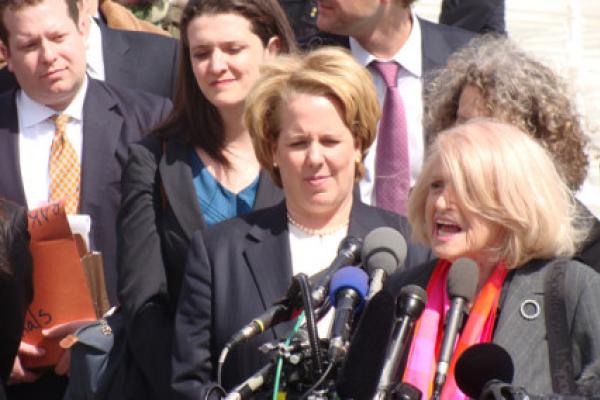
In nearly two hours of arguments on Wednesday, the Supreme Court heard many of the expected cases for and against recognizing gay marriage: that refusing to do so is blatant discrimination, that gay marriage is a social experiment that the court should not preempt, that Washington has no role in state marriage laws.
Yet it was arcane arguments over matters of legal standing that seemed to most animate the justices, reflecting what seemed to be a desire to find a way for the court to sidestep a definitive up-or-down ruling on one of the most divisive social issues.
In short, the court — particularly its conservative majority — seemed to ask why they should hear a second gay marriage case in as many days, particularly one in which the government supports the lower court’s ruling. And the answer to that question will go a long way toward determining the outcome of a spirited national debate.
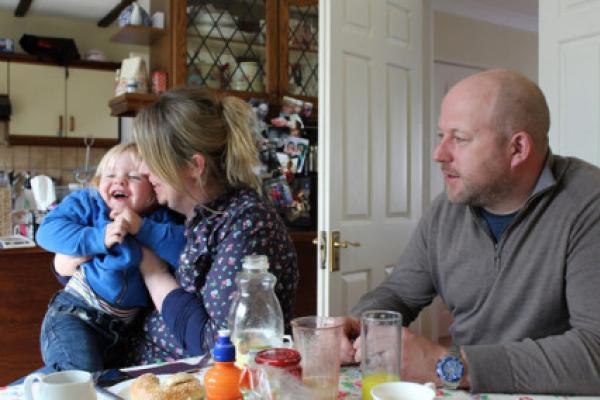
DUBLIN, Ireland — Ruth Bowie was in the throes of grief when she found out she would never know her unborn child. At the 12-week mark, a pregnancy scan showed the baby had anencephaly, a fatal condition in which a portion of the brain and skull never form.
Bowie, 34, a pediatric nurse, knew the implications of the birth defect even before the doctor explained. But the life-changing news didn’t stop there.
“The doctors said we will continue to look after you, or else you can choose to travel,” she recalled.
Put another way, if she and her husband wanted to seek an abortion, they would have to travel to England to end the pregnancy.