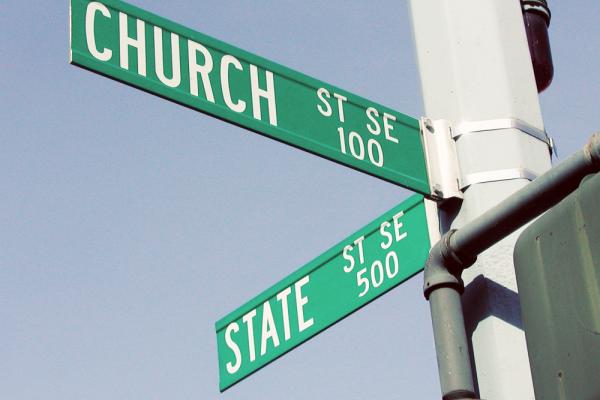
WILMINGTON, N.C. — A resolution to allow North Carolina to defy the Constitution and establish a state-sanctioned religion may be dead in the state capitol, but minority faiths say there’s more than enough reason to remain nervous.
Some worry about the implications the bill has for North Carolina, a majority Protestant state with growing Hindu, Muslim, and Buddhist populations.
Manzoor Cheema, a Raleigh resident and board member of the Triangle Interfaith Alliance, said he believes the resolution should be a wake-up call.
“I think this is a very disturbing development; very bad for our state. In my opinion, as a Muslim, a minority community member and immigrant from Pakistan, I believe that separation of church and state is fundamental and grants us many freedoms,” he said.
“But it’s a blessing in disguise to mobilize the interfaith community in North Carolina.”

LOS ANGELES — No sooner had Eric Andrews arrived on the set of The Lost Valentine, a 2011 Hallmark Channel movie starring Jennifer Love Hewitt and Betty White, when his neckwear attracted attention.
“People are looking at me, and trying to figure out who I was,” he said. “One of the actors came up and said, ‘Now, are you an extra for the wedding scene that is being shot?’”
But the Roman collar was no prop.
Andrews’ credentials as an ordained Roman Catholic priest and Hollywood producer make him a rarity in both religious and entertainment circles. The 48-year-old describes himself as too liberal for most priests and too conservative for most agents.

I am privileged to have a body that fits my gender, and for the majority of my life I was unaware of this ingrained and assumed personal and public privilege. As is the case with many in our world, during my adolescent years I never realized that “gender” and “sex” were two different aspects of my male identity, or in the words of Virginia Prince, I was unaware that “… gender is what’s above the neck and sex is what’s below the neck.” In light of these often ignored differences between gender and sex, I have come to recognize that many in our world do not experience full harmony between the two, and the result is a significantly misunderstood and strikingly marginalized transsexual and transgendered community.
While the differences between gender and sex are complicated, and the various distinctions between cultural and biological identity constructs are ongoing, The National Center for Transgender Equality estimates that 1 percent of all U.S. citizens are “trans.” However, as gender variance is rarely discussed in mainstream society, it would appear that far too many continue to make false generalizations based upon sensationalized media accounts of cross-dressing and transsexuality. As stated by Deborah Rudacille in The Riddle of Gender: Science, Activism, and Transgender Rights:
Gender variance still seems to be considered a more suitable topic for late-night talk show jokes than for journals of public health and public policy, even though a recent needs assessment survey in Washington, D.C., estimated that the median life expectancy of a transgendered person in the nation’s capitol is only thirty-seven years … Though many are far better off materially that the subjects of the Washington, D.C., study, transgendered and transsexual people of every social class and at every income level share many of the same vulnerabilities. Public prejudices make it difficult for visibly transgendered or transsexual people to gain an education, employment, housing, or health care, and acute gender dysphoria leaves people at high risk for drug abuse, depression, and suicide.

Unmarried couples who live together are staying together longer than in the past — and more of them are having children, according to new federal data that details just how cohabitation is transforming families across the U.S.
For almost half of women ages 15-44, their “first union” was cohabitation rather than marriage, says the report from the National Center for Health Statistics. For less than one-quarter, the first union was marriage. The report was based on in-person interviews conducted between 2006 and 2010 with 12,279 women ages 15-44.
“Instead of marriage, people are moving into cohabitation as a first union,” said demographer Casey Copen, the report’s lead author. “It’s kind of a ubiquitous phenomenon now.”
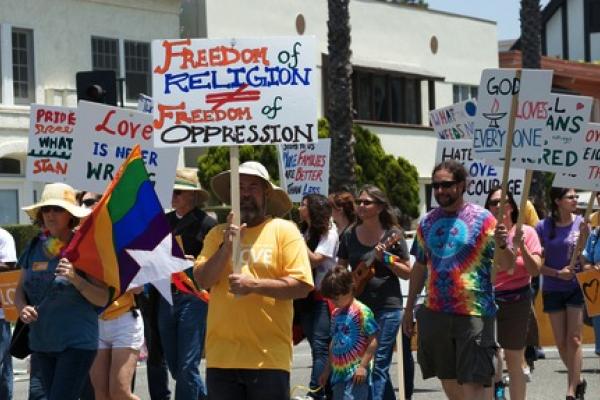
The notion of religious liberty has lately conveyed an impoverished attitude toward the common good among Christians. Namely, “we’ll pay for what we like, and won't pay for what we don’t.”
This stubbornness cropped up last week in College Station, Texas, when the student senate at Texas A&M voted for students to have the privilege of diverting tuition payments from services they object to on moral grounds. Named the “Religious Funding Exemption Bill,” the broadened proposal’s original language (“GLBT Funding Opt Out Bill”) specifically targeted funds going to the campus’ GLBT Resource Center.
Missing from the media coverage was a real look at the bill’s usage of religious exemption — or more specifically, its misuse. In its bill, the student government at A&M confused religious liberty with religious control, and managed to do a good degree of community damage in the process.

While there appears to be a lull in drone attacks in Pakistan and Yemen, are the next targets being prepared?
The Japan Times reports that as tensions on the Korean Peninsula remain high, the possibility of unarmed drones carrying out surveillance over North Korea is increasing.
“Japan and the U.S. might deploy the Global Hawk, a high-altitude reconnaissance drone, at Misawa Air Base in Aomori Prefecture to increase surveillance of North Korea … Interest in monitoring North Korea has been climbing since it began threatening nuclear strikes, and reportedly moved a midrange missile to its east coast Thursday.”
The Voice of America reported a confirmation of the story,
“The Defense Ministry in Tokyo also confirms the United States is considering deploying high altitude aerial reconnaissance "Global Hawk" drones to Misawa air base in northern Japan to monitor North Korea.”
While the Global Hawk is not designed to carry weapons, its surveillance capabilities have made it “one of the best sources of tips for where to send the Predator and Reaper drones, which fly at lower altitudes and fire missiles.” Is that what’s in store for North Korea?

How did the drone assassination program begin? In a front page feature Sunday, The New York Times’ Mark Mazzetti offered an answer. In June 2004, a Pakistani Taliban leader, Nek Muhammad , was killed by a drone strike in the South Waziristan tribal area. The killing, writes Mazzetti, was the result of a secret deal between the CIA and Pakistani intelligence officials.
“Mr. Muhammad and his followers had been killed by the C.I.A., the first time it had deployed a Predator drone in Pakistan to carry out a “targeted killing.” The target was not a top operative of Al Qaeda, but a Pakistani ally of the Taliban who led a tribal rebellion and was marked by Pakistan as an enemy of the state. In a secret deal, the C.I.A. had agreed to kill him in exchange for access to airspace it had long sought so it could use drones to hunt down its own enemies.
“That back-room bargain, described in detail for the first time in interviews with more than a dozen officials in Pakistan and the United States, is critical to understanding the origins of a covert drone war that began under the Bush administration, was embraced and expanded by President Obama, and is now the subject of fierce debate. The deal, a month after a blistering internal report about abuses in the C.I.A.’s network of secret prisons, paved the way for the C.I.A. to change its focus from capturing terrorists to killing them, and helped transform an agency that began as a cold war espionage service into a paramilitary organization.
“The C.I.A. has since conducted hundreds of drone strikes in Pakistan that have killed thousands of people, Pakistanis and Arabs, militants and civilians alike. While it was not the first country where the United States used drones, it became the laboratory for the targeted killing operations that have come to define a new American way of fighting, blurring the line between soldiers and spies and short-circuiting the normal mechanisms by which the United States as a nation goes to war.”
According to the Associated Press of Pakistan, a spokesman for Pakistan’s Foreign Office responded that “the story is baseless and a part of the propaganda to create confusion about the clear position of Pakistan on this matter.”