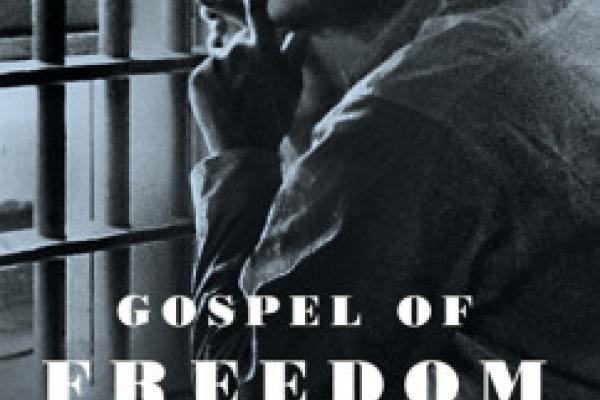
Fifty years after the Rev. Martin Luther King Jr. challenged white church leaders to confront racism, an ecumenical network has responded to his “Letter from Birmingham Jail.”
“We proclaim that, while our context today is different, the call is the same as in 1963 — for followers of Christ to stand together, to work together, and to struggle together for justice,” declared Christian Churches Together in the USA in a 20-page document.
The statement, which is linked to an April 14-15 ecumenical gathering in Birmingham, Ala., includes confessions from church bodies about their silence and slow pace in addressing racial injustice.
“The church must lead rather than follow in the march toward justice,” it says.

As Americans, we live in a culture that is hyper-individuated, fragmented, and dehumanizing as it pushes a mantra of success based on material accumulation and power. Being in community with others is the countercultural answer to this. Doing so with others unlike ourselves is an important part of this. At the end of the day, above the polarization and partisanship, there is much we can do to promote the common good together. As Maddie put it at a meeting that brought Christians of opposing social interpretations together, "We may never agree on some issues, but that is not why we're here; we're good people, you're good people, let's do good together."

Many of the great Christian thinkers throughout our history have seen that goodness, by its very nature, is diffusive of itself. That is, goodness is such that it pours itself out. To the degree to which I am good, I share that goodness with others to the same degree. The doctrine of creation is often seen in this light. God’s goodness is perfect and as such it is poured out naturally and freely to God’s creation. Goodness, in a word, is generous.
While thinking about immigration, I began to ask myself what this feature of goodness implies. How does the fact that goodness is diffusive of itself relate to my treatment of others, and especially to my treatment of those who, through no fault of their own, simply lack some of the basic goods that I have in abundance? Well, the answer seemed fairly obvious. My basic disposition toward my things and even myself must be one of generosity. Now we can argue over the fine points regarding this or that governmental policy, but we must recognize what we have and cultivate a deep desire to share it with others. Sharing our wealth, our food, our clothing is, I think, merely the first step towards becoming generous.

Last week, the Senate began a floor debate on gun control that brought to mind an earlier “floor debate” several months ago in Chaska, Minn.
Ever since our Community Dialogue on “Gun Violence in America,” I’ve searched for answers to what happened.
A crowd of 138 people came out on a Tuesday night to chime in following the tragedy at Sandy Hook in Newtown, Conn.
As the night wore on, it became clear that there would be no real dialogue, no moderated discussion. No give-and-take. A series of monologues, without interruption and with a time limit, was the best we could expect.
Fear, anger, hostility, and suspicion were in the room. The room was hot.
The months following have been a personal search for understanding of what happened that night, and how we in America move forward together on such a divisive issue.

Thousands of people flooded the National Mall on Wednesday to call on Congress for commonsense immigration reform that includes a roadmap to earned citizenship for the estimated 11 million undocumented immigrants living in the United States.
Coupled with a day of lobbying on Capitol Hill and sibling rallies across the country, Wednesday’s was one of the biggest immigration rallies to date. Sponsored by the Service Employee International Union, Casa de Maryland, the NAACP, and more, the rally began with an interfaith prayer service and featured the voices of faith leaders, including UMC Bishop of Los Angeles Minerva Carcaño, Director of Religious Action Center for Reform Judaism Rabbi David Saperstein, Director Hispanic Diocese of Arlington Padre Jose Eugenio Hoyos, and Islamic Center of Maryland Imam Jamil Dasti.

As has happened many times after I have given a talk about the Body of Christ’s responsibility to care for their brothers and sisters experiencing impoverished and dehumanizing conditions, I was asked to answerthose questions — the ones in my experience that are always the first to be asked the moment I stop speaking.
“How will I know I have given enough? How does the church balance financial responsibility with service to the poor? Where do we draw the line?”
These questions always come, sometimes spoken in a curious tone by a person whose heart is being convicted, sometimes in an angry accusing tone insinuating I must hate prosperity, sometimes privately as a whisper in my ear or in a personal email filled with insinuations about my sanity. What a preposterous proposal, that the Body of Christ in any particular location should be the first resource to its own community for spiritual, physical, and emotional well being! Don’t I know that such a mission is naïve and impossible to achieve? Most recently it was phrased like this: “I love this idea, but it is difficult to see benevolence funds go towards someone's electric bill when they smell like they smoked five packs of cigs before meeting with us; what do we do?”

Meaning happens when the purposes of the writer come together with what the reader thinks is important. Since all aspects of any one thing cannot be perceived all at once, we focus our attention on this or that aspect of a thing depending upon what we want to achieve. This is why we can read a particular text many times and find new insights each time. This is also why we cannot agree on what the Second Amendment of the U.S. Constitution means.