

“Ultimately, we have just one moral duty: to reclaim large areas of peace in ourselves, more and more peace, and to reflect it toward others. And the more peace there is in us, the more peace there will also be in our troubled world.” – Etty Hillesum, Dutch diarist who died at Auschwitz
The social fabric that wove together Amani’s moral values and passion for peace is the target of rebel groups that destabilize and destroy communities. Amani grew up playing football and attending school and church in an area that has been chronically unstable for the past 16 years.
Despite the threat, Amani learned within his local structures the power of community in overcoming insecurity—the hub for gaining moral and intellectual values “to make every effort to come together and live as a community.”
Congo is still suffering from the overspill of the Rwandan genocide, the aftermath of which took the lives of both of Amani’s parents. Rebel groups roam the Kivu provinces of eastern Congo and seek to unravel the very social fabric of Amani’s community.
Taking heart from the moral lessons he gained from playing football with his school and through his education, Amani decided to overcome the insecurity caused but he rebels by bringing people together by providing a peace market—a community nucleus for women, children, and men to gather in a safe, empowered, and peaceful environment to care for one another.

WASHINGTON — The head of the Family Research Council on Thursday accused the Southern Poverty Law Center of sparking hatred that led accused gunman Floyd Lee Corkins II to shoot a security guard at the conservative Christian lobbying group’s headquarters.
FRC president Tony Perkins called the Wednesday shooting “an act of domestic terrorism.”
“Corkins was given a license to shoot an unarmed man by organizations like the Southern Poverty Law Center that have been reckless in labeling organizations as hate groups because they disagree with them on public policy,” Perkins said.
The SPLC tracks domestic extremists and lists the FRC as an “anti-gay” hate group. On Thursday, Perkins called “an end to the reckless rhetoric that I believe led to yesterday’s incident that took place right here.”
The SPLC's Mark Potok called Perkins' accusations "outrageous," and said his group is committed to offering "legitimate and fact-based criticism."
 New music from Rufus Wainwright, World Party, Beth Orton, Glen Hansard, Alanis Morissette, and the wonderful new Anglo-Ugandan singer songwriter Michael Kiwanuka.
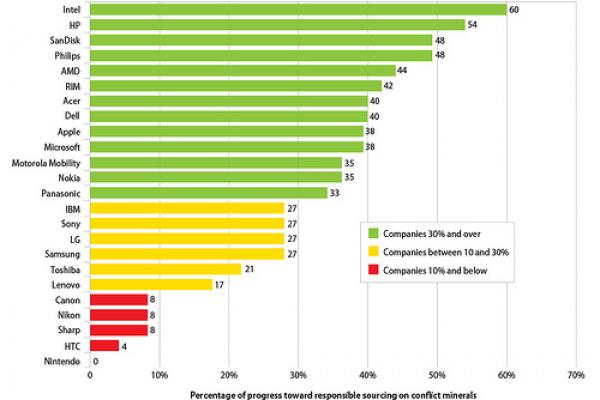
As conflict, rape, and other human rights abuses continue in eastern Congo, armed groups are still funding themselves with conflict minerals — gold, tin, tantalum, and tungsten — which are often used in the manufacture of cell phones, computers, and other electronics. Now advocacy group The Enough Project has issued a new report card about how well different corporations are doing at cleaning up their supply chain to avoid contributing to violence.
Some companies, such as Intel and HP, are doing much better than others — get an ethical clue, Nintendo! — but everyone has some room for improvement.
See the rankings here or take in the chart-at-a-glance here.
After four years of living in the U.S., Mohamed Jedeh is anxious to return to his native Libya.
It irks him that his local mosque in Union City, N.J., won’t broadcast the Muslim call to prayer for fear of angering neighbors, yet nobody complains about the noise from a local bar. Back home, there are no scantily clad women walking across his sight line, and fasting during the holy month of Ramadan is easier because almost everyone is doing it.
Jedeh would probably be home by now if he hadn't been asked by a mosque in Boston to help with special nightly Ramadan prayers. After graduating in May with a master's degree in clinical research from the New York University College of Dentistry, he's ready to get back to the small city of Zintan in northwest Libya, where he plans to teach dentistry and work at a local clinic.
“It’s different,” said Jedeh, who flies back on Aug. 20. “I miss the Islamic atmosphere.”
Despite his homesickness, Jedeh said he has had a positive experience in the U.S. He initially worried about his wife's safety because she wears a niqab, or face veil, but except for one insult shouted by a passerby, he and his family have been treated respectfully.
“I believe you cannot judge any country and say, all people are good or all people are bad,” said Jedeh.

As drones continue to proliferate, the technology is behind them is speeding ahead. Wired takes a look at the next generation of drones now in development.
"Today's unmanned robotic planes only seemadvanced. A decade after the CIA and the Air Force tucked a Hellfire missile under the wing of a Predator drone, much hasn't actually changed: pilots in air-conditioned boxes remotely control much of the armed drone fleet; the robo-planes are easy for an enemy to spot; the weapons they fire weigh about the same; as much as they love the skies, they take refuge on dry land; and they're built around traditional airframes like planes and helicopters. Yawn.
Drones are moving out to sea -- above it and below it. They're growing increasingly autonomous, no longer reliant on a pilot with a joystick staring at video feeds from their cameras. They're getting stealthier; the payloads they carry are changing; and they're going global. They're pushing humans out of the gondolas of blimps. And the laboratories of the drones of the future aren't only owned by American defense contractors, they're in Israel and China and elsewhere, too. … Here's a look at the more ambitious ways drones are getting re-imagined."
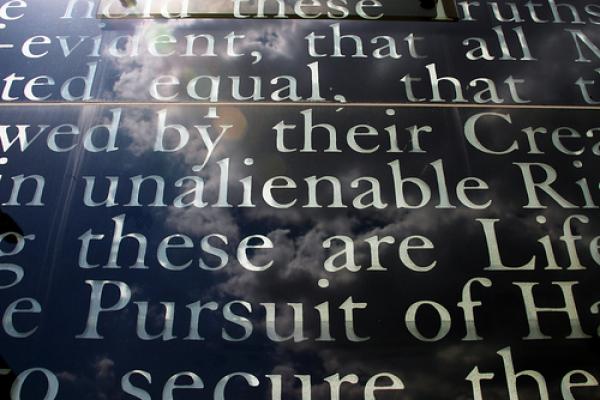
"We hold these truths to be self-evident, that all men are created equal, that they are endowed by their Creator with certain unalienable Rights, that among these are Life, Liberty, and the pursuit of Happiness (The Declaration of Independence, 1776)."
These words are some of the most familiar and beloved in the English language, as they offer a moral vision for humanity, and a standard to which the United States of America should strive.
While such expressions of freedom should indeed be cherished, we often forget the harsh reality that many contributors of the Declaration of Independence were also active participants in the brutal act of slavery. As the English abolitionist Thomas Day wrote in 1776: “If there be an object truly ridiculous in nature, it is an American patriot, signing resolutions of independency with the one hand, and with the other brandishing a whip over his affrighted slaves.”
In addition to racial inequality, while Abigail Adams reminded her husband John to “remember the ladies” during the Constitutional Convention of 1787, her warnings were mostly disregarded, and as a result, women were also marginalized, and they were relegated as dependents of men, without the power to own property, make contracts, or vote. In other words, John Adams’ reply to Abigail’s challenge was far from considerate: “As to your extraordinary code of laws, I cannot but laugh …”
Neighborhood Film Company reaches out to homeless people in Philadelphia --- interview with The Book's founder Nick Zammuto --- This American Life's "The Convert" --- Pixar's new short film "Partysaurus Rex" --- musicians Silversun Pickups vs. the Romney campaign --- Stride gum parodies Apple --- Over the Rhine documentary from Nowhere Farm in Ohio. See these and more in today's Links of Awesomeness...
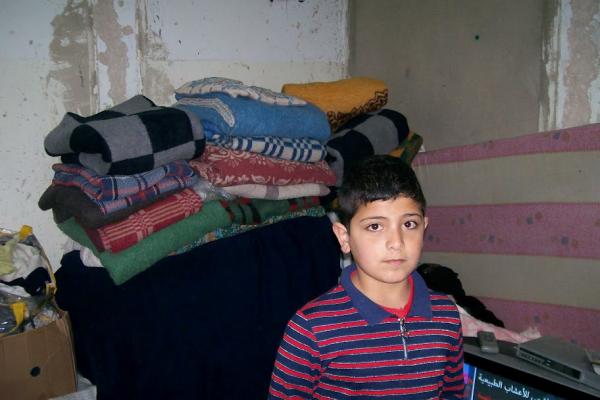
At the corner grocery in our Jabal al-Webdah neighborhood of Amman, a Syrian man in his early 20s now runs the meat and cheese counter. Ahmed (not his real name) is one of more than 150,000 Syrians who have fled to Jordan since his country’s violence began in March 2011.
Young males seeking to avoid mandatory military service are one of the largest groups leaving Syria.
Ahmed wires his wages to his family in Syria and calls them each evening to be sure they are still safe. “The situation inside Syria is even worse than reported in the news,” he laments.
A recent UNHCR report notes that, increasingly, Syrians are arriving in Jordan with only the clothes they are wearing and with few economic resources after months of unemployment.
"We have all known the long loneliness and we have learned that the only solution is love and that love comes with community." - Dorothy Day from The Long Loneliness