
The white working class, a potentially rich bloc of voters for Republicans or Democrats, hasn’t settled on Mitt Romney or President Barack Obama, a new study from the Public Religion Research Institute shows.
“These white working class voters are not particularly enamored of either candidate,” said Daniel Cox, PRRI’s research director. “In terms of their favorability, they’re both under 50 percent.” Forty-four percent look favorably upon Obama and 45 percent upon Romney.
Released seven weeks before the election, the August survey found Romney with a double-digit lead over Obama among the white working class, which preferred the GOP candidate 48 to 35 percent.
But Cox points out that the gap narrows to statistical insignificance among women voters in this group, and in the Midwest and West, home of several swing states. The upshot for Romney and Obama?
If they want to woo this group, which makes up 36 percent of the nation according to the study, the campaigns may want to consider other findings of the PRRI poll.

Cheerleaders at an East Texas high school are fighting their school district’s orders to stop using Bible quotes on their signs at football games.
In August, cheerleaders at Kountze High School, a school with fewer than 500 students 30 miles north of Beaumont, Texas, began painting Bible verses on large paper signs football players burst through at the beginning of games.
But this week, Kountze Independent School District Superintendent Kevin Weldon called for an end to the banners after consulting with a legal adviser at the Texas Association of School Boards.
“It is not a personal opinion of mine,” Weldon told KHOU, a Houston television station. “My personal convictions are that I am a Christian as well. But I’m also a state employee and Kountze ISD representative. And I was advised that such a practice would be in direct violation of United States Supreme Court decisions.”
That prompted the cheerleaders and their supporters to launch a Facebook page, “Support Kountze Kids Faith,” which attracted 34,000 members in its first 24 hours — more than 10 times the population of Kountze.
Parents of at least three cheerleaders have hired an attorney and are considering suing the school district.
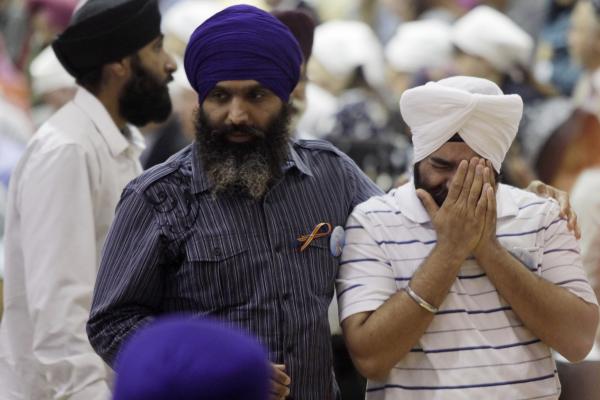
U.S. Sikhs are taking heart in a widely publicized Senate hearing on hate crimes and a pledge by the Justice Department to consider tracking hate crimes directed at their community.
The hearing, on Sept. 19, featured Harpreet Singh Saini,18, whose mother was one of six Sikh worshippers killed Aug. 5 when a gunman opened fire in their Wisconsin gurudwara (house of worship or, literally, "house of the guru").
“Senators, I came here today to ask the government to give my mother the dignity of being a statistic,” he told a subcommittee of the Senate Judiciary Committee. “My mother and those shot that day will not even count on a federal form. We cannot solve a problem we refuse to recognize.”
Sikhism, a monotheistic faith founded in South Asia, is the world’s fifth largest religion with an estimated 200,000 to 500,000 adherents in the U.S. Male Sikhs often keep their uncut hair bound up in a turban.
The Senate hearing, spurred by the Wisconsin shooting, brought more than 400 people to Capitol Hill, most of them Sikhs.
A cat runs for mayor and may or may not try out a new electric skateboard or a bike made out of cardboard. Some of the Pixar staff could've used some free coffee courtesy of GOOD when they studied for their graduate-level final exam in ichthyology for Finding Nemo. Oh, and the second trailer for The Hobbit came out too.
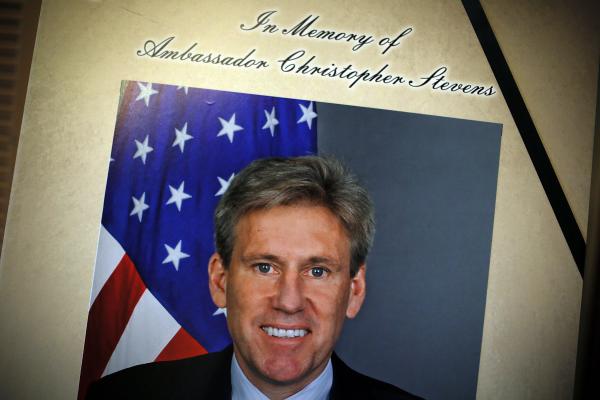
I’ve been reflecting on the recent events in Libya involving the death of Ambassador Chris Stevens, and every time, I arrive at a different feeling about it all.
There’s the obvious tragedy of a life unnecessarily lost. By all accounts, Stevens was a humble, passionate man who had invested his life in the betterment of the infrastructure for the Libyan people. He was not, as some dignitaries or diplomats tend to be, resting on his credentials in an easy gig, waiting for retirement. He was living out what he believed in a terribly volatile corner of the world.

Among my must reads are the Sunday New York Times Book Review and other book reviews I come across in various media outlets. There are too many books being published that I would love to read, but just don’t have the time. So, I rely on reading book reviews as one way of keeping in touch with what’s being written.
Here is my pick of this week’s books.
“On a Farther Shore: The Life and Legacy of Rachel Carson”
By William Souder, Reviewed by Elizabeth Royte
"On the bookshelves of many a contemporary environmental journalist looms at least one canonical text she’s hesitant to read. For this reviewer, it was Rachel Carson’s “Silent Spring,” among the gloomiest books ever written, an unrelenting catalog of crimes committed by man against nature. But after reading William Souder’s engrossing new biography of Carson, “On a Farther Shore,” I returned to the book and discovered its central message to be — depressingly — timeless. Substitute organic pesticides and herbicides with the endocrine-disrupting compounds found in everyday household items or the creep of chemicals used in hydrofracking, and you may experience the same hair-prickling alarm felt by Carson’s readers 50 years ago."

Today, Sojourners is launching a new project called Emerging Voices, and it’s one of the most exciting things I have been involved with for a long time. It aims to mentor, develop, and promote the most dynamic up-and-coming communicators — speakers, preachers, and teachers — who so clearly are called to lead and publicly articulate the biblical call to social justice.
The vision for this project is exciting and something to be celebrated. It also calls to mind a critical observation: Our world often wants saviors, not prophets; new messiahs, not leaders.
We want heroes with superhuman strength who save the day, not mere mortals who speak the truths we typically don’t want to hear. Even the modern day giants of social justice — Dr. Martin Luther King Jr., Dorothy Day, and Mahatma Gandhi, for example —were at best prophets, but never saviors.
It’s easy to slip into the mentality that one person, one voice will rise up in a generation, and that he or she will change the world as we know it. Perhaps we even think, “Maybe I will change the world.”