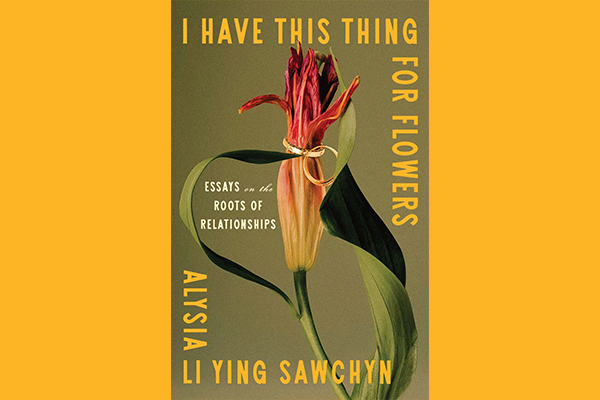
AN HERBARIUM IS a library of dead flowers, pressed between pages. I Have This Thing for Flowers is a literary herbarium, pressing together personal essay, history, science, and art writing to preserve both flowers and the relationships that have shaped Alysia Li Ying Sawchyn’s life.
The first relationship we learn about is a broken one: Sawchyn details how her fiancé ended their engagement after years of resentment and loneliness. Next comes the story of her roommate Sarah, whose friendship with Sawchyn turns into a marriage. Sawchyn and Sarah “were sitting together on [their] computers bemoaning the cost of health insurance” when they joked that they should just get married. What started off as a courtship of survival in the post-COVID economy turned into a tender love story.
Each chapter centers on a flower, such as gardenia, iris, jasmine, lily, magnolia, and poppies. “Laurel,” my favorite chapter, is about Sawchyn’s dear friend Laurel who died from unexpected medical complications. As Sawchyn goes through Laurel’s belongings, she’s met with grief and regret that “feels like a low-level acid on [her] nerve endings.” Sawchyn places this grief alongside the Greek myth of Daphne transforming into a laurel tree, and chef Samin Nosrat’s descriptions of bay leaves (which come from bay laurel trees) as smelling “alive.”
By connecting flowers and relationships, Sawchyn reminds readers that both are fleeting and require care. When Sawchyn was 18, she was “recently institutionalized and certified mentally ill, already a college dropout,” and had “no plans to live past thirty.” It was others, including a fortune-teller friend, who taught her “how to salvage [her] own remains” and “build something new.”
In the chapter on gardenias, which is also about Sawchyn’s history of illness, Sawchyn writes about Billie Holiday, who tucked gardenias behind her ear. She cites James Baldwin on “the importance of knowing that however another person is ‘you could also be,’ given the right set of circumstances.” Baldwin “recounts Miles Davis’s explanation to an onlooker about why he gave Holiday money knowing she’d use it to buy heroin: ‘Baby, have you ever been sick?’”
At times, I Have This Thing for Flowers feels rushed. I wanted more depth in the connections Sawchyn was making. Arranging the essays in chronological order might have helped anchor the reader; I felt adrift in some of the narratives. I wanted to know more about Sawchyn’s marriage with Sarah, of how they fell in love and what it was like to discover romance after friendship and marrying primarily for health insurance.
After the 2024 floods in Asheville, N.C., where Sawchyn and Sarah live, they witnessed a kind of resurrection through flowers: “A week after the storm, I stood in a colleague’s yard, hacking up silt, my eyes burning from all the plastic and waste products stirred into the air, blinking hard at dahlias that were starting to look like streetlights in the dusk, no electricity for miles in any direction.” I’ve often marveled at flowers growing in places where it seems nothing could grow: Tiny signs of hope in despair.
Emily Dickinson was one who knew where to look for tiny hope, praising it in the flowers. Sawchyn, who describes Dickinson as the “famed em-dasher and coreopsis-presser,” quotes the poet: “To be a Flower, is profound / Responsibility—.” We are like grass; yet consider the lilies.

Cassidy Klein is a journalist, writer, and editor based in Chicago. Find her work at cassidyrklein.weebly.com.
Did this article have an impact on you? Tell us how! Whether you’re moved to take action, have a question, or want to share a comment (good or bad), we value your feedback!