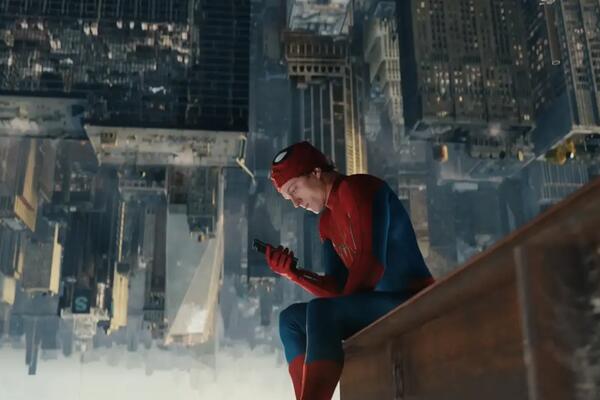
Midway through Spider-Man: Brand New Day, Peter Parker (Tom Holland) needs to track down the escaped villain Scorpion, so he tells his NYPD contact, Detective Jean DeWolff (Liza Colón-Zayas), that he’s going to hack every security camera in New York City to find his face. It’s a single line, delivered and dispensed within seconds, and the movie doesn’t ask us to think about it again. It also happens to be almost exactly what Batman does in The Dark Knight—except in that film, turning every phone in Gotham into a surveillance device was the movie’s moral crucible, the point where we saw Batman had gone too far. In Brand New Day, it’s just Tuesday.
The difference in how the two movies approach surveillance technology is worth sitting with. I enjoyed Brand New Day. Director Destin Daniel Cretton clearly takes the job seriously, and the result has real emotional maturity around the edges—a superhero film about loneliness and change, as much as it is about bad guys and crime fighting. Part of what makes Peter so effective as Spider-Man is his relationship with law enforcement and the digital infrastructure he’s built: an AI assistant named E.V. (voiced by Naomi Watts) that flags crime as it happens; a tight working relationship with DeWolff and the NYPD; a crime rate that's dropped to nearly nothing on his watch. It’s an impressive setup. It's also, quietly, a surveillance state with a wisecracking assistant attached, and the film’s only real acknowledgment of that is a bit of lighthearted teasing from DeWolff that Spider-Man laughs off.
Peter's dismissiveness feels especially striking when viewed alongside a scene from The Dark Knight, almost 20 years old now. Near that film’s climax, Batman’s tech guru Lucius Fox (Morgan Freeman) discovers a mass surveillance tool built by the hero to spy on Gotham City through its citizens' phones, hunting the Joker.
BATMAN: Beautiful, isn’t it?
FOX: Beautiful. Unethical. Dangerous. … This is wrong.
BATMAN: I’ve got to find this man, Lucius.
FOX: At what cost?
Fox agrees to run the machine “this one time,” on the condition that it's the last thing he ever does for Batman. By the movie’s end, he’s resigned. “As long as this machine is at Wayne Enterprises, I won't be,” he says.
READ MORE: Across the Spider-Verse Challenges the Idol of Sacred Stories
There's a name for what’s happening to Batman in that scene, and it comes from an unlikely source for a comic book movie: the biblical scholar Walter Wink, whose work on what he called “the Powers” has shaped a generation of Christian thinking about institutions and violence. Wink argued that the systems we build—governments, corporations, weapons, and yes, machines—aren’t neutral tools waiting for a person to decide how to use them. They carry a kind of spiritual weight of their own, an inner logic that presses on everyone who touches them, bending even good intentions toward domination. As Wink wrote in the pages of Sojourners itself in 1984: “An institution can even impose on people behaviors that they would not freely choose. It is not a mere personification. It is an actual, palpable force.” Nobody sets out to become a surveillance state. They arrive there, slowly but surely, each time they say to themselves, “just this once,” each step being justified by the last—until they have quietly internalized the logic of the machine. That’s the arc The Dark Knight draws for Batman, and it’s the reason Fox’s exit is a moral climax rather than a footnote.
It's also, I think, the real difference between these two movies. What Wink understood, and what Brand New Day accidentally demonstrates, is that the Powers are at their most dangerous not when they're being debated but when they’ve stopped being named at all. The Dark Knight forces its surveillance machine into the light and makes both its hero and its audience answer for it. Brand New Day builds a more sophisticated version of the same machine, wires it into an AI with a personality, and never asks the question in the first place. One movie treats mass surveillance as a wound. The other treats it as a given.
Wink’s framework for confronting the Powers involves three movements: naming them, unmasking them, and engaging them nonviolently. Fox does the first two in a single scene—he refuses to let Batman’s justification stand unchallenged, directly unmasking his actions as “wrong”—and then does the third by walking away the next day rather than lending the machine any more of his complicity. The film doesn’t let its audience off easy either, which is why it played, in 2008, like a direct address to a country that had just spent seven years learning to live with the Powers as articulated by Wink.
2008 was a long time ago, and a lot of Tom Holland’s biggest fans weren't even alive for the War on Terror protests that shaped that moment. But the surveillance state continued to expand as Nolan’s Batman trilogy faded into Dad Movie status. The Patriot Act, passed in the panicked weeks after 9/11, was renewed and expanded under both parties for the better part of two decades. Warrantless wiretapping, first exposed in 2005, turned out to be only a preview: Edward Snowden’s 2013 leaks revealed a global data-collection program built with the quiet cooperation of the country's biggest tech companies, while Julian Assange and Chelsea Manning paid steep personal costs for surfacing what the machinery of empire looked like up close. By the time local police departments were buying facial-recognition access and quietly partnering with doorbell-camera companies, the fight had moved from Congress to city council meetings most people never heard about.
For years, though, public concern about this terrifying new world in which the government had access to every part of our lives was never too far from mainstream discourse—including, at times, Marvel movie discourse. In 2014’s Captain America: The Winter Soldier, Nick Fury (Samuel L. Jackson) unveils his own mass surveillance program, boasting that “we’re gonna neutralize a lot of threats before they even happen.” Captain America (Chris Evans) isn’t a fan. “This isn’t freedom,” he says. “This is fear.” Same franchise as Brand New Day. Different time.
Wink never argued that naming the Powers was the same as surrendering to them, or that the only alternatives to a surveillance state were quiet complicity or matching its cruelty stroke for stroke. “Evil can be opposed without being mirrored,” he wrote in Engaging the Powers. “The oppressor resisted without being emulated, and the enemy neutralized without being destroyed.” The Dark Knight still trusted its audience to attempt this opposition and resistance. If Brand New Day is any indication, the judgment Fox and Cap fought for is now as outdated as phone booths. Whether it gets raised again isn’t really a question for Spider-Man’s next script. It’s a question for all of us who are deciding, right now, what to say the next time a Ring camera or a city council vote makes the choice feel small enough to laugh off.
What Wink understood, and what Brand New Day accidentally demonstrates, is that the Powers are at their most dangerous not when they're being debated but when they’ve stopped being named at all.
Did this article have an impact on you? Tell us how! Whether you’re moved to take action, have a question, or want to share a comment (good or bad), we value your feedback!