I DON’T KNOW about you, but I’m having a tough time. I look around and so much is broken that I don’t know how to fix. To make matters worse, your personal life never gives you a break just because the world is falling apart, which hardly seems fair. It’s always something, and it’s just too much for one person to hold.
We are not the first to feel this way. I found inspiration in the characters from our lectionary texts this month. They faced great challenges, too, and surely felt the same despair and fear we do. They navigated uncertainty, conflict, and circumstances beyond their control. And yet, it turns out God didn’t need them to be perfectly faithful or unshakingly stable.
When Peter gets scared and starts to sink, Jesus pulls him back up. When Moses’ life is threatened at birth, six women participate in his rescue (and it takes all of them). Peter questions Jesus to his face because he does not understand. Jesus corrects him without kicking him off the team. The heroes of these stories and of our faith are brave and also human—just like us. God is not upset about our human limitations. God sticks it out with us. Maybe faith isn’t about holding everything together. Maybe it’s about trusting that we are being held, even when we’re not sure we can hold on.
August 2
God’s a Fighter
Genesis 32:22-31; Psalm 17:1-15; Romans 9:1-5; Matthew 14:13-21
JACOB WRESTLED GOD all night, and I can’t stop thinking about what that says about God. Admittedly, I don’t understand why they were fighting in the first place. But I do understand what it feels like to be in the middle of a conflict when the other party refuses to engage, turning a repairable issue into an open wound.
For some reason, I’d always imagined this wrestling scene as one where the God-stranger tackles Jacob and a fight ensues. Or maybe Jacob started it, and instead of disappearing, God held on.
At one point in their midnight scuffle, the stranger-who-turns-out-to-be-God is ready to call it. After all, they’ve been at it all night. But Jacob insists: “Not until you bless me.” The divine wrestler agrees to Jacob’s terms.
My interpretation: This is a God who is in it for the long haul and doesn’t call it quits. The psalms reveal this same persistence. The psalmist complains, cries out, demands answers, but none of it scares God off. God is not threatened or repulsed by our questions, our emotions, or our demands.
When Jesus feeds more than 5,000 people, he has just gotten the news that his cousin, John the Baptist, was beheaded. He tries to carve out alone time for his grief, but the people follow him. They have needs. And despite his own pain, “he had compassion for them” (Matthew 14:14).
God does not leave. Does not abandon you. Does not block your number. God stays. God’s a fighter who always fights for us.
God is not threatened or repulsed by our questions.
August 9
Resilience Takes Friends
Genesis 37:1-4, 12-28; Psalm 105:1-6, 16-22, 45; Romans 10:5-15; Matthew 14:22-33
SURELY, IT’S THE worst kind of betrayal when your own siblings sell you into slavery. Mind you, this is after they plotted to kill you and after they threw you into a pit with no water to drink while they ate their fill. I am always impressed by Joseph’s resilience. Like how? How did he not give up and wilt?
Contrast Joseph with Peter. We give that man such a hard time for doubting and sinking. But maybe that’s not the point. Maybe the point is that Peter-the-mere-human walked on water. Then he freaked out, but that sounds totally understandable to me. I would freak out also. Wouldn’t you? When he started to sink, Jesus pulled him back up.
Joseph had some undeniably bleak days (years!)—in a pit, in a prison, as a slave. Surely his faith wavered. I can’t imagine that for every excruciating second of it he kept the faith that all would be well, that he never doubted. I can imagine that, perhaps, he had a friendly cellmate who helped him stay afloat or that Joseph received an occasional sign from God that he was not alone.
Because we all despair, and the waters threaten to take us under. That’s human. Resilience doesn’t come from sheer willpower. Resilience is one part faith, two parts friendship. It’s a team effort. Resilience is made possible when there is a hand to hold tight, one that keeps you from going all the way under.
August 16
The Long Road
Genesis 45:1-15; Psalm 133; Romans 11:1-2, 29-32; Matthew 15:10-28
“HOW VERY GOOD and pleasant it is when kindred live together in unity!” (Psalm 133:1). How good and how rare! We are living through contentious times, from the global arena to the intensely personal one. In many aspects of life, it’s hard to imagine that reconciliation is possible. I have no idea how we could get there from here. But I take comfort that surely Joseph didn’t see a way forward with his family either. It took 22 years. This reminds me that most reconciling takes place over a long—much longer than we ever want—time. And Joseph, so egregiously wronged by his family, had to be willing, eventually, to forgive.
Forgiveness, I know, is often misused to force survivors to accept their abuse, excuse harm, or skip the work of healing. But Joseph models a forgiveness that sets him free as much as it does his brothers. He isn’t overlooking the past but has shifted the narrative in such a way that his brothers no longer hold power over him. He’s recovered his agency, and that allows him to extend forgiveness.
The Canaanite woman in Matthew 15 has every right to be pissed at Jesus—he rejects her request by likening her to a dog! But she does not back down. She challenges him. Like Jacob, she demands her blessing. Jesus relents. Reconciliation isn’t easy. But with time, with agency, and a refusal to comply with oppression—it is possible.
August 23
It Takes a Village
Exodus 1:8-2:10; Psalm 124; Romans 12:1-8; Matthew 16:13-20
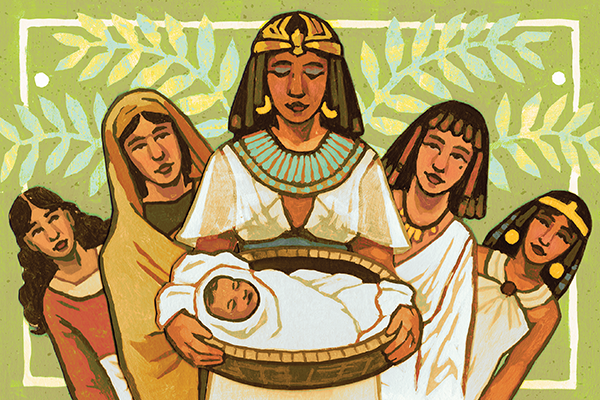
IT TAKES SIX women to deliver infant Moses. When Jochebed, his mother, gave birth to a son, she must have been terrified, as any mother would be after the ruler of the land ordered the death of all baby boys. But I also imagine that the bravery of the midwives, Shiphrah and Puah, was already legendary among her people, and that their courage gave her courage. That their ingenuity in the face of threat sparked her own creativity.
Miriam must have been terrified as well, watching her helpless baby brother float away down the river or when the pharaoh’s own daughter and her maidservant (the fifth and sixth women) discovered the baby. But perhaps the pharaoh's daughter had heard about Shiphrah and Puah’s quick thinking in response to Pharaoh’s questioning. Their courage gave Miriam courage, which is how, on the fly, she orchestrated a ruse to reunite mother and son.
Everyone knows that Moses delivered the Israelites out of Egypt, but we don’t say it enough that, before all that, it took six women to deliver him. The contributions may vary, but the credit belongs to all of them.
In Romans 12, Paul writes that we have different gifts—prophecy, ministry, teaching, encouragement, sincere leadership, compassion, cheerfulness—and thank goodness for that! It takes all of us to liberate the people. Some of us are front and center, while some of us are in the background, and all of it matters. You don’t get a Moses without willing midwives; you don’t have an Exodus without the ones who make bread for the journey.
It takes six women to deliver Moses.
August 30
‘Every Common Bush’
Exodus 3:1-15; Psalm 105:1-6, 23-26, 45; Romans 12:9-21; Matthew 16:21-28
ELIZABETH BARRETT BROWNING wrote, “Earth’s crammed with heaven, / And every common bush afire with God; / But only he who sees, takes off his shoes— / The rest sit round it and pick blackberries.”
The longer I live, the more convinced I am that the presence of the Divine One shows up in the mundane, in the difficult, and in the simple far more than God shows up in the flashy. Elizabeth Barrett Browning’s poem makes me think that the miracle in Exodus 3 is not that God set a bush ablaze without consuming it, but that Moses’ eyes were opened so that he could finally see the truth: The world is ablaze with God, and somehow, we are not consumed. Not unlike what Jacob experienced with his midnight wrestler, after which he said, “I have seen God face to face, yet my life is preserved” (Genesis 32:30).
Peter could find absolutely nothing holy or worthwhile about Jesus’ impending death, and I do not blame him. Death feels meaningless and cruel and unfair, and of course we want to resist it. But in Jesus’ case, there was something sacred afoot. Jesus could see and accept it when Peter could not. I often do not have eyes to see the sacred in the mundane, much less in the painful or destabilizing. Is this why Paul encourages us not to “repay evil with evil” (Romans 12:17)? There is always more to the story than what we can see on the surface, and it’s best not to get in God’s way.
Editor’s note: In the August 23 reflection, this article originally misstated how many women rescued Moses in his infancy. It was six, not five.

Rev. Kyndall Rae Rothaus is a preacher, spiritual director, co-founder of Nevertheless She Preached, and author of Thy Queendom Come: Breaking Free from the Patriarchy to Save Your Soul.

Did this article have an impact on you? Tell us how! Whether you’re moved to take action, have a question, or want to share a comment (good or bad), we value your feedback!