‘Children of Strife’ Is Theology, Not Fantasy

Adrian Tchaikovsky’s new novel is ostensibly about landing on a planet full of talking spiders, but it asks much deeper—and difficult—human questions.

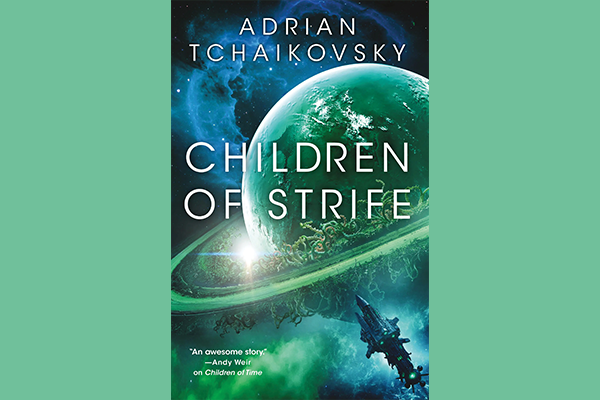
Children of Strife, by Adrian Tchaikovsky / Orbit

ADRIAN TCHAIKOVSKY’S Children of Time series begins with a premise so simple it sounds like a B-movie: What if we landed on a planet full of talking spiders? From that jumping-off point, he builds a story spanning star systems and thousands of years with remarkable insight and humanity. Four books in, with Children of Strife ’s 2026 arrival, he is still asking the question driving the whole series—Who is my neighbor?—and still finding ways to make the answer genuinely uncertain.

The book weaves three stories across three eras in the same world. In the first, five egomaniacal scientists attempt a terraforming project on a planet they’ve essentially stolen—each brilliant, each convinced their vision alone is correct, none willing to subordinate themselves to a shared project. The villain isn’t any one monster; it’s ego, the kind that looks, from the inside, exactly like faithfulness to a calling. Their paradise becomes a hostile, broken world two later groups inherit: refugees from Earth and the series’ latest exploratory crew—the most diverse yet: a human, two spiders, an octopus, a sentient virus, and a mantis shrimp. They arrive to find a world still shaped by sins committed millennia before.

Against that pathology, Tchaikovsky places Cato—the mantis shrimp and perhaps the most compelling uplifted creature in the series. Most science fiction cheats: Aliens think like humans, just with different bodies. Tchaikovsky doesn’t. Even animals from our own planet experience reality in ways completely alien to us, and Cato is no exception. He can kill any living organism within reach instantly and be killed just as instantly by any member of his own species.

At the novel’s crisis, Tchaikovsky puts us inside that biology: “[Cato] displays again, flashing the light-scattering spots at the base of his fighting arms, flaring his antennae, semaphoring with his walking legs. Signals of aggression and dominance. Threat, in essence ... I will fight. The basic message of one Stomatopod to its neighbour.” The threat is real—but Cato doesn’t know that the creature he’s facing, an entity that could consume the planet if destabilized, has been pulled back from the edge by a crewmate.

Cato feels the draw of what biology has programmed him to do—and then he remembers what it costs. He can choose to strike, and win, and doom everything. Or hold. Trust his crew. Trust that what looks like weakness is the only move that saves the world. In the novel’s most quietly devastating line, Cato concludes: “Sometimes winning is worse.”

He chooses weakness. This is precisely what makes Children of Strife theology rather than fantasy: the conviction that biology isn’t destiny.

In Romans 7, Paul rages against his nature, doing the very thing he hates, unable to stop—until the question breaks through: “Wretched person that I am! Who will rescue me from this body of death?” Cato might as well be the one giving voice to this lament. Cato’s answer comes not through willpower but through community. Ours is the same—salvation through the Spirit we encounter in community. The Spirit who, Romans 8 insists, frees us from the law of sin and death and enables a possibility that supersedes our genetics. A grace theologians call sanctification.

Will you strike, or will you choose the harder thing? Cato chooses the harder thing. It might be the most hopeful moment I’ve read in years.

This appears in the August 2026 issue of Sojourners