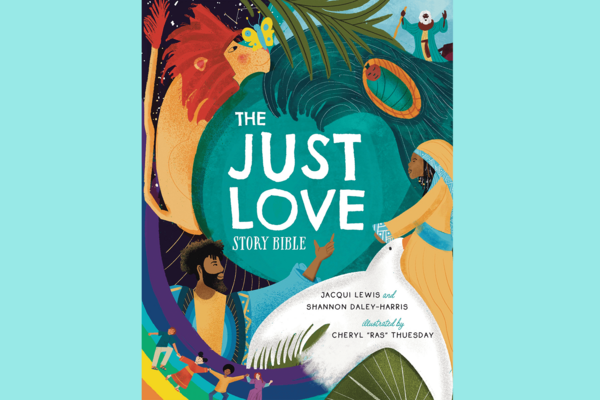
I DON’T WANT to exaggerate, but my family are sort of kids’ Bible specialists. We’ve been through a fair many, both for independent reading for our 8-year-old daughter and for the family reading time we share every night. That’s why I greeted The Just Love Story Bible (Beaming Books) by Jacqui Lewis and Shannon Daley-Harris, with illustrations by Cheryl “Ras” Thuesday, with excitement—it offered just the sort of justice-centered telling of scripture that my wife and I are trying to expose our daughter to.
Lewis, senior minister at Manhattan’s Middle Collegiate Church, and Daley-Harris, associate dean of Auburn Theological Seminary, deliver 52 paraphrases of Bible stories for readers aged 4 to 10, and do so with gentleness and fidelity to the text. My daughter had no trouble following the stories, which are simplified but still contain nuance. The language might be slightly different, but the beating heart of the Bible remains.
Without a doubt, this Bible centers justice, portraying Jesus’ ministry as a “promise of liberation, hope, and revolutionary love.” More than that, it offers guiding questions that help readers learn how they might be a part of Jesus’ vision of the Reign of God through justice.
One particularly moving portion in the retelling of the angel Gabriel’s appearance to Mary stands out. The authors invite young readers to imagine themselves as “leaders in this movement of love and justice. Every time you love on your family and friends, every time you are kind to strangers, every time you are good to your body—you are a part of this movement too.
Admirably, The Just Love Story Bible trusts its young readers with understanding complex topics. For instance, in the introduction to Genesis, the text explains, “Some of the stories had made-up characters and events. Others were about real people and things that really happened.” Likewise, in the introduction to the two creation stories in Genesis, the text imagines a storyteller sitting around a campfire to tell the first story. On the next page, a second storyteller joins the campfire to contribute their own creation myth, saying, “I like that—God thinking everything God made is very good. I heard a different story about how it happened.”
These complexities—that stories can contain truth without being factually true, that Genesis offers two creation stories—can be challenging even for adult readers. The Just Love Story Bible gently introduces young readers to these foundational ideas, showing them that scripture is made up of different stories and storytellers, and they too can be a part of the story God is telling.
Parents benefit from these reminders as well. The text offers a way to wrestle with some of the more difficult passages of the Bible without coming across as sermonizing. Indeed, this Genesis passage, in particular, led to some powerful insight about the difference between what the authors of scripture understood to be true and what we might take to be true today.
“Maybe God created us through evolution, and it just took a really long time for God to create,” my daughter added one night after reading the creation stories, placing scripture and science into conversation. I doubt we would have had that rich discussion if not for this story Bible.
The illustrations deserve a special mention, because they truly make the stories come alive. Thuesday’s diverse representations of characters in the Bible are a particular point of interest for my daughter, who told me, “What I really like is seeing how people in the Bible dressed, and that they look a lot like our Muslim neighbors.”
We need more resources that help children understand that God loves diversity.
Those illustrations hammer home one of the authors’ central aims: “We don’t know exactly what Jesus looked like because there were no cameras back then. But because Jesus’ ancestors were from the Middle East, we know that Jesus looked less like the white, blond, blue-eyed pictures and more like the people who live in the Middle East today.” Similar to another kids’ Bible that my family loves dearly, Growing in God’s Love, readers are introduced to biblical characters with a variety of brown skin tones.
The Just Love Story Bible also explicitly frames Jesus as Jewish, which opened up opportunities for my family to discuss the ways that the Judaism of the Bible is different from how it is practiced today. This is particularly important in a world where the values of pluralism are under attack. We need more resources that help children understand that God loves diversity—not just with regard to race, language, and culture, but religion as well.
There’s one area where this Bible could have been strengthened. While there is plenty of talk about the importance of justice, the authors don’t connect that value to real world examples. After the commentary on creation care, for instance, I found myself wishing the book had included a few pages on the ongoing water crisis in Palestine, or, closer to home, the Colorado River—especially if paired with concrete ways readers could build a world where everyone has access to clean water.
Such examples are not in scripture, but then again, neither are some of the hermeneutical ideas that the authors introduce so ably to young readers. Giving more clear examples of what justice looks like in the world would have made The Just Love Story Bible stand head and shoulders above the other progressive choices for kid’s Bibles currently on the market, and it would have provided more points for conversation for families who are reading this story Bible together.
Perhaps that’s the best part of Bibles like these. They are made to bring families together around scripture. For parents looking for ways to instill the biblical call to justice into their daily lives, I can scarcely think of a better example than Lewis and Daley-Harris’ The Just Love Story Bible.
Today, the Bible is used for all kinds of purposes in our public life: In April, President Donald Trump read the Bible from the Oval Office “to give thanks for the countless ways in which God has been the sacred source of our unity and national strength.” And last year, as U.S. Immigration and Customs Enforcement ramped up their presence across the country, the Department of Homeland Security utilized scripture in recruitment videos, quoting Isaiah 6:8: “I heard the voice of the Lord, saying: ‘Whom shall I send, and who will go for us?’”
In this context, building biblical literacy feels like a necessary, quiet act of resistance. It is never too late or too early to develop a robust understanding of scripture. The Just Love Story Bible does just that, and it does it with skill and aplomb. It might be enough to finally displace my daughter’s beloved copy of The Unofficial Holy Bible for Minecrafters.

Did this article have an impact on you? Tell us how! Whether you’re moved to take action, have a question, or want to share a comment (good or bad), we value your feedback!