THE AUTHORITARIAN MOVEMENT reshaping American public life has a Christian vehicle—and it is the fastest-growing sect of Christianity in the country today.
The New Apostolic Reformation (NAR), which seeks an explicitly Christian command of government, is no longer fringe. It’s running the show. The “Seven Mountains” dominionist theology instructs followers to place government, media, education, arts, business, family, and religious institutions all under Christian control. That’s happening.
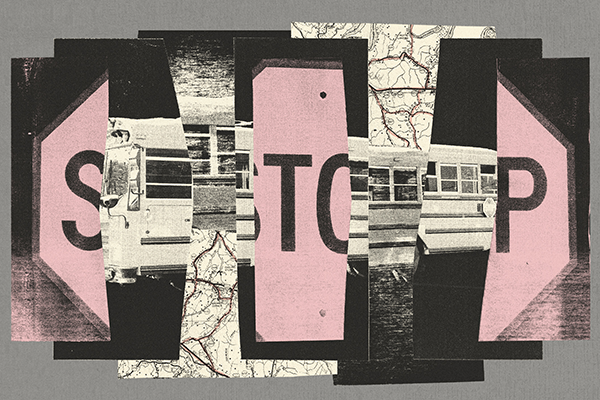
The Seven Mountains Mandate is a published road map for Christian authoritarian takeover. They are already “sending the bus” to capture the rights of transgender Americans. Attacks on progressive and mainline Christians are a later stop on the same route.
In How Fascism Works, Jason Stanley identifies the targeting of vulnerable minorities as a core mechanism of authoritarian consolidation. We know this. Targeting trans people—specifically trans youth and trans women in sports—is not a policy agenda. It is a strategic operation.
The function is not primarily to harm the targeted group, though that harm is real. The goal is to test the solidarity of potential opposition coalitions, to find and exploit fractures, and to establish a precedent: that some members of the coalition can be sacrificed when the political cost of defending them is judged too high.
This is the context in which the question “How can faith institutions defend trans rights?” must be answered. Churches must not see defending trans rights as charity toward an outside group, but in solidarity and as recognition that the bus is already in motion, the driver is named, and the route is known.
Wedge politics works because it targets a small, visible minority when the majority is tired and looking for ground that feels defensible. Trans people are roughly one percent of the country. They were selected precisely because cruelty against them can be normalized without immediate political cost.
But the method never ends at the wedge. It keeps going. Earlier stops on this bus route are already behind us: abortion protection, LGBTQ rights broadly, voting rights, immigrant families. The next stops are already posted. Where will faith institutions position themselves?
I am gay. Being gay is why I abandoned my faith—because my faith abandoned me first, in the long familiar way churches abandon their gay children. My church chose its own comfort over our existence.
I am writing from an earlier stop on the same road. I know what it looks like when the bus arrives, and I know what it looks like when the people who could stand in front of it choose instead to “wait and see.”
Here is what I want to say to progressive Christians: The question before you is not whether you have worked out every theological disagreement about gender, medicine, or ministry. Many of you have not. That is allowed. What is not allowed, if the gospel means what it says, is abandoning people to state violence and social erasure because you have not yet finished thinking.
Theological uncertainty is a reasonable condition. Abandonment is a decision. These are not the same. The lesson of the Confessing Church is not that some pastors failed to defend a persecuted minority. It is that a faction of German Christianity had fused with the state project and was rewriting the faith to fit it—and most of the church mistook a schism for a family disagreement until it was too late.
That is the situation you are in now. The NAR has declared mainline and progressive Christianity apostate. It is building political machinery to act on that declaration. Treating this as a conversation within one tradition rather than recognizing that a capture is underway is the error history has taught us not to make.
Serious defense of trans neighbors requires naming them explicitly—from the pulpit, in pastoral letters, in press statements, at coalition tables—as members, children, and siblings. Refuse to let the conversation about LGBTQ people in public life quietly shed the “T.” As clergy, show up at school board meetings, state legislatures, and courtrooms to defend trans youth. Provide sanctuary, legal aid, and material protection for families fleeing states that have criminalized their children’s existence. Name the New Apostolic Reformation aloud so that congregations understand what they are organizing against. Unnamed movements cannot be resisted.
None of this requires theological unanimity. It requires the moral clarity your tradition already gave you: that whatever you did for the least of these, you did for Christ; that the neighbor is the one you did not expect to defend.
Throwing any community under the bus does not protect the rest of the movement—it just tells the driver where to go next. The bus is coming. It is closer than you have let yourself see.
The gospel you inherited was written by people who were themselves the wedge—a small, strange, politically inconvenient minority whose survival depended on whether anyone with more power would stand between them and the machinery of the state. Somebody did. That is how the tradition reached you.
Get off the road the New Apostolic Reformation is paving. Stand first with the people its bus is running over.
Some of this material appeared in Nakagawa’s essay, “The Bus Is Coming: Trans People, Coalition Solidarity, and the Authoritarian Wedge Strategy.”

Scot Nakagawa directs the 22nd Century Initiative and writes The Anti-Authoritarian Playbook on Substack.

Did this article have an impact on you? Tell us how! Whether you’re moved to take action, have a question, or want to share a comment (good or bad), we value your feedback!