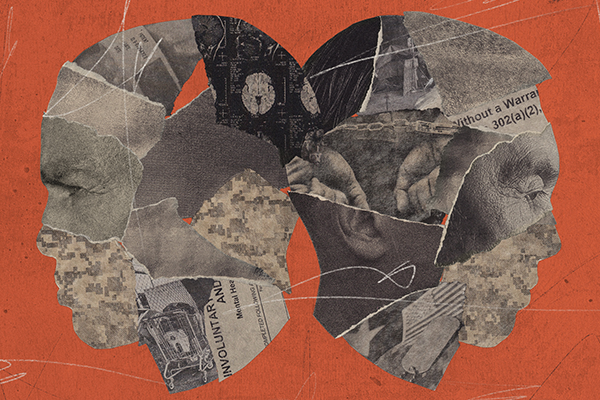
THE TRUMP ADMINISTRATION announced in March an agreement between the Department of Veterans Affairs and the Department of Justice that would make it easier to place homeless veterans under conservatorship. This means that VA attorneys can now be appointed as special assistant U.S. attorneys who have the power to initiate guardianship for homeless veterans and increase involuntary hospitalization for those with mental illnesses.
While people struggling with mental illness and addiction need more support, this is not the way to provide it.
Conservatorship and involuntary commitment should remain a last resort after all other efforts to provide housing and services have failed. This policy jumps to these extreme tools instead of investing in proven housing and case management approaches.
Before I was born, my great uncle was involuntarily committed to Bryce Hospital—the Alabama state mental hospital in Tuscaloosa—where he would spend two decades of his life. He was suffering from schizophrenia but had posed no threat to himself or those around him. As the nation moved toward deinstitutionalization in the 1970s, he was released and spent the last years of his life happily living with supports in the community. The tragedy is that he didn’t need to have been hospitalized at all.
Since those days of mass hospitalization, mental health treatment has come a long way. We have developed more sophisticated medications to treat psychosis, bipolar illness, depression, and anxiety. We have created evidence-based case management models such as assertive community treatment, critical time intervention, and coordinated specialty care for early psychosis. We have tested housing programs like Housing First and permanent supportive housing that decrease homelessness and promote housing stability, even for people with serious mental illness and addiction. Using such approaches, we as a nation have slashed the number of homeless veterans by 55% since 2010.
We don’t lack tools to support people. We lack the political will to scale what works.
We can’t solve homelessness with handcuffs.
The latest Trump policy is part of a broader push to criminalize homelessness, leveraging the control the administration has on veteran services. Through executive orders that encourage communities to arrest people who have nowhere to go and deep funding cuts to housing programs and Medicaid, the administration is eliminating the tools that actually solve homelessness and stabilize people with mental illness. At best, these misguided policies are based on a profound misdiagnosis of the problem and willful ignorance of what works. At worst, these actions are a willful attempt to disappear people the administration wants out of the public eye—an extension of the Trump administration’s turn toward authoritarian violence. Whatever the motive, the administration’s approach revives the failed policies of trying to police our way out of homelessness and hospitalize our way out of mental illness and addiction.
There is a better way. A comprehensive approach to ending homelessness and treating mental illness includes three key pillars: First, prevent homelessness before it starts. Second, implement an effective crisis response, including adequate shelter, street out-reach, and access to mental health and addiction treatment. Third, scale up evidence-based housing and supportive service models.
How will we pay for it? According to the National Alliance to End Homelessness, it would cost $9.6 billion to provide access to housing for everyone, not just veterans, living in shelter in the United States for one year. The Pentagon has claimed that the first two months of the war against Iran cost U.S. taxpayers $25 billion, while independent analysts estimate the cost to be nearly $72 billion. In other words, for even the lowest estimated cost of the first two months of the war, we could house every sheltered person for the next 36 months, freeing up shelter capacity to serve those who are currently living on the streets or in tents. Over the course of a year, savings on war spending would provide $150 billion dollars to end homelessness in the United States.
What can we do? Educate ourselves about the solutions, get involved with organizations working to end homelessness, and advocate with and for people experiencing homelessness to enact more humane effective policies.
We must resist the pressure to think that we can solve homelessness with handcuffs rather than housing. We can imagine a better future—a future where everyone has a home and everyone suffering the trauma of homelessness, mental illness, and addiction has the care, support, and human connection they need. Then we must do everything we can to make that future a reality. Everyone deserves a safe place to call their own, and we live in a society with the resources to pay for it.
Editor’s note: This article originally misstated how much the Pentagon spent in the first two months of the war in Iran. It is $72 billion, not $72 million.

Jeff Olivet is a senior adviser at the Harvard T.H. Chan School of Public Health and was executive director of the U.S. Interagency Council on Homelessness from 2022 to 2025.

Did this article have an impact on you? Tell us how! Whether you’re moved to take action, have a question, or want to share a comment (good or bad), we value your feedback!