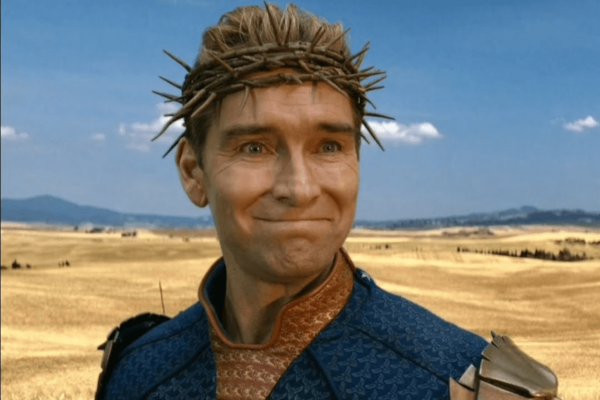
Amazon Prime’s The Boys wrapped up its fifth and final season last week, and its overarching theme was: faith. After becoming the de facto CEO of Vought and president of the United States, antagonist Homelander—a narcissistic Superman foil, wrapped in the American flag and played to perfection by Antony Starr—still isn’t satisfied.
Craving what he’s craved since lab birth—unconditional love and devotion with no expectation of anything in return—he declares himself a god and uses Vought’s media machinery to convince the American public of his divinity. Guided by visions of his former boss, Madelyn Stillwell—a Mary-esque mother-figure who, before he murdered her in Season One, used to breastfeed him—he ultimately decides to kill (“cleanse”) anyone who doesn’t “in their heart of hearts” believe in his divinity.
Though The Boys ended on a divisive and disappointing note—many fans rightly took issue with the meandering pace, bogged down by sub-par writing and shoehorned references to an upcoming prequel series—its political satire has never hit closer to home. As Homelander proselytized his godhood, his real-world counterpart, President Donald Trump, took another bold step toward self-deification: He posted an AI-generated image portraying him as a Christ-like figure healing the sick. In both The Boys and real life, disturbed onlookers were left asking themselves the same question: When, if ever, will people stop buying this crap?
As politicians and public figures, Homelander and Trump both pander heavily to evangelical Christians. Trump dispelled an initial wave of skepticism by coming out against abortion and conflating American greatness with Christian faith, among other factors. As a result, white evangelicals played a major role in securing his first presidential victory in 2016, and according to recent polling they remain among his most loyal supporters—though some are finally starting to have doubts.
Unlike Trump, Homelander has always been popular in the Bible Belt. As early as the first season, long before the character enters the political arena, we see him attend a so-called Believe Expo (alongside a megachurch pastor superhero called Ezekiel) and sprinkle religious language in his speeches. We even learn that Homelander’s an ordained minister when he surprise-baptizes protagonist Hughie. His supposed faith is as much a part of his image as his alleged patriotism, engineered by Vought to appeal to as many Americans as possible.
But if Homelander and Trump’s relationship with religion is politically expedient, it’s also highly precarious. Despite their claims to the contrary, both live their lives in repeated, unrepentant sin by any definition of the word. “No God,” an annoyed Homelander tells a suicidal teenager on the edge of a high-rise rooftop in Season 3, before forcing her to jump. “The only man in the sky is me.” In past interviews, Trump appeared unable to name a single Bible verse (“I like them all”), and critics and supporters alike referred to his since-deleted Jesus post as “blasphemous.”
READ: ‘The Sheep Detectives’ Is ‘Babe’ Meets ‘Knives Out’ Meets Jesus
The final season of The Boys suggests there inevitably comes a point where a leader’s performative religiosity ceases to convince: when disingenuous identification with God gives way to an unacceptable desire to be God. But while Homelander fails to replace Christ in the eyes of his followers—and commences Judgement Day in response—Trump has yet to lose control of his base. Even now, the majority of white evangelicals remain firmly on his side.
Why does Trump seem capable of succeeding where Homelander fails? No answer readily presents itself, not least because their strategies have been so similar. Both express politics in existential, moralizing terms: battles between good and evil, heroes and villains, national rejuvenation and civilizational collapse. Relatedly, both feed on fear: of terrorism, Islam, immigration, white replacement, cultural Marxism, woke mind viruses, and ruling class conspiracies.
If Homelander and Trump’s relationship with religion is politically expedient, it’s also highly precarious.
Both argue that current times call for a new kind of Christianity, or—rather—a return to an older kind, one thought to have existed during the crusades: less “love thy neighbor,” and more “an eye for an eye” and “I have not come to bring peace, but a sword.” Homelander’s Southern sidekick Firecracker, who anchors an Infowars-like news program, puts it best when brainstorming a way to sell his divinity to the masses:
“The things [Christ] preaches, turning the other cheek and taking in foreigners…caring for the poor…that s--- don’t sell no more. What we need is a church that preaches American. America is God’s government, and we are his chosen people. Manifest Destiny, from sea to shining sea.”
Speaking of Firecracker, Homelander and Trump both have underlings committed to sane-washing their most outrageous or controversial statements. Homelander’s PR team, though utterly loyal to him, initially tries to market him not as a god but as a prophet and, later, the second coming of Christ—compromises Homelander furiously shuts down. On Instagram, the evangelical minister Mark Burns tried to claim that “celebration is not bowing down to a false god,” while speaking at an event literally unveiling a golden statue of Trump.
Homelander and Trump each seek absolute authority by making their followers identify with them. As living embodiments of the nation and its people, Trump and Homelander don’t fight on behalf of the average citizen so much as they make the average citizen root for them in their own fights—the way we root for superheroes. Their victories are our victories, their victimization our victimization.
On paper, you’d think Homelander would have an easier time convincing people of his divinity than Trump. He may not be omniscient or omnibenevolent, but he is as good as omnipotent. From the very first episode, he is established as the most powerful superhero in existence, surpassing all others by a wide margin. Unrivaled and—following events in the final season—immortal, he is a god in all but name. More Greco-Roman than Christian, to be sure, but godly nonetheless.
Maybe Homelander struggles to make people believe in his divinity precisely because he is so powerful. As mentioned, his political success—like Trump’s—rests in large part on making his followers afraid of the world around them. The more afraid they are, the more they flock to their leader for protection, and the more willing they will be to excuse the crimes committed in the name of said protection. Homelander’s omnipotence reduces that fear, paradoxically making his divination a tougher pill to swallow.
Conversely, it could be that Trump has yet to run afoul of his base because the real America is in a much more precarious position than America as presented in The Boys. In the latter, superheroes all but exclusively reside in the U.S., making relations with Russia and China afterthoughts as opposed to existential threats. Geopolitics in The Boys is stuck in the late ’80s and ’90s when Washington emerged from the Cold War as the world’s one and only superpower. Though experts disagree on when and how, there’s little doubt that—in the real world—the American sun is setting, and many are desperate to hold on to something, anything, to avoid facing this reality.
One other difference stands out. While Homelander’s claim to godhood is based mostly on his invincibility, Trump’s associations with Christ—in his own eyes as well as those of his followers—concentrate on his vulnerability, on his relentless “persecution” by a corrupt state and its shadowy puppet masters. Where Homelander emphasizes he is different from and better than Christ, Trump pretends to be like Christ: down-to-Earth, no pretense, nailed to the cross for his honesty, and selflessness. One is undeniable idolatry, the other is—for the time being—clever marketing.

Tim Brinkhof is a U.S.-based Dutch journalist who writes about religion, politics, and history.
Did this article have an impact on you? Tell us how! Whether you’re moved to take action, have a question, or want to share a comment (good or bad), we value your feedback!