When Our Faith Forgets People

June reflections on scripture from the ‘Revised Common Lectionary,’ Cycle A.

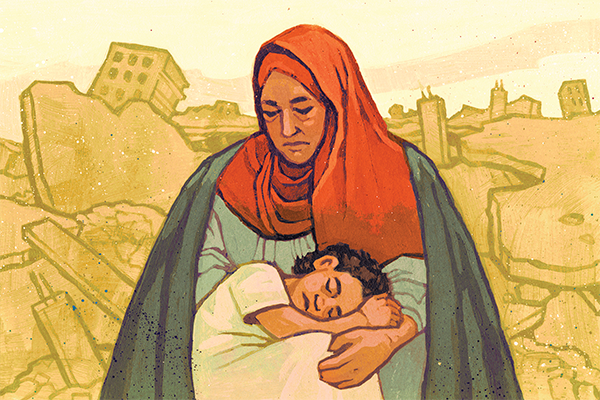
Illustration by Jocelyn O’Leary

AS CHRISTIAN NATIONALISM continues to plague the United States, I find myself asking the question: Who pays the price when faith separates itself from humanity? History is clear. It is the children. The mothers. The women. The foreigners. The outsiders. The marginalized. 

Who reaps the reward when we reconnect faith to the unlimited compassion of Jesus? All of us. All of us. All of us.

Never in my lifetime has it felt as critical as it feels right now to make Christianity Christ-like again. Critical, as in people are dying. Critical, as in babies are starving. Critical, as in we are losing our very souls.

I recently saw a Facebook advertisement promoting the “right way” to teach your children about the Christian faith so that they wouldn’t be overcome by secular arguments in college and become atheists. I was struck not just by the fear behind it, but by how misplaced that fear seems.

I know many people who have left the church. Not one of them left because an atheist out-argued them. Everyone I know who has left the church left it because they experienced a church that was cruel instead of compassionate. Sure, many of them have rejected the theology of the church too, but it’s almost always a rejection of the part of that theology used to prop up cruelty, misogyny, racism, etc. Most of those I know have not rejected Christ so much as they’ve rejected the hypocrisy of his followers. The texts this month invite those inside and outside of the church to see our God in new ways.

Make Christianity Christ-like again.

June 7
Upending Our Priorities

Genesis 12:1-9; Psalm 33:1-12; Romans 4:13-25; Matthew 9:9-26

IN MATTHEW’S GOSPEL, the Pharisees are confused as to why Jesus dines with tax collectors and sinners, but Jesus says something like this: “Why are you surprised? These are my people.” Their conversation is interrupted because a little girl is in trouble. Immediately, Jesus follows her father to help. On the way, there’s another interruption, when a woman with an eternal menstrual cycle touches his cloak. Jesus stops, and she is healed. Then he brings the little girl back to life. None of these people—a tax collector, a ritually “unclean” woman, a small child—are the type of people that society values or watches out for. But for Jesus, they are who he lives for.

In Genesis 12, Abram boldly follows God’s call at the very ripe age of 75. Society today might have written him off due to age, but God saw him as just the right person to begin a whole new thing. If you read a little beyond the lectionary verses, you will see that Abram almost writes off his own wife—by passing her off to Pharoah as his sister to save his own neck. But Sarai is not expendable in God’s eyes, and God intervenes to make Sarai’s identity known.

Repeatedly God is on the side of the underdog, even when God’s people are not. No one is dispensable in these stories, even if they are treated like it by their fellow humans. In God’s economy, no one is required to bleed out for the cause. Women are not meant to sacrifice themselves for the sake of their husbands. The children and the sinners are Jesus’ first choice of company. We might get our priorities backward, but God does not.

June 14
Blessings of Strangers

Genesis 18:1-15, 21:1-7; Psalm 116:1-19; Romans 5:1-8; Matthew 9:35 - 10:23

UNLIKE IN LAST week’s gospel, with its cozy vibes of inclusion, today Jesus is harsh. Consider this: “Sibling will betray sibling to death and a father his child, and children will rise against parents and have them put to death” (Matthew 10:21).

As I watch ICE agents wage violence in our communities, I get why Jesus sounds like this. Jesus came to make room for everyone, prioritizing the ones society over-looks or rejects. Unfortunately, there are always people who fight against that wide welcome. But recall that line from the book of Hebrews: “Do not neglect to show hospitality to strangers, for by doing that some have entertained angels without knowing it” (13:2).

That very thing—entertaining angels unaware—happened to Abraham and Sarah in Genesis 18. When these strangers shared their message from God, it seemed so ludicrous that Sarah laughed out loud. Humans, it turns out, have always struggled to see divinity in the other. But when the strangers’ prophecy came to pass, and Sarah gave birth in her old age, she named her son Isaac, meaning “laughter.” It was still funny nine months later, but in a new way—tears turned to joy, weeping to laughter.

What if Abraham and Sarah’s willingness to extend hospitality was a prerequisite to receiving the blessing? We know from previous stories that Abraham is distrustful of strangers. Perhaps several angels came before these and were turned away (and that is why Abraham and Sarah are so darn old). This time, Abraham makes a different choice. He welcomes them, and as a result, he receives the blessing of strangers, through whom God’s promise is finally realized.

June 21
Incline Your Ear

Genesis 21:8-21; Psalm 86:1-17; Romans 6:1-11; Matthew 10:24-39

“INCLINE YOUR EAR, O Lord, and answer me, for I am poor and needy. Preserve my life.” (Psalm 86:1-2). When Hagar, in this Genesis reading, finds herself forsaken and alone in the desert with her boy, she cannot even muster a prayer like the psalmist’s, asking for help. She is so low in that moment that the most she can think to ask for is that she not have to watch her child die from starvation and thirst. I’ve had some low moments in my life, but nothing like that. Imagining what it would feel like to be Ishmael’s mother, stranded in the desert, rips my heart. Or a mother in a detainment center torn from her child, or a mother in Sudan who doesn’t know where the next meal will come from—Hagar’s story takes many forms.

Yet in this story, God hears them. God sees them. God delivers. And so today, on behalf of the mothers whose throats are hoarse from crying, for the mothers whose words have failed them or whose voices have been silenced, I join the psalmist and pray: Give your ear, O God. Answer! You are good, steadfast, loving, so listen. Today, right now, is the day of trouble, and we call on you. You will answer. You must answer. You said it yourself, “Are not two sparrows sold for a penny? Yet not one of them will fall to the ground” without your knowledge (Matthew 10:29). You have the very hairs of that mama’s head counted and her baby’s head too. “Save the child of your maidservant,” O God (Psalm 86:16). If possible, use me. I’m available. I’m not afraid of those who could kill my body but not my soul (Matthew 10:28). I’m afraid of losing my soul if I forget about the children.

I’m afraid of losing my soul if I forget about the children.

June 28
What Is Going On?

Genesis 22:1-14; Psalm 13; Romans 6:12-23; Matthew 10:40-42

THE BINDING OF ISAAC—the near murder of a child in the name of God—is such a morally obscene story that instead of looking away, I usually find myself looking harder. What is really going on here? Why does the man who once argued so fiercely with God to prevent mass deaths in Sodom (Genesis 18:16-33) now so obliging to accept killing his own son?

Jewish midrash has much to offer. Some say Abraham misunderstood God. Others suggest the real test was not whether Abraham would “obey” God, but whether he could recognize the absurdity and violence of God’s request and refuse it. Some rabbis have imagined Sarah in so much distress that she asks to be sacrificed too, and in one modern retelling at the Midrashic Monologues blog, Sarah sneaks up the mountain with a ram and pretends to be the voice of an angel to save her son from death. Rabbi Esther Adler suggests the angel had to call Abraham’s name twice to get through his thick skull, and she imagines God saying, “Why didn’t you refuse? ... Don’t you know that saving a life is like saving the world, and that destroying a life is like destroying the world?” Rabbi Paul Kipnes imagines Abraham coming to his senses and saying, “I failed the real test. I loved God, but I didn’t love God’s child sufficiently.”

I don’t always know what I can say for sure about who God really is—the question is so big and daunting. But this I know for sure: God gives out cups of water to the little ones (Matthew 10:42), and She never, ever, ever asks for their deaths.

This appears in the June 2026 issue of Sojourners