Deep in Depression, a Philosopher Turned to the Mystics

In Make Your Home in This Luminous Dark, James K.A. Smith shows how the “mystical path of unknowing” can lead to a felt sense of God’s love.

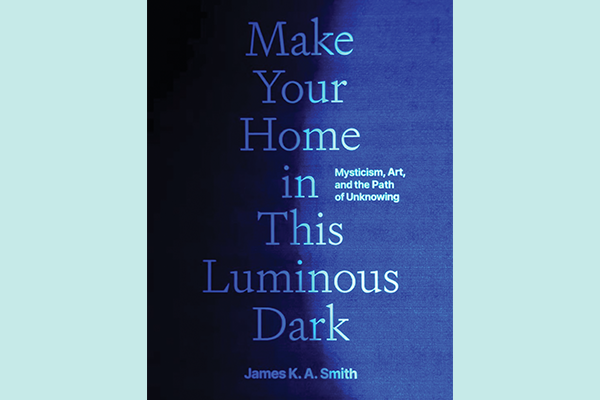
Make Your Home in This Luminous Dark: Mysticism, Art, and the Path of Unknowing, by James K.A. Smith / Yale University Press

IN HIS BOOK Make Your Home in This Luminous Dark, author James K.A. Smith traces his own evolution through a personal “dark night of the soul.” Marooned by depression, Smith experiences a crisis of meaning, foreign terrain for him as a philosophy professor and preacher. In the context of what Smith calls our “knowledge economy,” the discipline of philosophy encourages academics to know, define, profess, defend, and win. In his darkest moments, Smith realizes this epistemology fails to address core human concerns, like grief and suffering. In addition to working with a therapist, he finds restoration through the Christian mystical tradition and approaching art with a contemplative posture. In these compelling pages, Smith, who was once comforted by the “security of knowledge,” reveals how unknowing grows wisdom that helps us heal, both personally and collectively.

Drawing from texts such as The Cloud of Unknowing (14th century) and St. Teresa of Ávila’s The Interior Castle (16th century), and from contemporary artists like Agnes Martin, Smith constructs an engaging and highly readable portrait of Christian contemplation: letting go of what we think we know about faith and life itself to become truly receptive to God’s non-dual wisdom, loving presence, and transformation. Smith makes contemplative Christianity accessible through the lens of his own experience of unknowing, of relinquishing his desires to control, judge, and defend his claims on truth.

“What happens when the philosopher is enveloped by a cloud of unknowing that refuses to be dispersed by the tools of knowledge and conceptual analysis?” Smith asks. The answer is to learn how to be in the midst of mystery. Through contemplation, he cultivates silence, stillness, and a radical, non-intervening openness that provides surprising clarity.

Lacking answers and certainty at first feels disorienting to Smith, but as he continues down the “mystical path” of unknowing, the darkness “begins to glimmer, somehow, as ‘a luminous cloud’ of being loved.” For centuries, mystics have testified to this experience. For example, The Cloud of Unknowing describes “contemplative work” as “love at its best.” Putting down anxiety, analytical tools, and the impulse to control, Smith, like the Christian mystics before him, opens himself to a felt sense of God’s love. This love is not earned by winning or proving. It abides with and surrounds us like ocean water.

Smith finds this to be inherently healing because we finally understand that we are not alone and that God will never abandon us. Further, it transforms us into more compassionate people who see more clearly. We learn, as Smith puts it, to see how God sees. We see ourselves, other people, and the experience of being human through the light of compassion. Smith writes, “Compassion and contemplation are braided in such a way that we can’t have one without the other.”

Ultimately, Smith’s journey in contemplation leads him to see redemptive possibilities everywhere—for academic philosophy, spiritual formation, and community work. Make Your Home speaks beautifully to the heart of what troubles us most today—fear, distraction, human suffering—and reminds us to embrace the luminous dark: an ancient, “generative” place of remembering where we can rest, be healed, and be guided by love.

This appears in the June 2026 issue of Sojourners