Pentecost Is More Than Speaking in Tongues—It’s Learning to Sing Together

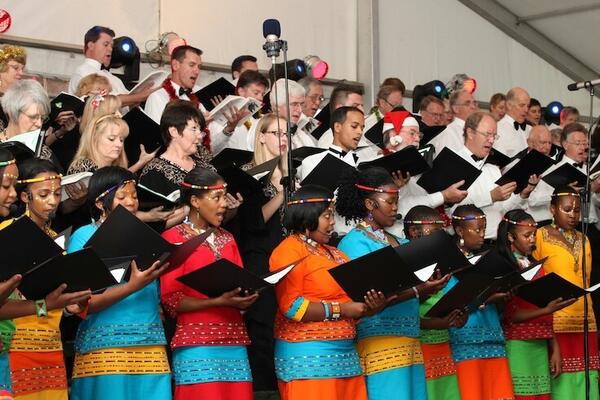
Group of people singing in a choir. Photo credit: Ngobeni Communications/Unsplash

In a dark church, a dozen disciples gather in the upper room of the choir loft. We warm up our voices. We practice our hymns. Although we are not silent, in many ways, we are the disciples on the eve of Pentecost: waiting for the Spirit to descend. 

I’m a lifelong choir member. I caught the bug in high school, joined a liturgical choir in college because the boy I had a crush on told me to, and I was briefly a member of St. Patrick’s Cathedral Choir in New York City. I keep finding my way up to the choir loft, even when other priorities crowd out my life. And as much as I enjoy cantoring, leading the congregation in song from the ambo, or singing from my pew with full heart and voice, sitting up in the choir loft among a chorus of voices is where I’ve always felt most at home in church. 

Two years ago, my fiancé and I moved to Harrisburg, Pa. We run a Catholic Worker house directly across the street from the parish church. It wasn’t long before the pastor asked me to help with building a bilingual choir, which debuted one Easter vigil. The parish here in Harrisburg is split into Spanish-speaking Masses and English-based services. But for big holidays like Easter vigil and, this year, Pentecost, the church committed to singing together in a bilingual choir.

There are a handful of truly bilingual singers, and the rest of us stumble along in each other’s languages. We learn as we go; English speakers lead our Spanish-speaking choir mates in practicing the English language verses, and Spanish singers give impromptu Spanish lessons to the Anglo singers. One of our choir members is Hungarian, singing in two second languages—English and Spanish. Another choir member is a septuagenarian English-speaking grandmother who tackles new Spanish words in her alto vibrato with gusto.

Our bilingual choir crosses not just language divides but cultural divides and practices. The English-speaking choir members learn mostly with the help of sheet music. The Spanish-speaking choir members learn aurally, through listening to YouTube videos and practicing alongside a track. The approach of the Spanish-speakers, I think, would be highly rated by my college choir director, who desperately asked his student choristers to lookathim and not bury their noses (and voices) in their scores. Sheet music only takes you so far. You need to look at one another. And listen.

Pentecost was a favorite feast day of Dorothy Day, co-founder of the Catholic Worker movement. It was the date of her confirmation into the Catholic Church on May 19, 1929. “Pentecost never passes without a renewed sense of happiness and thanksgiving,” Day wrote in her 1938 autobiography, From Union Square to Rome.

It’s easy to understand why Day might be so fond of Pentecost: She was drawn to the unleashing of the Spirit. The “primacy of the spiritual” made the rest of the Christian faith easy to Day. Once we understand “the reason for our existence is to praise God,” Day wrote in 1953, we soon realize that we can “only do this by loving our brothers.” Once the Spirit moves us, we have to act, we have to speak, we have to sing. Our movement is not derived solely from our own singular genius, but is rather a creative impulse in response to the wild love of God.

Theologian Willie James Jennings describes Pentecost as the wild, untamed action of the Spirit: “This is God’s doing: no one helped,” Jennings writes in his commentary on Acts. “His words will now and forever be only commentary on what the Spirit is doing,” he says of Peter’s kerygma, where he preached the good news of Christ’s death and resurrection to the assembled Jewish diaspora coming to worship God in Jerusalem. Before the Spirit arrived, the disciples were waiting, mute, suspended in prayer. 

The story of Pentecost is an unleashing. The miracle, Jennings said, is not so much the listening, not so much that the diaspora can understand Peter’s words: it is that the tongues of the disciples are moved. 

“They are also in mouths and in bodies. God, like a lead dancer, is taking hold of her partners, drawing them close and saying, ‘step this way and now this direction,’” Jennings writes.

“To learn a language requires submission to a people,” Jennings writes. To learn a language is an act of humility that reduces the person to a child once again. To sing with one another, to sing in new tongues and new languages in our choir, requires the openness of little children, ears attuned to the miracle of another language, another culture.

To sing with one another, to sing in new tongues and new languages in our choir, requires the openness of little children, ears attuned to the miracle of another language, another culture.

The unleashing of the Holy Spirit at Pentecost is the first step toward revealing the universality of Christ’s message. Throughout Acts, the early church slowly realizes just how many bridges they will cross, just how far their savior will expand. The Apostle Paul, the creative missionary, begins to see signs of Pentecost in other cultures, as far afield as Athens (17:16-34). He sees the same dance in different steps, the same waiting on the Spirit to move different tongues to offer praise.

Choir is a school of cooperation. You have to work together to make good music—it’s not a series of solos side by side, but a gaggle of individual voices corralled to make something richer. In an age of yelling, choir may involve turning up the volume, but you cannot make a truly joyful noise without listening to one another. 

READ MORE: This Is What Democracy Sings Like

You can spill oceans of ink on the need to listen, but stand next to a pitchy chorister, and you’ll learn the need to listen in two seconds flat. Our brains take in the notes around us to help us sing the correct pitch. When we sing a note wildly off-key, it’s because our ear is not tuned to the sound around us. 

A choir lives and dies by its “blend.” Which means, even if you have a well-trained tongue (Isaiah 50:4-10), bel canto soprano or opera-ready vibrato, nothing will sound good if you fail to listen to your neighbor’s voice and sing with them. You have to sound good with them. The bane of a choir is the wanna-be diva; you can hear them a mile away. When you stand next to them, you are fighting for your life to hear everyone else, even yourself. Or perhaps your neighbor sings joyfully, with full heart and voice, but woefully off-pitch. Because we can only sing together, listening to their sour note drags you off course as well.

In those moments, I’m reminded of Day’s favorite paraphrase of Romano Guardini’s articulation of the church as the cross upon which Christ was crucified. You can’t separate the cross from Christ. Without pain, there’s no unity. A discordant choir member may feel painful to the ears, but you would never excommunicate them—they’re part of the choir, after all, and the point is to make beautiful music together. But their failure to listen becomes a communal cross to carry. The mission demands that every single person enter into the song, and the mission is not complete until we’re all singing together. 

That our society and our churches are divided and discordant is no longer news. When you walk or sing alongside somebody in community, the good, bad, and the off-tune come out.

When the church seems full of judgmental old ladies, priests who neuter the gospel rather than embody it, or bishops who co-opt Christ’s message for their own power rather than tend to Christ’s lambs suffering on the margins, I find my hope renewed at my choir. 

Choir members carry you when you don’t have enough breath to hold a note eight counts, when you don’t have the full volume to hold the final “amen” with full fortissimo for a full eight counts—you can lean on the voices and the breath of your fellow singers. 

In Paradiso, the third and final section of the epic medieval poem The Divine Comedy, Dante depicts the afterlife as incessant praise of God, and that praise of God spills over into the blessed in heaven’s praise of one another. Former rivals praise each other’s virtues. Heavenly glory, to Dante, is harmonious. It is eternal beatitude, it is sharing in the unmediated life of the God of love, expressed through song, praise, a joyful shout, together. In our choir loft, I see that vision for a moment, singing “Glory to God,” and then “Gloria a Dios.” Differing languages united by melody, harmony, music, and praise. In choir, different voices—the tenor, the alto, the soprano lines—strive to become tuneful, harmonious, rather than warring. 

You can do all things through Christ who strengthens you, and you can hit all notes with a choir that supports you. We help each other remember which line comes first, the English or the Spanish. We help each other remember our harmonies. We help each other find sheet music for those who need to read it, and record the songs for those who need to hear them. There is grace extended, as multiple miscommunications, translation failures, and differing traditions unfailingly brew last-minute chaos, song switching, or changes in plans. 

In choir, our church is alive. There is confusion—there is babel—but, also, we are Pentecost.