MY FOUR-WORD SUMMARY of the book of Amos: God hates bad parties. Aiming serious prophetic fire at powerful people who host showy religious festivals instead of attending to the needs of the poor, telling truth, or acting with integrity, God doesn’t mince words: “I hate, I despise your festivals, and I take no delight in your solemn assemblies” (5:21).
This verse keeps coming to mind as I watch the nation’s capital ready itself for the semiquincentennial (yep, it’s a word) marking 250 years since the signing of the Declaration of Independence. According to President Donald Trump, this occasion commemorates “two-and-a-half centuries of liberty and triumph, progress and freedom.” As part of the festivities, he has urged America—“the most incredible and exceptional nation ever to exist on the face of the Earth,” he says—to pray, read the Bible, and “rededicate ourselves as One Nation Under God.” Meanwhile, the city has swept unhoused people out of sight, Congress has given billionaires bigger tax breaks, and nearby in the Pentagon, the secretary of defense has offered a “prayer” lifted from Pulp Fiction to bless our newest war.
This issue of Sojourners is our response. As Jemar Tisby points out, describing U.S. history as “two-and-half centuries of liberty and triumph” leaves out a lot of the truth that Jesus said would set us free. We wrestle with relationships on Turtle Island far older than this young republic and consider flags—yes, plural—in church. And while we’re heeding Trump’s call to prayer, we suspect the confessions, laments, and blessings we’ve gathered aren’t what the White House had in mind.
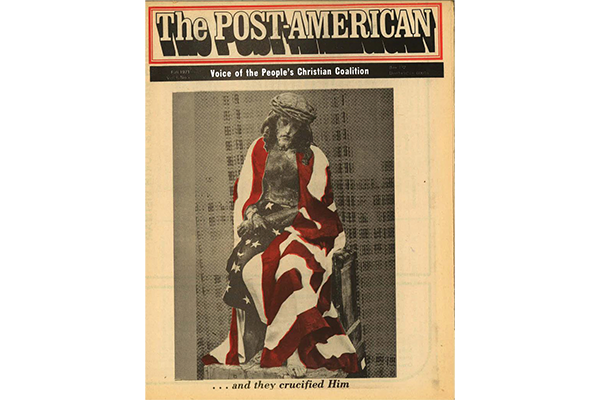
As the U.S. remembers its founding documents, I thought about this publication’s origins. Our first issue, back in 1971 when we were called The Post-American, featured a crucified Jesus wrapped in an American flag. Founding editor Jim Wallis didn’t mince words either: “Institutional Christianity in America has allowed itself to become a conservative defender of the status quo, a church largely co-opted and conformed to the American system in direct disobedience to Biblical teaching (Romans 12:2).”
That same moral clarity thunders through Kenji Kuramitsu’s pastoral tough love for all the sneaky ways American exceptionalism still ensnares us. But whether in 1971 or 2026, we don’t publish sharp critiques to inspire collective hand-wringing or despair—that’s exactly the kind of response authoritarianism feeds on. Instead, we aim to urge the body of Christ in these United States (ourselves included) to deeper faithfulness to the gospel.
In recent years, some have marked the weeks between Juneteenth and Fourth of July as “Civic Season,” mixing community history and volunteering to help make this place a more perfect union. It’s a good example of what columnist José Humphreys III writes about when he reminds us we are “tethered to an ecosystem of beautiful humans, past and present, who have pursued the vision of the beloved community.” Which is pretty much how Sojourners is observing the 250th: Taking stock of where the U.S. has strayed from “liberty and justice for all,” with gratitude for all those who keep working “toward a more perfect union,” then rolling up our sleeves to help.


Did this article have an impact on you? Tell us how! Whether you’re moved to take action, have a question, or want to share a comment (good or bad), we value your feedback!