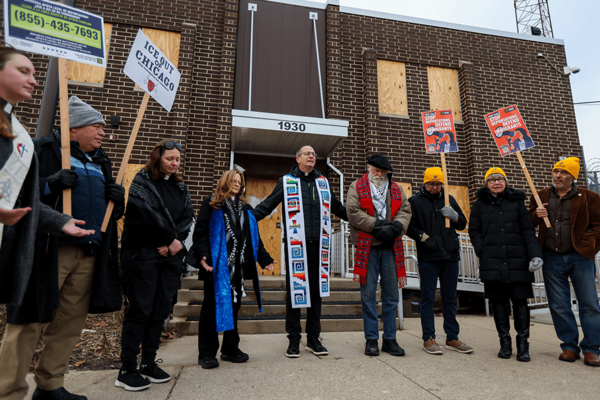
A federal district judge ruled that government authorities must allow clergy to minister to Broadview Processing Center detainees on Ash Wednesday this Feb. 18. The order, if followed, fulfills months of organizing by Chicago area clergy to minister to detainees of Immigration and Customs Enforcement within the oft-protested facility.
The government and its officials substantially burdened the exercise of religion by the clergy group who brought the lawsuit and made no argument that the burden was “in furtherance of a compelling governmental interest, and that it is the least restrictive means of furthering that compelling governmental interest,” according to the injunction, written by Judge Robert W. Gettleman.
The ICE processing center in Broadview has come under national attention in the last year. Residents, often joined by local clergy and faith leaders, have protested the detainment and treatment of undocumented immigrants and others swept up in the Department of Homeland Security’s Operation Midway Blitz. In September, a photograph of officers using chemical irritants directly in the face of Rev. David Black went viral.
The lawsuit was brought by the Coalition for Spiritual and Public Leadership, a Chicago-based religious advocacy group that organizes on the principles of liberation theology. Father Dan Hartnett, a Jesuit priest and member of CSPL’s clergy council, said the injunction was a victory, “but not simply in the courtroom.”
“We’ve been trying for the last couple of years to create a grassroots movement here [in Chicago] of lay people, of religious sisters and priests,” he told Sojourners. “That’s really what this is about. So while we celebrate the court order, the proof will be in the pudding.”
Gettleman granted the injunction to immediately cease harm stemming from a general practice at Broadview by which clergy are not permitted to enter the facility. The practice, which in effect includes most members of the public, has resulted in limited public opportunity to observe Broadview detainee living conditions.
“Allowing plaintiffs to provide pastoral care to migrants and detainees will improve the condition of those detained at Broadview,” the injunction stated.
Clergy remain unsure if ICE will follow the judge’s injunction. Its terms also require that government authorities confer with Chicago clergy to establish safety protocol for Ash Wednesday and negotiate future ministry after, including personal interaction with detainees at Broadview and the act of prayer outside the Broadview facility. As of Tuesday, Feb. 17, CSPL said they had not heard from ICE officials. ICE did not immediately reply to a Sojourners request for comment.
Over late 2025, ICE repeatedly rejected or ignored clergy requests to enter Broadview, according to the lawsuit. Once, an “anonymous” federal representative called in November to assert that “there is no more prayer in front of [the] building or inside the building because this is the state and it’s not [of a] religious background.”
Father David Inczauskis, another member of CSPL’s clergy council who is frequently active at protests, criticized how the Trump administration invokes Christianity when expedient, but censors aspects of the faith that uplift the poor, migrant, and imprisoned.
“The administration would like to see a version of faith which is either silent or supportive of them, and I would imagine that there are many other cases in which people, of course, pray on federal property all the time,” he said. “But when one has the sort of faith of Mary, who says that the mighty should be cast down from their thrones and the lowly will be uplifted, then that’s the kind of faith that is not allowed.”
This Ash Wednesday, CSPL will hold a large mass and neighborhood procession in Chicago’s Melrose Park. Chicago Cardinal Blase J. Cupich, archbishop of Chicago, will lead the service. Inczauskis credits the advocacy group’s growth to consistent good faith efforts to communicate with ICE and with their neighbors in Chicago.
While the size of their events has grown over the past year, Sister Jeremy Midura said the political climate for organizing has shifted dramatically. In her experience, DHS agents are becoming less reliable in following previously agreed-upon law, such as not entering homes without a warrant signed by a judge. Midura serves as a member of the Felician Services executive leadership team, coordinating ministries across North America, and has ministered to imprisoned people for years. She is also a plaintiff in the lawsuit against the government.
“Until everyone is treated with respect and human dignity and their rights are respected, then no one is really safe,” she said. “Because this government is a government of the country in which I am a citizen, so much of this injustice is interpreted as being done in my name, because we are the people who elect our officials. If we don’t do something to right these wrongs, then we have no right to complain.”
Hartnett and CSPL are also plaintiffs in the ongoing lawsuit against ICE acting Director Todd Lyons, Department of Homeland Security Secretary Kristi Noem, Attorney General Pam Bondi, Border Patrol officer Gregory Bovino, and others.
With time running out for the government to make arrangements with clergy for their visit in compliance with the injunction, the next steps for CSPL and community clergy vary depending on its decision. Either clergy will be admitted and ICE will coordinate to allow religious services in the processing facility, or the government will disobey the judge’s order. Hartnett said CSPL is prepared either way.
“This is a U.S. federal judge, so if they start ignoring that, that’s important to notice and we will make it clear. We’ll make it visible,” Hartnett said. “I think they [the administration] do think that if they say no often enough, people will just give up. And we don’t plan on doing that.”
The judge set a status hearing for Feb. 25. The results could have ramifications for ICE processing centers nationwide, as the usually tightly controlled facilities bear a legal expectation to allow religious leaders to minister to detainees.
“Our one message to the government, to DHS or ICE would be, don’t terrorize our communities,” Hartnett said. “But even if you continue to do that, we are not afraid, and we will continue to push not only for religious services for these people, but we’ll push so that Congress will refuse to keep adding funding to ICE.”

Tate Young is a reporter in Washington state. They were a news cohort journalist for the 2025 Sojourners Journalism Cohort.
Did this article have an impact on you? Tell us how! Whether you’re moved to take action, have a question, or want to share a comment (good or bad), we value your feedback!