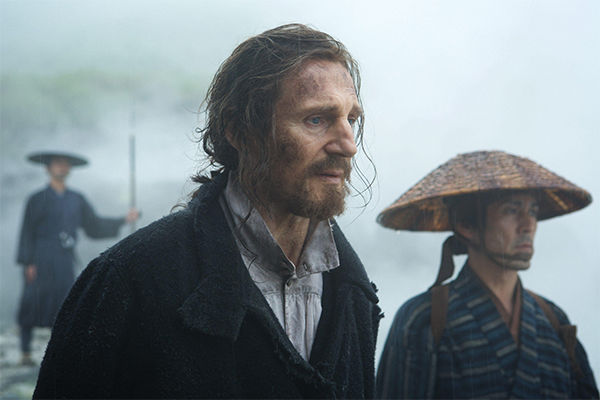
WHEN MARTIN SCORSESE’S Silence was released in 2016, many reviewers invoked the “L” word: legacy, a capstone for a lauded director with nearly five decades of films under his belt. But looking back, Silence is less like a summation and more like a fresh exploration of the themes that had always fascinated the director.
Scorsese, who based the film on the 1966 novel by Shūsaku Endō, spent more than 25 years laboring over its script and production. Two Portuguese Jesuit priests, Sebastião Rodrigues (Andrew Garfield) and Francisco Garupe (Adam Driver), journey into fog-shrouded Japan to find their former mentor, who seems to have abdicated his evangelizing responsibilities under fear of persecution and death. To restore his name and maintain their own faith, the two venture into a country where the government offers large cash rewards for exposing hidden priests.
Ten years on, with a film industry dominated by branded franchises, the existence of Silence—a personal, uncommercial, non-franchise passion project—seems like a minor miracle. A particular highlight is the painterly cinematography of Rodrigo Prieto, who achieved the perfect balance of darkness and light: Unseen forces hover on the edge of your vision, and pounding waves, pouring rain, and oppressive silence are constant.
Silence’s real triumph, though, is narrative: It’s a film that centers doubt.
Scorsese has always been concerned about doubt’s creeping, crucial impact on faith. And while some of his films, such as The Last Temptation of Christ, explore themes of spirituality and salvation explicitly, even his gritty urban films, such as Taxi Driver and Raging Bull, deal with wretches who gesture, even if unknowingly, to the sublime.
But Silence stands out as the most distilled expression of Scorsese’s lifelong wrestling with faith and doubt. When Rodrigues’ persecutors question whether faith can really take hold in Japan, he answers, “There are some here who may be praying in the silence of their hearts.”
The narrative’s theological ambiguity, reinforced visually through the interplay of light, darkness, and the misty unseen, points to the mystery of faith. In doubt, Scorsese’s priests come to grasp, tentatively and uneasily, a deeper meaning to faith, one that can evolve over a lifetime.
The film suggests that God may be as mysterious to us as a foreign language. And yet, struggle to understand we must. In the struggle, God comes to us—albeit not as we might expect or want. As Garfield’s character realizes in the end, we are never alone, particularly in moments of doubt: “It was in the silence that I heard Your voice.”

Sergio Lopez is an author, historian, and vice mayor of his hometown of Campbell, Calif.
Did this article have an impact on you? Tell us how! Whether you’re moved to take action, have a question, or want to share a comment (good or bad), we value your feedback!