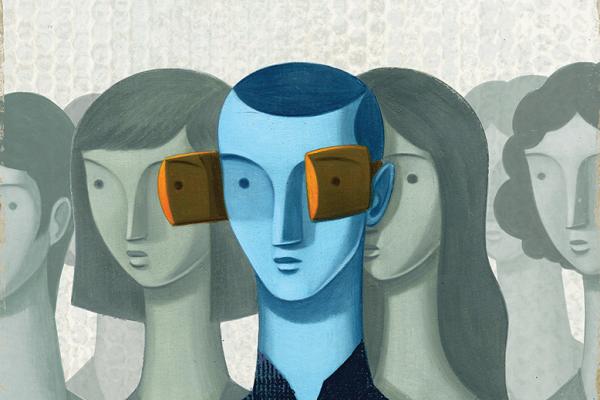
AS WE APPROACH A PRESIDENTIAL election in which each candidate’s gender is sure to be discussed, it’s worth evaluating the automatic assumptions we—yes, all of us—make when it comes to women, men, and the meaning we attribute to gender. These assumptions include everything from outright sexism to subtler forms of gender bias, such as the knee-jerk association of men with “competence” and “gravitas,” women with “incompetence” and “emotion.”
“The battle for women to be treated like human beings with rights to life, liberty, and the pursuit of involvement in cultural and political arenas continues, and it is sometimes a pretty grim battle,” writes Rebecca Solnit in the title chapter of Men Explain Things to Me, a 2014 collection of essays that helped coin the term “mansplain.” “This is a struggle that takes place in war-torn nations, but also in the bedroom, the dining room, the classroom, the workplace, and the streets.”
I would add, of course, that this battle also takes place in the church, our spiritual homes. After all, for women this is a struggle that’s older than feminism, perhaps as old as our faith traditions themselves. So how, exactly, can we end the battle?
The answer, it seems, lies in understanding the difference between explicit and implicit bias, the former resulting from deliberate stereotypes, the latter a growing topic in social science that doesn’t absolve us of guilt but helps us understand how biases of all kinds have been so difficult to identify, name, and change.
CHERYL STAATS, senior researcher at the Kirwan Institute for the Study of Race and Ethnicity at Ohio State University, told Sojourners that implicit bias is best understood as “attitudes or stereotypes that affect our understanding, actions, and decisions in an unconscious manner,” including “the associations we carry around in our minds.”
And while implicit bias is helpful for understanding the unconscious associations we carry about gender, implicit bias also affects associations about race, class, and physical ability. For example, the recent U.S. outcry about the disproportionate arrests, brutality, and death experienced by black and brown people at the hands of white law enforcement officers is partly a conversation about implicit bias—the implications of automatically associating white with “law-abiding” and black with “law-breaking.”
So while explicit bias is a conscious expression of one’s stereotypical beliefs, implicit bias is unconscious, a kind of prejudice we exhibit without even realizing it. “These are associations—favorable or unfavorable—that you make when you think about a group that may or may not be accurate,” explained Staats. “They occur in a part of our minds that works quickly. It’s an involuntary dynamic.”
And it is the subtle reinforcement between implicit and explicit bias—our unconscious associations and our deliberate actions—that requires the attention of those who want to untangle their nuances. But this is challenging. “Many of our anti-discrimination policies focus on finding the bad apples who are explicitly prejudiced,” wrote New York Times op-ed columnist David Brooks in 2013. “In fact, the serious discrimination is implicit, subtle, and nearly universal.”
WHEN STAATS EXPLAINS how implicit bias influences gender, she often cites “Orchestrating Impartiality: The Impact of ‘Blind’ Auditions on Female Musicians,” a 1997 paper by economists Cecilia Rouse and Claudia Goldin.
In 1970, female musicians made up less than 5 percent of all players in the top five U.S. symphony orchestras, but by 1997 they were up to 25 percent; Rouse and Goldin wanted to know why. Since “many of the most renown male conductors have, at one time or another, asserted that female musicians are not the equal of male musicians,” Rouse and Goldin hypothesized that the increased numbers of women who advanced to final auditions was related to the implementation of blind auditions—in which those auditioning sit behind a screen, out of view of the judges—in the 1970s and ’80s.
They were right: After analyzing orchestra personnel rosters and audition data, Rouse and Goldin found that blind auditions increased a woman’s chances of advancing from preliminary rounds by 50 percent. The stark results were also instrumental in increasing the number of women in American and European orchestras in the decades that followed.
Despite such hopeful examples, patterns of implicit bias negatively affecting women remain. “Beliefs about gender differences continue to persist even in the face of knowledge about their instability and reduction over time,” write psychologists Kristi Lemm and Mahzarin R. Banaji in their 1999 paper “Unconscious attitudes and beliefs about women and men.” And these lingering beliefs—even when we know they aren’t true—have a profound effect.
For example, many people automatically associate women with an affinity for language and arts and men with excellence in math and science. And as law professor Joan C. Williams wrote earlier this year in the Harvard Business Review, this association may be part of what has pushed women out of science, technology, engineering, and math (STEM) fields. As evidence, she cited a 2012 double-blind study that randomly assigned a male or female name to fictitious application materials and delivered them to science faculty at research universities. The study found that faculty—both male and female—“rated the male applicant as significantly more competent and hirable than the woman with identical application materials.” Williams also cited a 2014 study that found that jobs requiring math were twice as likely to go to a man, whether the person hiring was male or female.
IN THE CHURCH, much as in the workplace, confronting gender bias—both explicit and implicit—seems to fall squarely on the shoulders of committed women of faith.
For Jann Aldredge-Clanton, a Baptist minister and author of Changing Church: Stories of Liberating Ministers, the idea of challenging patriarchy in the church was impossible until she read All We’re Meant to Be: Biblical Feminism for Today. Written in 1974 by Letha Dawson Scanzoni and Nancy A. Hardesty, two women who helped found Christian Feminism Today (formerly the Evangelical Women’s Caucus), All We’re Meant to Be challenges the assumption that a biblical, God-honoring faith must be strictly patriarchal. The book planted a seed that God “might be more than male,” Aldredge-Clanton told Sojourners. “At that time, the only way that feminism could reach me was through the Bible.”
Aldredge-Clanton was eventually ordained in Waco, Texas, and wrote about her own journey toward Christian feminism in Breaking Free: The Story of a Feminist Baptist Minister. But in the years since her ordination, she discovered that ordaining women was only one step toward a culture that bestows value on women as full members of the Christian community.
“I began to see intersectionality and how people are marginalized and oppressed as it relates to gender,” she said. Like Mary Daly, Rosemary Radford Ruether, Katie Cannon, and other theologians who talk about the power of language to shape our world, Aldredge-Clanton explained that adding women and people of color to the imagery, texts, and rituals we use to describe the divine can heal the wounds of racism and sexism.
“The more I studied, the more I realized that the foundation of this patriarchal culture was the belief that the most powerful image and the strongest support for patriarchy is the description of God as a straight, white man,” she said.
Using exclusively male-gendered language for God is usually an example of explicit gender bias—when we consciously think of God as masculine, we use male descriptors. But according to Mary E. Hunt, a feminist theologian and co-founder of Women’s Alliance for Theology, Ethics, and Ritual (WATER), exclusive language is also “the first-level articulation of implicit gender bias.”
“If we talk about God as Father, Lord, Ruler, King, that is how people experience the world,” Hunt told Sojourners. “Opening up the possibilities, you have a whole new lease on life in terms of how the divine might look.”
Language that glorifies God as strictly male discourages women from participating as fully as possible in the body of Christ. For Carol Howard Merritt, a Presbyterian pastor and writer, that was nearly the case: “I grew up in a very conservative Baptist church and I always had a real calling to preach,” she explained. “But I was told growing up that women in the church should be silent, so it was difficult for me to hear this calling and not think that it was a sinful thing. I went into PC(USA) and people began to affirm my calling and affirm my gifts, and it provided me with an amazing moment of grace.”
ACCORDING TO HUNT, Christian denominations looking to dismantle gender bias have plenty of resources. Twenty years ago, the United Church of Christ made headlines by creating a hymnal that includes masculine, feminine, and gender-neutral images for God. And nearly 40 years ago, the National Council of Churches published a three-volume lectionary that was intentionally gender inclusive. “People don’t have to reinvent the wheel,” said Hunt. “They just have to use it.”
Aldredge-Clanton’s personal research led her to examples of gender-inclusive language throughout the Bible and Christian history. She’s also expanded liturgy and hymn books to provide examples of what it looks like to incorporate inclusive language in faith communities. But despite the wealth of examples she’s discovered, she hasn’t seen the church fully embrace them.
“There is still this issue against women’s presence and imagery,” Aldredge-Clanton said. “Male apostles are still prominent on stained glass windows, and there are pictures in Sunday school classes of the patriarchs in the Bible, but not the strong women in the Bible. There are women associates in the church, but they don’t have equity.”
One of the ways Aldredge-Clanton is trying to help the church embrace gender equity is through a project called Calling in the Key of She, which is developing an age-appropriate curriculum that presents female characters in the Bible in a positive light; describes God with a balance of male, female, and gender-neutral imagery; and exposes young people to models of female and male clergy in practice.
Yet while Aldredge-Clanton believes it’s critical that churches adopt more inclusive language, images, and examples of leadership, she recognizes that the challenge runs deeper than vocabulary. So along with other women, she’s working to develop the Lydia Project, an initiative that will give financial support to clergywomen who create new Christian communities that affirm those who have found themselves on the wrong end of racial, cultural, and gender biases. “I feel called to do this work at the theological, symbolic level but also at the pragmatic level,” Aldredge-Clanton said.
FOR INDIVIDUALS AND organizations looking to eliminate gender bias, researcher Cheryl Staats recommends taking the Implicit Association Test, available for free at Harvard University’s nonprofit Project Implicit website. She urges those who take the test to remember that implicit associations “don’t necessarily align with some of the explicit associations we have.” The point, she emphasizes, is to recognize that we have these implicit associations so “we can build newer or different associations.”
It’s also critical that the responsibility for confronting biases isn’t left solely to those the bias most negatively affects. And when we’re talking about gender, this means ensuring that men and boys are part of the solution. “We have to remember that the associations exist in [our] male counterparts as well,” said Staats. “Both genders have a role to play when it comes to the dynamic.”
This article has been updated from the print version, which misidentified Jann Aldredge-Clanton.

Joshunda Sanders (@jvic) is a Washington, D.C.-based writer and the author of the forthcoming book How Racism and Sexism Killed Traditional Media (Praeger, 2015).
Did this article have an impact on you? Tell us how! Whether you’re moved to take action, have a question, or want to share a comment (good or bad), we value your feedback!