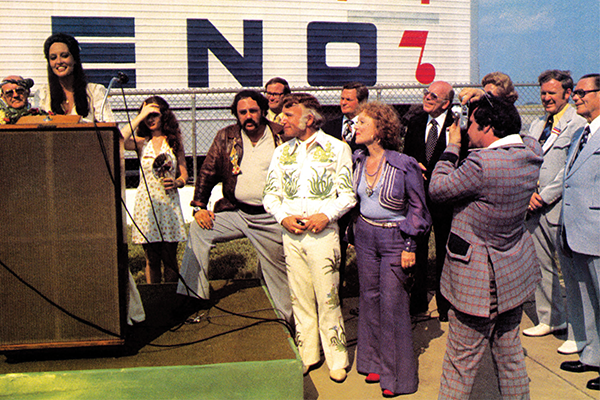
“WE MUST BE doin’ somethin’ right to last 200 years,” proclaims the opening song of Robert Altman’s 1975 magnum opus Nashville. Over a dizzying five days, a cast of dozens of characters, all of whom feel true to life, stagger to put together a concert in support of a populist third-party presidential candidate. But the film’s plot is ultimately beside the point; what matters is the spirit Altman captures.
Fifty years later, as we approach the 250th birthday of the U.S., Altman’s vision of America still resonates: the obsession with fame; politics as just another form of celebrity; the American penchant for self-reinvention; the need to always conceptualize and contextualize oneself as performing to an audience. Altman’s vision is kaleidoscopic and challenging, and like America itself, Nashville lacks an easy central thesis to explain away its contradictions.
The United States of Nashville echoes today: divided, disillusioned, and reckoning with political scandal that feels like betrayal of the country’s ideals. In Nashville, the U.S. lurches toward its anniversary while haunted by the specter of Watergate. The loss of faith in the American spirit wrought by those crimes suffuses the film.
But politics (just another performance), offers no easy answers. Left or right, neither side in Nashville holds particularly strong convictions. A left-coded folk singer offers lyrics that are one big shrug: “Economy’s depressed, not me … / And you may say that I ain’t free / But it don’t worry me.”
Besides politics, faith, too, is just one more commercial performance peddled to the masses. The song opening the film is immediately contrasted with the recording of a gospel track—a Black choir, led by a white singer. A Catholic Mass is followed by a Baptist ceremony, and then a smaller, lonelier secular performance. Don’t like one view of religion on display? We’ve got another on tap—take your pick.
But while Nashville’s reputation rests on its sharp satire, Altman has real affection for the ordinary Americans who populate the film. With dozens of performances, it works as an arresting concert film. And its characters, while they can be small, naive, and foolhardy, are never completely bowed down and beaten.
Take the film’s climax: Following a tragic shooting, the varied musical genres showcased throughout the film meld together in a performance that features at least two bands, a gospel choir, and a lead singer who seizes a chance for what might just be her big break. It’s left open to the viewer’s interpretation whether this is a triumph, or just America as empty spectacle. Viewed from the perspective of 2026, Nashville may not offer a clear answer, but in its familiar portrait of our flawed nation, there is some comfort. When in Nashville, do as they do: Keep singing.

Sergio Lopez is an author, historian, and vice mayor of his hometown of Campbell, Calif.

Did this article have an impact on you? Tell us how! Whether you’re moved to take action, have a question, or want to share a comment (good or bad), we value your feedback!