THOUGH OTHER COUNTRIES have banned books, enforced strict censorship, and created structural barriers to education, the U.S. has a unique history of anti-literacy laws targeting Black people. During the years leading up to the Civil War, several states enacted harsh laws making it illegal for African American people, whether enslaved or free, to learn to read, to write, or to own books. These reactionary laws were rooted in a fear that literacy—especially the ability to read the Bible—would lead to violent revolt.
Layle Lane was a 20th-century educator, activist, and community organizer and a close friend of my paternal grandmother. Lane’s father, Rev. Calvin Lane, a Congregationalist minister who died in 1939, wrote about his family’s struggles and triumphs in their pursuit of literacy; his account is stored in the Howard University Layle Lane collection.
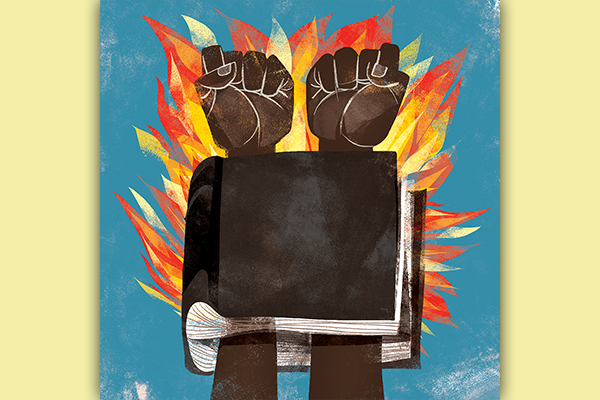
Calvin Lane’s parents were free people of color who procured a few books in 1857 and kept them locked safely in their home in Elizabeth City, N.C. One night in 1860, “seven white men, all well-known,” entered their home. The armed intruders searched the house and threw most of the family’s papers, hymnal, and speller into the fire, but the family Bible “was carried off, for they were too deeply religious to burn it.”
The Civil War erupted the following year. After it ended, Northern missionary teachers established schools for Black children across the South. The Black men and women of Elizabeth City formed a guard to watch over the teachers’ houses at night to protect them from harm.
The family Bible “was carried off, for they were too deeply religious to burn it.”
Despite their first books being burned and stolen, Calvin Lane and his brothers earned college degrees. After his older brother Wiley Lane completed an advanced degree in Greek, one of the thieves, an “almost illiterate” man, invited their father to come get the Bible he had stolen from the family so many years prior. By that time, the Lanes had more books than they could use. Rather than make the three-mile trip to the man’s home, the proud “parents were glad to let him keep that [Bible] as his waybill to Heaven.” Not long after, the thief, “prowling in a most untoward place,” died in a ditch on a winter night, his body found days later, blanketed in snow. The Lord only knows where his soul or that old stolen Bible ended up. And what became of the other intruders? “Out of such marauders as searched our home and burnt our books, grew the Ku Klux Klan,” Calvin Lane wrote.
“Deeply religious” people stole a Bible from children learning to read. I think of the “deeply religious” men and women of the past and the present, so intoxicated by the lies of white supremacy, who are dying in ignorance. The “deeply religious” people breaking into the homes of immigrant families, upholding cruel laws, and disrespecting human rights and human dignity. Perhaps our greatest resistance will be to keep learning the sobering truth of American history, teaching it accurately and honestly, and encouraging literacy as one path toward liberation for all.
Josina Guess is a Sojourners associate editor and a contributor to Bigger Than Bravery: Black Resilience and Reclamation in a Time of Pandemic.
Did this article have an impact on you? Tell us how! Whether you’re moved to take action, have a question, or want to share a comment (good or bad), we value your feedback!