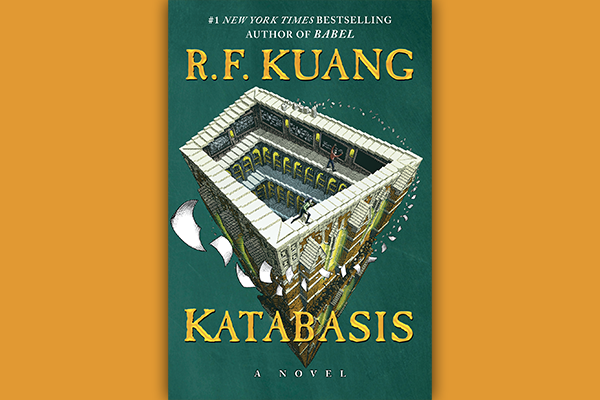
IN HER NEWEST novel, Katabasis, R. F. Kuang straps the mythic baggage of Dante and Orpheus onto two graduate students, Alice Law and Peter Murdoch. After accidentally killing their tyrannical professor, Grimes, the two sneak into hell to resurrect him. What they find there is barely distinguishable from their graduate studies. Kuang’s underworld is no cartoon inferno; it is a chilling landscape of extreme isolation, where the circles of punishment are the final expressions of the sins that isolate us in life.
The world of Katabasis (meaning “journey to the underworld”) is nearly identical to our own, save that magic is real. It has been institutionalized and is studied at the world’s premier universities. Grimes rules the Magick school at Cambridge with an iron fist, his abusive behavior excused as a function of his genius (and the price graduate students must pay for success). Alice and Peter are Grimes’ current star students, but this makes them more subject to his tyranny, not less. Alice “was of course underpaid and overworked, but this condition was common among graduate students and no one cared much about it,” Kuang writes. Neither Alice nor Peter (“the nicest guy in the world … who always holds you firm at arm’s length”) can see their suffering for what it is: a deluded isolation so complete that even hell seems preferable.
Kuang’s underworld strips away these delusions precisely because it is so familiar to its residents. “Hell is a mirror,” she writes, arguing that all the ancient religions and philosophies have this in common. “At the end of the day, human beings preferred the predictable order of their known bureaucracies. One’s sins took on meaning in the context of their moral universe, comprised of their loved ones, their idols, their rivals, their victims. ... One was hurt most by what one knew.”
That’s probably why, for Alice and Peter, hell looks so much like Cambridge. As they descend through the various circles of sins, the two students realize they have been dishonest with each other and themselves about the dark secrets of their path to Cambridge. They encounter Elspeth, another former student, who tells them the core tragedy of their class: “Magicians are terrible at getting through Hell. They never think they did anything wrong.”
A life in authentic community is the surest way to dispel the self-delusions that keep us feeling righteous and holy. To choose deep, authentic community is to choose the flames of intimacy, the searing self-knowledge that only comes by seeing oneself through the eyes of another. This choice is frightening precisely because by choosing others, we surrender control. But it’s only in this choice, this risk, we find real connection. So too, as Alice and Peter descend deeper into hell, they learn to see each other: “All this time they’d both been drowning, and thinking the other was gloating at them from the shore.”
Katabasis’ enthralling, satirical narration demonstrates that isolation isn’t the shameful byproduct of personal failure; it’s the intended outcome of oppressive systems like capitalism, patriarchy, and meritocracy. Kuang’s purgatorial descent insists that community is the only salvation from these forces. Our only hope of becoming holy is together.

JR. Forasteros pastors the Haven Collective in Dallas, co-hosts the Fascinating Podcast, and wrote Empathy for the Devil: Finding Ourselves in the Villains of the Bible.
Did this article have an impact on you? Tell us how! Whether you’re moved to take action, have a question, or want to share a comment (good or bad), we value your feedback!