[Match] Stand for Truth. Work for Justice. Donate

Bad Bunny's Holy Halftime

Why it’s fitting that Bad Bunny’s Super Bowl show takes place during the Christian season of Epiphany.

Bad Bunny performs on July 11, 2025, in San Juan, Puerto Rico. / Kevin Mazur / Getty

PUERTO RICAN MUSIC star Bad Bunny had quite the run this past year. In September, he was announced as the headliner of the Super Bowl LX halftime show. In October, Billboard recognized him as the top Latin artist of the 21st century. All of this was on the heels of his 31-concert residency on the island of Puerto Rico. The residency infused close to $400 million into the Puerto Rican economy, centering, and, for many, revealing the music and culture of Puerto Rico.

The act of revealing the beauty of humanity and culture is very much tied to the Christian season of Epiphany. Many Christians consider this season to mark the revelation of God enfleshed, encultured, and embedded in time and place. God chose to participate in human life in a little-known territory occupied by the Roman Empire. In choosing the obscure village of Nazareth, the Divine presence signified that Love, in the world, begins at the margins.

Many people do not know that Puerto Rico has existed at the margins of the United States since it became a U.S. territory in 1898. Bad Bunny’s performances have been considered a gift to Puerto Rico, bringing visibility and individualization to the island. It is beautiful when marginalized communities see their stories, languages, bodies, and brilliance reflected in cultural spaces—like a Super Bowl halftime show. This signals an unveiling: the Divine moves through reggaeton beats, through barrio histories, and through those whom the empire has overlooked. Visibility is the ultimate gift extended to forgotten peoples. And when we shine a light somewhere, the entire world can celebrate.

When I reflect on the beauty of visibility in my own sphere, I remember being with my good friend John and his three children at a WNBA game. We were in Madison Square Garden, and one of the arena cameras panned to our children, showing them on the jumbo screen. The glee they experienced from seeing themselves was probably more of a gift to us parents. If we could see their “thinking bubble” at that moment, perhaps it would read, “We are here, and we matter.”

Visibility is the ultimate gift extended to forgotten peoples.

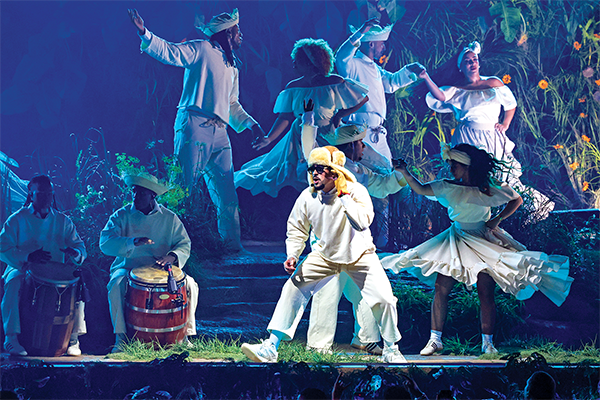
Not surprisingly, in the case of Bad Bunny, centering the island of Puerto Rico has come with backlash, as he has chosen to do his halftime show in Spanish. Yet ultimately, this choice demonstrates hospitality, which he thoughtfully demonstrated in his PR concert tour by having a full replica of a traditional Puerto Rican house on stage. He wanted his people to feel at home in their own land during a time of gentrification.

One of Bad Bunny’s songs, “Lo Que Le Pasó a Hawaii” (“What Happened to Hawaii”), is a cautionary tale about how culture can be stripped and erased by larger forces. In one verse he laments, “Quieren quitarme el río y también la playa / Quieren al barrio mío y que abuelita se vaya.” (“They want to take my river and my beach too, they want my neighborhood and my grandma to leave.”) Bad Bunny resists this displacement, demonstrating how art can be prophetic and political. Art can brilliantly confront bullies and expose deep, historical, colonial tendencies.

For one day, an epiphanic moment will be witnessed—the holy will be made visible. Some will rejoice and others will reject it—a tension Christ was all too familiar with.

This appears in the January/February 2026 issue of Sojourners