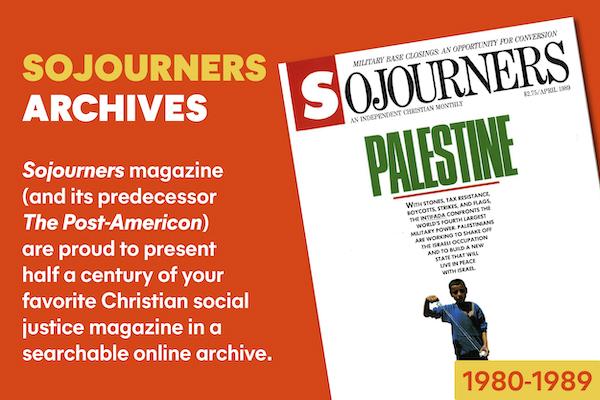
Palestinian pacifist Mubarak Awad gained international attention when he was deported from Israel to the United States in June 1988. Awad was deported for advocating nonviolent civil disobedience against the Israeli occupation during the Palestinian uprising, or Intifada, in the West Bank and Gaza. Since the uprising began in December 1987, Awad's ideas about nonviolence and civil disobedience have become increasingly popular and have been used in Palestinian protests for self-determination.
Awad was born in Jerusalem in 1943. His mother is a Christian who always stressed that to love Christ meant loving your enemies. He attended a Mennonite high school in Beit Jala on the West Bank before coming to the United States in 1969 to study at Bluffton College, also a Mennonite school, in Ohio. Awad became a United States citizen in 1978. In 1983 he returned to Jerusalem and worked with the Center for Counseling until 1984, when he returned to the United States.
During his years here, Awad studied the writings of Mohandas Gandhi, Martin Luther King Jr., and Gene Sharp, a scholar at Harvard University's Einstein Institute. Initially, Awad says, he had trouble believing in nonviolence. But he was won over by the Quaker concept that there is a part of God in everyone and that to kill someone was to kill a part of God.
Awad is married to Nancy Nye, an American Quaker, who is the principal of the Friends Girls School in Ramallah on the West Bank. Nye was in the United States with her husband after he was deported, but returned to Ramallah to resume her duties there in July. The couple has two children.
In 1985, Awad returned to Jerusalem and founded the Palestinian Center for the Study of Nonviolence. The most popular act of civil disobedience that Awad, and the center, undertook in the struggle against the Israeli occupation was to plant thousands of olive trees on Palestinian land. Olive trees are now the symbol of nonviolent resistance. Other nonviolent actions organized by Awad include boycotting Israeli products, tax resistance, refusing to fill out official documents in Hebrew, and lying down in front of bulldozers clearing Palestinian land for new Israeli settlements.
Awad believes that nonviolence has been a sustaining force for the uprising and that nonviolence is the only way to achieve real peace. Nearly 300 Palestinians have been killed in the violence of the uprising, with thousands more beaten, maimed, jailed, and deported. Despite the violence, Awad says that the majority of Palestinians are committed to nonviolence and seek peaceful coexistence with Israel.
Awad has not given up on returning to Jerusalem. Since his deportation, he has traveled extensively in the United States and abroad. He says that his primary task is to educate the public about the uprising, nonviolence, and the prospects for mutual peace and security for Israel and Palestinians.
Awad reflected on these and other issues when he was interviewed by Jim Wallis in Washington, D.C., in September 1988.
--The Editors
Jim Wallis: Like others, we at Sojourners have been following the events in the Middle East. The situation for Palestinians has been the same for a long time. Then there was this tremendous eruption. Why has this eruption taken place now? What was the cause?
Mubarak Awad: I think that Palestinians, especially the young people, felt that they were desperate; desperate not only on a daily basis because of what the Israelis have been doing, but they felt that they had no future. They felt that, for them as Palestinians, there was no justice at all.
Then it started sparking everywhere: We are feeling tired, we are feeling fed up, and we are losing hope. Losing hope is reaching bottom. The feeling is that we have to take action ourselves; not the PLO, not anybody, could help us from outside. If there is to be any salvation, we have to do it ourselves, and doing it ourselves means we have to learn how to sacrifice.
Then the Intifada, or the uprising, started, and no one knew that it would continue or what would be its resolution. Even now there is still no grasp of the Intifada in the European, American, or world communities. They see it as a revolt that will go away. I don't think so.
The Intifada is creating social change that we have never had before. Palestinians have been empowered not just to believe that their cause is just, but that the other side has a cause also. They started thinking that if we want to be free, we have to free the Israelis. And that is a change in our way of thinking.
Many Palestinians now see that if there is to be a solution, we need to accept Israel. As Palestinians, we have to accept Israel's need for security. We have to tell the Israelis that we are willing to make a free life for them, just as we want to free ourselves. This change in our thinking came because of the Intifada.
How did that change come about as a result of the uprising?
The change came through people feeling that they needed to be united. The more beatings, the more people were united; the more oppression, the more they were united. We were afraid of the Israelis before, but now we are finding ways to confront them.
I am against throwing stones, but still the youths are confronting the Israelis. So there is the unity of confrontation, but also the unity between the refugee and the person from the village and the person from the city.
The Intifada has also united us politically. As much division as the Palestinians have had, the Intifada helps make them less important.
We also became generous. I say generous because many times we feel as refugees that we should always ask for money or help; this is how we have lived for 40 years. But with the Intifada, we started giving.
We started going to refugee camps and saying, "We heard that you are hurt; we want to give you some money." They would say, "No, please don't give us money; give it to another refugee camp." We would go to that other refugee camp and they would say, "No, send it to Gaza." This never happened before in the Palestinian society. On top of that, collaborators who are working with Israelis are now told to go to the churches, to the mosques, and ask forgiveness.
This is something new. That is why I feel that social change is possible—it is a victory within ourselves.
Are you saying that instead of the old attitude of fear, perhaps along with some hatred, of the Israelis, this confrontation has actually allowed a different attitude toward the Israelis?
Yes. Before the Intifada not a single Palestinian would have dared to say, "I accept Israel. I will accept the two-state solution." Now, not only the Palestinians on the West Bank, but the PLO is saying it will accept the two-state solution.
There is something very fascinating about that in terms of nonviolence and confronting oppression. When you free yourself of fear of the oppressor, you are more able to see his or her humanity than you were before.
Exactly.
And you find a way through the confrontation to create a solution that both sides can live with.
Yes, not only live with but understand that your enemy with the gun is a human being, and that he is afraid of you, too. That is one thing that I did not believe in the beginning—that Israelis are afraid. I never believed it.
But when I was talking openly with a lot of Israelis during the Intifada, I found that they really are afraid. We need to help them get rid of this fear, because it is much better for us to talk with people who are not afraid. Then at least we could have more of a sharing of the power. Because when you are afraid, you want to hold all the power; when you are not afraid, you are able to share power.
Many people would never have expected a movement of nonviolence to arise out of the Middle East. It is a hopeful but unexpected sign. How has this nonviolent movement come about?
I think it came about gradually. When we started even writing about nonviolence, many Palestinians felt it was not in our blood or our culture.
I believe people have an emotional need to struggle. And when we struggle in a nonviolent way, we find that anyone can do it. It doesn't matter who you are—your color, your religion, your race. When you see that other people are doing the same thing, this brings power.
It is a unity that is experienced when a lot of people are doing the same thing for the same cause and are willing to sacrifice anything. And because everyone is making the same sacrifice, we are willing to sacrifice more and more.
There have been several actions where people felt they were able to confront the Israelis, like planting olive trees. For example, the Israelis would put a fence around a piece of land, and we would go and take it down. In the beginning we would ask for a demonstration permit, and five people would come. Then we would ask for another permit, and 15 people would come; then 20, 50, and 100. Then people start saying, "Hey, this feels good. I want to protest."
They find out that they don't only listen and talk, but that there is action in it. When many people start doing those small actions, they feel they are able to achieve a small victory—not against the whole concept of Israel, but a victory within themselves. "I did something today, and I feel good about it." Then it starts to become an acceptable thing.
You appear to be convinced now that nonviolence opens up new possibilities where the unending cycle of violence does not. What does that mean for the Middle East?
It means that it is not a shame or a betrayal to meet with Israelis. Before, if anyone talked to the Israelis, they were a traitor. Now, Palestinians are willing to sit down and talk to the Israelis and see where they are coming from. Then we also have the chance to tell them about our situation and our feelings. This is happening more and more.
We are working with both Israeli peace groups and non-Israeli peace groups and finding out that not all Israelis are the same and not all Israelis want to destroy us. And the Israelis are finding out that not all Palestinians want to destroy them. We are able to look at each other as human beings, and that is a power by itself.
So the first thing that changes in a nonviolent movement are the people themselves.
Exactly. And I experienced that change when I was in prison. I was fasting, and my lawyer came to me and said, "Look, there's an Israeli who is fasting for you outside. If you don't stop fasting, he will die. You are fat. You can handle yourself, but he cannot." I stopped my fast because of an Israeli fellow who was fasting in support of me. Imagine how you would feel if your enemy was fasting for you.
What is this change that is occurring among the young people who are standing up and speaking out? What are they saying to the Israelis? What does this change mean?
I think that the message to the Israelis is that we are human beings. We need our national rights. We need to raise the Palestinian flag. We need to have our own anthem. We need to rule ourselves. But we will not do that by destroying the Israelis. I hope that this message will reach the Israelis.
But there are dangers here. If the uprising was stopped by force or for whatever reason, people will say that civil disobedience does not work. Another danger is that Palestinians might start getting a very big head and say that this is our problem, that it has nothing to do with the war at large. We may start concentrating just on us rather than being involved with what is going on around us.
How did you find your way into nonviolence?
I was interested in the Quakers and the Mennonites. When there is trouble, they will come from the United States and Europe to work here with the poorest of the poor.
I used to say, "What's wrong with them? Why would they leave all the luxuries and come and work with us?" Then I realized that they saw Christ as being with the poorest of the poor, with those people who are deprived and who are refugees.
Then, after struggling with it for a long time, I came to strongly believe the Quaker concept that there is a part of God in every person. We don't have the right to kill another person because we don't have the right to kill God or part of God.
Then I knew that all killing is wrong. It doesn't matter who does the killing—the government, the police, the army, a soldier, or a civilian. It is wrong because it is killing a part of God. I have incorporated this into the Christian tradition of civil disobedience and nonviolence. And I've been influenced by Gene Sharp's concepts of nonviolent direct action.
What is your strategy now?
I think that we are going to continue to push for our own government which would mean having our own education system, our own money, our own judicial system, our own hospitals--all separate from Israel's.
Many people are accepting this idea and are willing to take the risk for this alternative. I hope Israel will see that and accept a two-state solution.
So you'd prefer not to have a government in exile but to form a government right there among the people?
Exactly. I feel if we were to have a government in exile, it would take six or seven months to put it together. It would take away from what is going on in the West Bank and Gaza. I also see that the people in the West Bank and Gaza already have their own government, their own committees.
So, in the tradition of nonviolent direct action, you are not waiting for a national conference, or for someone to say it is all right to set up your own government. You feel you need to be independent. What do you expect the response to be? And what would a Palestinian state look like?
I think it would be very difficult for the Israelis as well as for the Palestinians. For example, if we decided to have a minister of health, we might need to put in 20 ministers of health, knowing that 19 of them would probably go to jail. Still, it could be done. There would also be many others in jail. So we would have a Palestinian state that has thousands of ministers, and every one would be in jail!
But setting up the government will send a message. Each individual would start using Palestinian currency. When a child is born, he or she will have a Palestinian birth certificate. If we need to show identification, we would show a Palestinian ID card, rather than an Israeli identification card. Instead of having an educational system that is either Jordanian or Israeli, we would have a Palestinian education system. I think this by itself would help create an alternative state for the Palestinians in the occupied territories.
One of the considerations is that we have to have compensation either for our land or for the 40 years of being refugees. And refugee camps have to be eliminated. The elimination of refugee camps would mean that there is no Palestinian refugee problem anymore. We would then build in those areas and make them victory cities.
Jerusalem would have to be the capital for both Israel and Palestine. And the settlements could stay there if they chose to be under the Palestinian state. The Arabs could stay there under an Israeli state and an Israeli flag.
Gaza could be built as a financial center for a Palestinian state. We cannot live economically on our own. We need to continue the support or connection with Israel and Jordan.
I am one of those who has been saying that when we have a Palestinian state, we won't need an army. If you look at most of the Arab armies, they weren't created to destroy Israel or to kill or fight Israelis. The armies are there to protect the leaders of those countries. I think we don't need an army.
We also need an assurance that, as a state, we could secure Israel's rights. Any military action against an Israeli would be criminal. But they have to be able to secure our rights, too.
Are these kinds of strategies and solutions compatible with the present political leadership of the PLO in the West Bank? What is its strategy, and how does that relate to the strategy you have been talking about?
I think the PLO has gone through several phases. At this point, I think it is in the phase of the Intifada, of the two-state solution, of saying to Israel that we are willing to live in peace, of accepting Israel's security.
I think that both Palestinians and Israelis see that they cannot go back to the status quo. The Arab population is increasing, so Israel would not be able to annex Arabs.
There would never be a Jewish state if they annexed Arabs. The government of Israel is talking about transferring them to other Arab countries, but I don't think that the world would allow that, because this is what happened in Germany when they put the Jews in trains. So there will be no transfer of Arabs.
I think the PLO is starting to accept what the people in the West Bank and Gaza are saying--that we need a two-state solution.
Does this nonviolent movement that has emerged have an organization or a central leadership? How is it being organized?
It is organized as needs arise. If people from a village come to the Center for the Study of Nonviolence and ask for help, we will help them. We would not ask them if they are people that believe in our struggle or not. The same for a community or a refugee camp. We will go and show them how to organize committees. We tell them that this is how it is done in other places, and we will help you.
Can you say more about the center?
Mostly, at first, we did a lot of lectures about nonviolence and civil disobedience. This started in January 1985.
In the beginning, our attendance was small, about 10 or 15 people. Later on, it started to increase, and more and more young people started to come. Then we started going out in refugee camps and cities and other places, and we began to publish information on nonviolence and how it can be used. We printed a list of approximately 120 nonviolent things that people could do. Then we started writing about Islam and nonviolence.
But what made our center more popular was when the Israelis started to feel the impact of this civil disobedience and nonviolence; then they started pushing. And when the Israelis started opposing my ideas and the actions of the center, the Palestinians started saying, "If the Israelis say this is something bad, for the Palestinians it is good."
Obviously, nonviolence is more than an idea or a theory. It is also actions. It is something that changes people and history. Would you tell some of the stories of things you have seen that make you believe in nonviolence?
Palestinians who were very militant, and who had said we want all of Palestine, are now saying they are willing to accept a two-state solution. This is reality. Palestinians who felt that Israelis are arrogant, that they lie and are terrible people, are now saying they are human beings. Part of it is the idea of forgiveness. Palestinians must forgive each other and forgive the Israelis.
There are Palestinians who are looking at themselves and saying we need to be honest with ourselves. Our leadership, our old leaders, didn't do us good so we have to depend on ourselves.
For the first time, a Palestinian woman will tell her son to go to the streets rather than trying to protect him. This is courage. Then she will go after him to the street. Then the man who owns the shop, he cannot do nothing, so he has to close the shop.
When you see the sacrifices of people who are willing to die for freedom, you feel the same thing. You feel proud. This is the first time in our history that Palestinians feel proud. We feel that we are free. It is an experience of empowerment that it is growing and growing. I am seeing that there is much hope.
How does the Palestinian struggle relate to what is happening in the rest of the world?
I think that the attempt of Palestinians using civil disobedience is part of a larger movement. In South America, in South Africa, and in other places around the world, we are hearing about people who are tired of war and killing and want to use civil disobedience and nonviolence in working for peace. I think there is a link between those movements and the struggle of Palestinians.
In the end, it is a question of life or death. I think all human beings want to live. They want to enjoy life. It doesn't matter what their religion or politics are; they want to live and allow others to live.
When I speak of civil disobedience and nonviolence, I'm saying that I want to live, but I want you all to live with me. I think that is a powerful message.
Jim Wallis is editor-in-chief of Sojourners.
Got something to say about what you're reading? We value your feedback!