Catherine Meeks Says Christians Need Solidarity, Not Racial Reconciliation

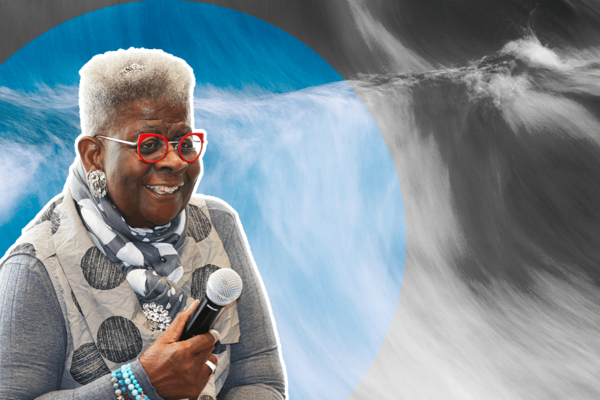
Catherine Meeks. Photo courtesy the author. Graphic by Mitchell Atencio/Sojourners

I was born into a church in Chicago that was founded by fathers of the “racial reconciliation” movement in American Evangelicalism.

Led by those such as the late John Perkins, racial reconciliation aimed to encourage primarily Black and white interracial relationships meant to reconcile people to each other and to God, in a post-Civil Rights Movement (but still deeply segregated) U.S. I was taught to understand reconciliation as a ministry, as Paul advises in 2 Corinthians 5, where Jesus bestows the “ministry of reconciliation” onto the church.

As I grew up, I found the concept linguistically and historically fraught—misguided at best and destructive at worst. Reconciliation among contemporary racial groups implies a historical moment of racial harmony; the U.S. has none. Whatever Perkins and others envisioned for the movement, white evangelicals and others began to bypass the need for actual systemic change in favor of emphasizing spiritual harmony and claiming that the only way to true racial unity is through Christianity. 

Catherine Meeks, a scholar who previously served as founding executive director of the Absalom Jones Episcopal Center for Racial Healing, diverges from her contemporaries and has a vision for a new way: racial healing among Black people, Indigenous people, and other people of color to create a unified front against white supremacy. Her recent book Bridging the Rivers of Difference: A Proclamation of Unity in Resistance, she says, is “much more pointed” than her previous work. Meeks draws on her decades of social science research, award-winning community organizing, leadership in the racial justice sphere, and 80 years of life experience to carry her readers through American history and point them to a more just future.

I interviewed Meeks to hear more about this vision and to my surprise, I found she does not believe that organized religion, specifically Christianity, will be the system doing the heavy lifting to achieve this racially healed and unified future.

“The notion that God is mostly the errand runner for the empire ... has captured organized religion across the board in America,” Meeks writes in Bridging the Rivers of Difference. “Until it wakes up and decides who is really going to be its master, the problem will continue.”

She still believes the teachings of Jesus Christ can “help mitigate against the greed, violence, and dehumanization involved in maintaining white supremacy.” But, as we discuss in our interview, “Christianity as it is practiced has proven completely impotent in bringing about the needed change.”

This interview has been edited for length and clarity.

Evana Upshaw, Sojourners: What are the origins of this book? Who did you write it for?

Catherine Meeks: The audience is anybody looking at what we’ve been doing around racial healing in this country and realizing how far away we are from actually achieving the goal, and saying to themselves, “Well, we need something different. We need another way to see.’” Other people will find it helpful because it may get them to think, “Wow, we haven’t done what we needed to do, because here’s another whole way to look at this.”

Any thoughtful person that’s interested in justice will find it to be, I hope challenging and thought-provoking and encouraging. I don’t want to just write things that cause people to feel like they need to go crawl in a hole and never come out, you know?

After 50 years of doing the work myself, of workshops and writing and teaching and then looking at where we are in 2026 in terms of race and racism and race relations, it’s clear to me that we need to switch gears. We need to get on a new path. We’ve made progress. I mean, nobody can argue that we haven’t made progress. But making progress and actually creating a world where everybody, no matter what color their skin happens to be, is free to live their lives without feeling like they’ve got to be endangered because they’re not white—we haven’t done much about that. I mean, look at how Latinx people are being treated. Look at how Black people are being treated, and anybody else that’s not white.

This book focused on the relationships between African Americans, Latinx folks, Asian Americans (especially East and Southeast Asians) and Indigenous people—these four groups and their relationship to white supremacy and white people. How did you narrow it down to these four groups?

There are 575 different, federally recognized Indigenous tribes in that one category. There are about 20-30 different groups of Asian Americans. Latinx people are diverse. And African Americans, we don’t even know what all the pieces are because we came from so many different parts of the continent, mostly West Africa and some from East Africa.So, it really was going to be hard to not go with some of these clumps of people that we already have.

We started with the Native people, because the explorers got here and said, “We discovered this place,” automatically erasing them. Then they set about to really erase them by killing them. Then they brought Africans here as enslaved persons, then Chinese people and Mexican people came as workers, but they treated them like slaves. If you look at the history of America, these are the major people that have been at the forefront of the oppression hammer. I know there are other groups of people here, but not to the extent that these four groups have been marginalized and continue to be.

I chose those groups knowing full well that in choosing those groups, it’s just another whole big piece of challenge to do anything about it because [with] 575 different Indigenous nations, how do you even start to get people to start being unified? By now, everybody’s figured out a way to try to survive amid a white supremacist-dominated society. And these groups have become enemies of each other in some ways, in terms of not being able, in any major sense, to really come together and stand in solidarity with each other.

We have a lot of competition between us. Competing for the scarce resources—as I talk about in the book, “Oppression Olympics”—competing to see who’s the most oppressed and thus, who deserves the most relief. That’s not helpful. Ultimately, we’ve all been oppressed, and if we can all work together, we can change that. But if we keep on competing with each other, then the system that’s got us all under its thumb doesn’t really have to worry because we’re keeping each other down ourselves.

When you start thinking about all of that diversity that’s gotten covered up by a system that wasn’t willing to take the time to find out or honor where anybody came from—the white supremacist system was saying, “You don’t look like us, so we’ll call you this, we’ll call you that”—it just makes your head swim.

But you’ve got to get out of the head swimming and get focused or else you’ll spend forever with white supremacy ruling.

That’s a long story about how I came here to this place with Bridging the Rivers of Difference. Those rivers are so wide and yet they’re so narrow. I want to focus on the narrowness. I want to focus on what we have in common. What are the threads that link us together? What are our ancestral stories? Maybe, when you get right down to it, some of the ancestral stories are actually the same. They just got different characters in them. We share a lot of different cultural themes that have gotten completely lost in being pitted against each other. If I sit down and you tell me stories that your grandmother or great-great-grandmother told you and I tell you my great-great-grandmother’s stories, we might find out that they both understood the universe in some similar ways.

You name “othering” as a root of white supremacy and as sort of “the big bad.” How would you describe “othering”?

I start out the book talking about Cain and Abel. When Cain didn’t feel like God liked his sacrifice as well as God liked Abel’s, instead of him taking responsibility and saying, “How can I fix this?” he blamed his brother for having a better offering. Somebody else becomes responsible for you. That’s part of what “othering” is about.

The other part of it is you decide that this group of people out here or this person out here is somehow just not as good as you and they need to bear whatever stuff you don’t like in yourself. You can give it to them because they’re not as good in the first place. Once you make that decision, once you project, once you assign all those traits to that person or entity, then whatever you do to them is okay.

So, we decided as a nation on the white supremacist notion that people of color are somehow less than white people—all of that ties into creating a space to other people to assign stuff you don’t want to deal with to somebody else and make it somebody else’s fault.

The best [example] at the moment is the way in which President Donald Trump has assigned everything wrong in the country to brown and Black immigrants. “Everything that’s wrong is their fault.” Instead of sitting with ourselves as a people and saying, “Let’s see, what is the matter here?”

We decide the matter is “those Mexicans are taking all of our jobs away from us because they’ve come here and they’ll do the jobs that Black folks used to get.” I mean, this is a real conversation. “They’re getting more money than they would get if they were in their own land, so they’re okay with this. Therefore, they are our problem.” But that is not true. They are not the problem that we need to try to solve. We need to try to solve why somebody would bring folks and pay them low wages and exploit them. That’s the bigger problem. That’s the real problem. We’re not talking about the real problem because we just made them into the scapegoat for us. So, “othering” is scapegoating.

At the beginning you write about the Doctrine of Discovery, and you implicated Christianity in the creation of white supremacy. I assumed you would also consider religion a very significant part of the solution to help bridge divides. I was a little surprised, though I agree, to find that you made a clear statement that organized religion isn’t really going to take us to that unified place. Why not?

“I don’t think organized religion is capable of vacating its own allegiance to itself and becoming selfless enough to reorganize to the extent that it could create the kind of world that I’m imagining, because it’s been so complicit with creating this world that we’ve got.”—Catherine Meeks

I don’t think organized religion is capable of vacating its own allegiance to itself and becoming selfless enough to reorganize to the extent that it could create the kind of world that I’m imagining, because it’s been so complicit with creating this world that we’ve got. It just runs through everything. It’s woven into the capitalist, patriarchal, dominating structure, and it would have to unweave itself and be willing to stand alone. I don’t see leaders in organized religion with that kind of courage. Because they don’t want to be too far out of the arena of respectability and continual support.

I’m an Episcopalian; the Episcopal world is so grounded in the culture. We want to sound radical, and we’ll do a few things that may be a little bit more radical than somebody else, but we’re not ready to stand up and take on the establishment … Our leaders in the Episcopal Church need to be standing in way greater opposition to Trump. And instead, they’re all just trying to figure out how they can get to the end of his regime without being scathed too much. Well, I think you’ve got to be willing to be scathed. You’ve got to be willing to come out on the other side with some wounds and scars because you really didn’t just try to tweak stuff, you said, “Things got to be new.”

We run around talking about “a new heaven and a new earth, and that’s what Jesus came to create.” Well, what do we think it’s supposed to look like? It’s not going to look like the United States of America. I don’t know exactly what it’s going to look like, but it’s not going to be that.

About racial reconciliation: We need to quit using that terminology. Reconciliation means that two, three people, or two or three million people had relationships with each other that worked and were good, and then something happened, and they got splintered. And you’re trying to reconcile, go back, and fix whatever happened, so that you can be back where you were. Now, there is no time in the history of this country where white folks and people of color have had good, transformative, equal relationships. White people have dominated Native people; they’ve dominated Black people; they’ve dominated every minority group here. So, what are you going back to? Take it out of the vocabulary and let’s talk about racial healing.

Now, of course, people will be different. I’m talking about saying no matter who you are, where you are or come from, you deserve to have a chance to live the best life you can live without somebody standing at the gate saying your skin’s not light enough, your hair’s not good enough, your zip code is the wrong one. We should make sure you have a good school, good opportunities, good health care, good food to eat, good water to drink, and a good environment to live in. That should be the least that every human can expect. For me, that’s about racial healing. That’s about creating a beloved community where people can really have what they need.

But folks always want to be talking about beloved community and racial reconciliation, but they don’t want to talk about what that really means. It sounds so good to talk about it. I am so tired of hearing these words that have no meaning anymore. If you even understood what they meant, you would quit using them because it means that you’re willing to have your life turned in a different direction.

I’m willing to pay more taxes so that little kids can have better playgrounds and can have grocery stores that they can go in, so folks aren’t buying their dinner at the 7-Eleven. I have two sons, and I want to live in a world where my sons don’t have to worry about cops killing them because their skin is Black. I want that world. And what does it mean to get there? It means investing in a different way in creating the communities that we live in.

With how much you’ve seen and experienced, and how much work you’ve done, how do you have hope for change? I think that I can speak for many in my generation—it’s hard to have any kind of hope when things are so dark. How do you maintain?

Well, think about this: the young person like you that got kidnapped on the continent and brought here, who would have become your great, great, great grandmother or grandfather, came here to this place as an enslaved human and worked and died and never got a chance to see anything different but always dreamed that you could be possible—that you could be here and be free and be somebody that they could not be because they were living in this hell hole.

You have to think about what kept the enslaved people going. It was hope. It was the hope that freedom is going to come. It didn’t come for them, but they kept believing it. They kept hoping it. And because they did, it did come. It came for generations after them. We are free people, even though we’re not as free as we deserve to be or we want to be. So, I let myself think about that legacy of hope.

I sit here talking to you, 80-years old, with three honorary degrees and a degree from Emory, a presidential commendation hanging on my wall—I better have hope. Your children, your grandchildren can have a better life because we’re here. We can do something.

If our ancestors could keep on believing and keep on hanging on—they could have just all committed suicide and we wouldn’t even be here, and they didn’t. Some of them did sometimes, but for the masses, not only did they hang on, they left things. They left music; they left poetry; they left dance; they left a cultural narrative and perspective. It wasn’t just hope we got—we got a legacy.

That helps me a lot and it’s the foundation out of which I work. When I had an office at the Absalom Jones Center, on my wall I had a picture of my mother, Fannie Lou Hamer, Mary McLeod Bethune, Ida B. Wells-Barnett, Sojourner Truth, Harriet Tubman. They were all on my wall right behind me. And in the yard at the Absalom Jones Center was a monument paying tribute to all of the people who’d been lynched in Georgia. I get out of my car in the parking lot, and I walk past the names of all these folks who were lynched in Georgia, and I go into my office, and I sit down and I’ve got my legacy of women on the wall looking at me. They’re all there saying, “It’s all right. You can cry, you can be sad, you can be outraged, you can be whatever you want to be. But when you finish, get to work. Whatever your call is, whatever you figure out to do in the world, you do it.” That keeps me going.