parable of the talents

THE CONCEPT OF talent as innate skill comes from an interpretation of one of Jesus’ parables (Matthew 25:14–30). In the parable, a man entrusted his slaves to grow his wealth by investing his money for him. A talent was a unit of currency and roughly represented 20 years of wages for an average worker.
The story goes: The rich man gave one slave five talents, another two talents, and another one talent. When he returned, the first slave had doubled his investment to 10 talents. The master said, “Well done, good and trustworthy slave; you have been trustworthy in a few things; I will put you in charge of many things; enter into the joy of your master.” The second slave also doubled his investment and received the same reward.
The third slave returned the one talent he was given. “Master,” he explained, “I knew that you were a harsh man, reaping where you did not sow and gathering where you did not scatter, so I was afraid, and I went and hid your talent in the ground. Here, you have what is yours.”

The question at the center of both the parable of the talents and Jerry & Marge Go Large is the same: What will you do with all you’ve been given?

IN MARCH , I made my first, and hopefully last, “panic-buy” of the pandemic: three survivalist books that look more like they belong in a nuclear bunker than on my bookshelves amid the theology, poetry, and knitting patterns. My purchases were, however, inspired by my reading Parable of the Sower and Parable of the Talents, classics by the science fiction literary giant Octavia E. Butler (1947-2006).
In these novels, Lauren Olamina—a young, disabled black girl—survives the apocalypse and helps rebuild society with her knowledge of edible wild plants, her sheer will and bravery, and her newfound religion, Earthseed. Lauren’s ability to adapt, to change, is her route through unimaginable suffering and the bedrock of her faith.
Originally published in 1993 and 1998, respectively, Butler’s Parable books were reissued last year, highlighting their current resonance. Sower introduces us to the United States in 2024, a dystopia ravaged by global warming, capitalism, and violence. Slavery, misogyny—the witch-burning kind—homelessness, and addiction are rampant. Lauren’s community is secure as long as the walls that surround it stand; as she rightly senses, walls are wont to crumble. She launches a backup plan that offers a hard hope within relentless loss. Talents continues Lauren’s, and her daughter Asha’s, journeys over the coming decades as the U.S. faces rising terrorist Christian nationalism and the election of an ultraconservative president who wants to “make America great again.”
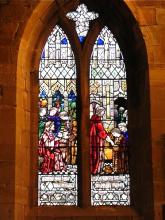
The Sunday, Nov. 13 lectionary gospel is Jesus’ Parable of the Talents (Matthew 25:14-30).
Kari Jo Verhulst, in Sojourners, reflected on Jesus’ challenging teaching: “The point is not to perfect our particular gifts, or ourselves, but to quit hoarding ourselves from others, and instead step out in faith that we have been given all we need.”
The following new hymn affirms that Jesus’ parable calls us to faithfulness even when it involves risk and challenge today.
O God, we yearn for safety; We long to be secure.
Yet faithful, loving service Is what you value more.
You give us what is needed; You love, forgive and save.
Then, sending us to serve you, You call us to be brave.
You give to some ten talents—to others, two or three;
To some you give one blessing To manage faithfully. ...