Midwife
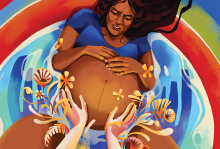
A LOT OF BEGGING happens at Christmas. There are pleas in the toy aisle and hints left open on laptops. But no one begs to be in labor. Not even a woman who is pregnant. Unless, of course, she is at the bitter end of her pregnancy.
In the language of King James, Luke tells us that Mary is not just pregnant, but she is “great with child” (Luke 2:5). She is on the cusp of birthing, of being the first one to slide her hands up under the armpits of the warm, slippery flesh of God. No one before or after will have God in quite this way.
In Mary, the Word became flesh and was born in the most mundane, most primal human act. This flesh must count for something. The extremely pregnant body of Mary — great with child — reveals the nature of our waiting for Christ and what it might mean to cry out for Jesus’ coming.

IN THE EIGHTH season of Call the Midwife, set in post-war east London, nuns and nurse midwives of Nonnatus House assist a woman with severe complications from a “backstreet” abortion. Sister Julienne says to a young nurse, “The word ‘midwife’ means ‘with-woman.’ A woman in that situation needs somebody by her side.”
I’m pro-choice, which was an unpopular stance in the Catholic community I grew up in. For my views on reproductive rights, people in youth group called me a “baby killer” and “Pontius Pilate.” During Advent, specifically, I loathed the hollow teachings on Mary and childbirth. We sanitized the Nativity into a cute story — the equivalent of a Disney movie featuring a white family and a manger crowded with men. Only recently did I learn that some scholars believe that midwives attended Jesus’ birth. As reproductive freedom and care are further undermined in the United States, this is an apt time to reclaim a more feminist view of the Nativity and rethink Advent as the season of the midwife.

Activist Vanessa Nakate on Jesus, erasure, and the climate crisis in the Horn of Africa.
I think it was sometime early in 2007 that I began to find myself almost possessed by a profound premonitory sense that the next year, this year, 2008, would be filled with a special power.
In the first weekend of June I watched some au naturel how-to videos on the oldest profession in the world.
Anyone who's read The Red Tent, by Anita Diamant, knows that I'm talking about the ancient practice of women supporting other women in childbirth. The assisting woman, whom today we would call either a midwife (medical training) or a doula (comfort techniques training), [...]