Cemetery
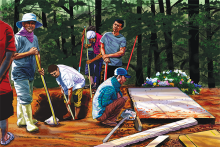
Jesus couldn’t afford his own tomb, and neither can thousands of people in this country. A modern funeral costs around $7,000 while the median savings for Americans in 2025 was $8,000—with many people living and dying with far less. Common U.S. practices around death, such as embalming and concrete vaults, take a huge toll not only on people’s finances but also on the environment, leaching harmful chemicals into the earth and slowing the natural process of decomposition.
Jubilee Partners, an intentional Christian community best known for its work welcoming refugees and asylum seekers, keeps a simple cemetery on its 260-acre wooded property. In addition to reducing environmental impact and financial strain, the Jubilee cemetery offers a glimpse of radical hospitality and love of neighbors, even to the very end.
Cemeteries, like just about everything in the United States, tend to be separated, by design or by default, into categories of ethnicity, religion, and class. But the 40 people buried in the Jubilee cemetery comprise a unique underground community where-in those walls of difference crumble beneath a layer of red clay and dirt shaded by a canopy of sweet gum, cedar, and pine. Of the 26 men and 14 women buried there, six died on Georgia’s death row, seven were homeless, 14 came to the U.S. as refugees, several served as pastors and missionaries, one held a Ph.D., some were illiterate, and many found solace and connection during their lives in the offbeat community that named itself after the biblical celebration of Jubilee.
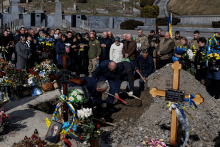
The now twice weekly funerals of soldiers, which take place at the Church of the Holy Apostles Peter and Paul in the center of the city, are one of the few reminders of war.
The first speaker I heard complained to Imam Khalil Abdur-Rashid, the Islamic Association of Collin County representative, about what she understood to be the tenets of his faith.
“It’s not your custom to bury caskets,” she said, referring to the prevalent and erroneous belief that Muslims, who sometimes bury their dead without coffins, may poison the drinking water. The potential pollution of the water was repeated over and over.

An undisclosed community on Wednesday accepted the body of Boston bombing suspect Tamerlan Tsarnaev, which is now “entombed,” according to police in Worcester, Mass.
Tsarnaev’s uncle, Ruslan Tsarni, found a funeral home in Worcester to handle the body, but had struggled to get a cemetery to accept it. The Boston Globe reported that the body is buried in a community outside Massachusetts.
“As a result of our public appeal for help, a courageous and compassionate individual came forward to provide the assistance needed to properly bury the deceased,” read a statement posted on the Worcester Police Department’s website.

Soon after the Boston Marathon bombings, local Christian leaders stepped swiftly into the public eye, convening vigils and urging peaceful healing in the wake of senseless violence.
But their public voices have fallen mostly silent as noisy resistance grows to the prospect that suspected bomber Tamerlan Tsarnaev could be buried in local soil.
Cemeteries and even some mosques have refused to take his body. His city, Cambridge, has urged family members to bury him elsewhere. Republican U.S. Senate candidate Gabriel Gomez and local talk radio host Dan Rae want him dumped in the ocean, like Osama bin Laden. Clergy have largely kept mum.
“The only signs of people who are showing some sort of moral conscience are those few who stand with a card near the funeral home saying [burial] is a corporal work of mercy,” said James Keenan, a moral theologian at Boston College. “To say, ‘we won’t bury him’ makes us barbaric. It takes away mercy, the trademark of Christians. … I’m talking about this because somebody should.”