holy ground
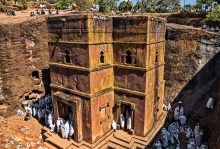
COMPLETELY BY COINCIDENCE, travel writer and translator Shahnaz Habib once joined thousands of pilgrims in Lalibela, Ethiopia. Habib’s trip happened to overlap with Ethiopian Christmas, which brings Ethiopian Orthodox Christians from across the country and world to the town, famous for its medieval rock-hewn churches.
Detailing her experience in her book Airplane Mode, a personal history of travel with a sharp eye for the colonial legacies in tourism, Habib calls Lalibela’s churches “marvels of subterranean engineering.” Carved from red volcanic rock, they sit embedded in the ground, connected by tunnels. The complex of structures was built in the 12th century as an homage to Jerusalem, complete with replicas of Christ’s Nativity crib and tomb.
Habib observed as her fellow travelers lined up around the churches to kiss crosses offered by priests: “A kiss at the top of the cross, a kiss at the bottom, a touch of the cross to the forehead. Hundreds of kisses every hour.” She noted the procedural quality of the ritual.
“To lose oneself in a crowd. To walk the beaten path. To wait and be bored,” she writes. “Perhaps what separates the tourist and the pilgrim is not the reasons for their travel but the satisfaction that the pilgrim finds in what frustrates the tourist.”
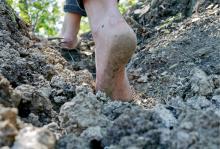
Take off your shoes.
No, I really mean it. Right now. Stop what you’re doing. Put down your phone, turn away from your computer screen. Loosen your laces, step out of your sandals, and free your feet from wherever they are currently confined.
Shoes off? Ok, now keep reading.
Take off your shoes, for you are standing on holy ground.

But one thing has not changed even a little bit is the human condition. Parts of the Bible can feel hard to relate to until you get to a thing like this reading from Romans 7, in which Paul says, "I do not understand my own actions. For I do not do what I want, but I do the very thing I hate. I can will what is right, but I cannot do it. For I do not do the good I want, but the evil I do not want is what I do."
Finally. Something I can relate to. This I know about. I too do not understand my own actions. I too can't manage to consistently do what I know is right. Paul's simple description of the human condition is perhaps a most elegantly put definition of what we now call addiction.
It's no secret that I am a recovering alcoholic. By the grace of God I have been clean and sober for more than 19 years. But, boy, do I remember that feeling of powerlessness that comes from not being able to control your drinking. I'd wake up each morning and have a little talk with myself: "OK Nadia, get it together. Today is going to be different. You just need a little will power." Then, inevitably, later that day I'd say, "Well, just one drink would be OK," or, "I'll only drink wine and not vodka," or, "I'll drink a glass of water between drinks so that I won't get drunk." And sometimes it worked, but mostly it didn't. In the end, my will was just never "strong enough" Like Paul, I did the thing I hated. But that's addiction for you. It's ugly. Yet on some level I feel like we recovering alcoholics and drug addicts have it easy. I mean, our addictions are so obvious. The emotional, spiritual, and physical wreckage caused by alcoholism and drug addiction has a certain conspicuousness to it.