
From the opening scene to its closing postscript, God’s Not Dead tells a story of persecution and courage, focusing on a young white man named Josh Wheaton (Shane Harper). “Mr. Wheaton,” as he is referred to in various parts of the movie, finds himself in a predicament on the first day of his Philosophy 150 course. In a scene that echoes Rome’s historic persecution of Christians, the powerful intellectual Professor Jeffrey Radisson (Kevin Sorbo) stands before his class of impressionable students and tells them they can skip the section of the course that discusses the existence of god, if each of them signs a piece of paper that says “god is dead.” The professor makes it clear that this proposal is more of a threat when he slowly and emphatically informs his students that the section on god’s existence is where “students have traditionally received their lowest grades of the semester.” This is Mr. Wheaton’s unexpected predicament: can he sign a piece of paper that proclaims god, as a philosophical category and concept, is dead? And if he decides not to sign that paper, can he have the courage to face the consequences?

Currently there are more people in slavery than any other time in history. In response to this, there are hundreds of anti-human trafficking organizations throughout the world. People are working tirelessly for justice and restoration for the victims.
There are the men and women who are rescued, some are just children. There are also the rescuers, the judges and lawyers who bring justice, and the psychologists who help to rebuild wholeness. Countless numbers of people support the end and rescue of those enslaved by trafficking – especially sex trafficking. But where are the “Johns” - the men[1] who play the role of Demanders in the Supply and Demand economics of this billion dollar international industry? I’d like to put some money toward restoring them.
Aren’t they an important aspect to this equation? Women and girls would not be victimized sometimes 40 times a day without those who pay for it. The captors would move on to more lucrative business ventures if there weren’t men willing to fork over money again and again for something that the world has decried as both illegal and immoral.
I’m surprised that this plays little to no role in our larger conversations about being serious in ending the sex slave trade. What is it that these men are seeking? Why are they paying for sex? Why are they choosing to have sex with someone who is clearly not there willfully? How much is power at play in this situation? What about the men’s ability to be in stable relationships? Why is there still a demand for enslaved persons?
Buying sex from enslaved people does not happen in a vacuum. There is a progression that includes various aspects. If we are serious about ending the sex slave trade we will need to address some serious issues within every nation in the world, particularly those with male-dominated societies that promote male aggression, provide women with limited or no educational and economic opportunities, and deprive men of solid and symbiotic relationships where they can find genuine intimacy and self-expression for their feelings.
Might I suggest 10 ways we can fight sex-trafficking:

"It's about God, stupid." I can still hear Dean Richard Hays addressing Duke Divinity School at its convocation two years ago, reminding a room full of ambitious, intelligent, and talented theologians to keep their priorities in line. "You will all be writing papers, reading books, studying for exams. Some of you will be worrying about getting published and applying for Ph. D programs. But just stop. Just remember: It's about God, stupid."
Meanwhile, I sat there in awe at this powerful message, but also amused at how he just called three hundred graduated students at Duke "stupid."
Yet Dean Hays was right on target. We needed to hear it.

I don’t know about young girls, but I know from experience that young boys obsess about sex.
They crave it, fantasize about it, do everything in their meager power to obtain it, worry about their adequacy, get confused by their longings, and for the duration of adolescence — and often beyond — see people in terms of “getting laid.”
I suppose this obsession is natural, and that it serves some fundamental purpose, such as perpetuating the species or giving us something to think about besides our gangly bodies, weird thoughts, and being young and insecure.
I don’t know any adult who would willingly repeat adolescence. Yet here we are — we Christians seeking hope, grace, mercy, and purpose, we believers in a God of justice — treating our faith as an endless adolescence centered around sex.
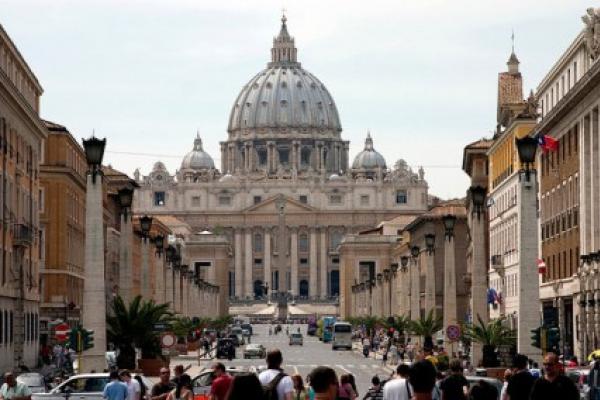
VATICAN CITY — While millions of pilgrims are expected to attend the Catholic Church’s first-ever double canonization at the end of April, the Vatican is preparing its most ambitious TV and social media campaign for the millions who don’t make it to Rome.
For the first time viewers will be able to watch the historic event live in 3-D movie theaters in 20 countries across North and South America and Europe through a deal between Vatican TV and Rupert Murdoch’s Sky TV network, Sony, and other partners. City officials are expecting more than 5 million people to attend the ceremony when Pope Francis declares his predecessors Pope John Paul II and Pope John XXIII saints in St Peter’s Square on April 27.