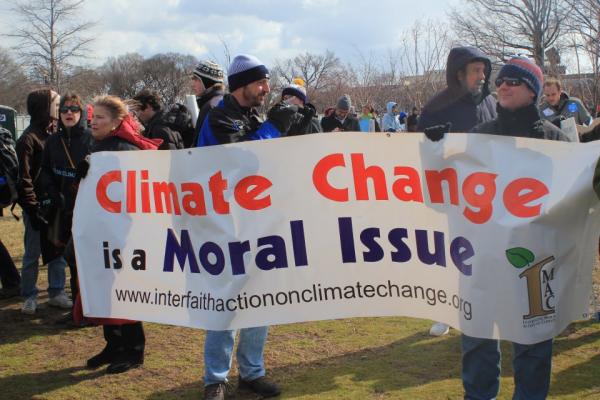
God’s creation is in danger; and to call upon the powers of the world to heal it, God’s people are prepared to go to jail.
Perhaps most famously in our recent history, the startling sight of a religious leader in jail was embodied in the willingness of Dr. Martin Luther King, Jr., to go to jail more than 20 times in order to embody his religious commitment to racial justice, peace, and nonviolence.
As we approach the Holy Week of Christianity and Passover, we should be aware that this tradition goes back thousands of years. The movement of ancient Israelites seeking freedom from a lethal Pharaoh began even before Moses, when two midwives – the Bible carefully records their names, Shifra and Puah – refused to murder the boy-babies of the Israelites as Pharaoh had commanded. The recollection of that moment is the first recorded instance of nonviolent civil disobedience.
When that cruel and arrogant Pharaoh, addicted to his own power, refused freedom to his nation’s slaves, his arrogance forced the Earth itself to arise in what we call the Plagues – ecological disasters like undrinkable water, swarms of frogs and locusts, the climate calamity of unprecedented hailstorms.
Passover has kept alive and lively the memory of that uprising. So it is not surprising that the Gospels record that just before the week of Passover, Jesus led a protest against the behavior of the Roman Empire, its local authorities, and a Temple he and his followers thought had become corrupted from its sacred purpose.
To protest against the Empire of his era, Jesus chose a time that was both appropriate and dangerous, since Passover celebrates the fall of Pharaoh. His challenge resulted in his arrest and imprisonment, and then his torture and execution.
Both Judaism and Christianity can trace their origins to acts of nonviolent civil disobedience. Indeed, for several centuries of Imperial Rome, the very persistence of Rabbinic Judaism and Christianity were collective acts of civil disobedience.
Today, religious folk face modern plagues imposed upon our countries and our planet by a new kind of Pharaoh.

I used to lead and organize inner-city mission trips. Churches, youth groups, non-profit organizations, and well-intentioned philanthropists would excitedly arrive within the diverse and fast-paced world of Chicago and enthusiastically dive into whatever tasks we gave them. The work they volunteered for made a huge difference in people’s lives, but more importantly, it dramatically challenged — and changed — their own way of thinking about urban ministry.
For years “The City” has been the pet project of Christians throughout America. Billions of mission trips have been made to homeless shelters, food pantries, and poor neighborhoods, all in an effort to “clean up,” “rehabilitate” and “evangelize” in Christ’s name. Unfortunately, the inner-city isn’t as stereotypical as we want it to be, and our missionary zeal can often cause more harm than good.
Here is the most common myth that Christians mistakenly apply to urban areas: The Inner-City is Morally Bankrupt.

Following a three-day visit to Pakistan, Ben Emmerson QC, the U.N.'s special rapporteur on counter-terrorism and human rights, warned that continuing U.S. drone strikes are a violation of that country’s sovereignty. According to the Guardian, Emmerson said,
"The position of the government of Pakistan is quite clear. It does not consent to the use of drones by the United States on its territory and it considers this to be a violation of Pakistan's sovereignty and territorial integrity.
"As a matter of international law the US drone campaign in Pakistan is therefore being conducted without the consent of the elected representatives of the people, or the legitimate government of the state. It involves the use of force on the territory of another state without its consent and is therefore a violation of Pakistan's sovereignty.
"Pakistan has also been quite clear that it considers the drone campaign to be counter-productive and to be radicalizing a whole new generation, and thereby perpetuating the problem of terrorism in the region.”

As an Iranian fighter jet approached a Predator surveillance drone over the Persian Gulf earlier this week, it was warned away by a U.S. Air Force jet escort. The Los Angeles Times reports:
“The incident, which was not disclosed for two days, is at least the third time U.S. and Iranian military forces have faced off over American spy drones in the last 15 months, and it inevitably raised concerns of a more serious confrontation.
“The Obama administration has stepped up military and intelligence surveillance flights near Iranian airspace and moved warships and other military assets to the Middle East in connection with the increasing Western pressure on Iran to suspend its nuclear development program.”

In an opinion piece this morning, former Clinton White House chief of staff John Podesta urges President Obama to make available to Congress and the American people the legal opinions governing the targeted drone killing program. Podesta writes:
“In refusing to release to Congress the rules and justifications governing a program that has conducted nearly 400 unmanned drone strikes and killed at least three Americans in the past four years, President Obama is ignoring the system of checks and balances that has governed our country from its earliest days. And in keeping this information from the American people, he is undermining the nation’s ability to be a leader on the world stage and is acting in opposition to the democratic principles we hold most important. This is why I say, respectfully: Give them up, Mr. President.”

Sarah Palin is writing another book. This one focuses on putting faith and values back into Christmas.
The former GOP vice presidential candidate is writing, “A Happy Holiday IS a Merry Christmas,” in which she will focus on Christian values and criticize the “over-commercialism” and “homogenization” that have come to define Christmas. The Associated Press says the book will come out in November.
Sharletta Evans of Denver says it was her faith that motivated her to forgive the teens who killed her 3-year-old son, Casson, during a drive-by shooting. When she did, Evans says, she could feel the hate evaporate from her body. She has since developed a relationship with one of the young men, whom she hopes to see released from prison.
Minnesota’s Mary Johnson drew on her faith for the strength to meet with and forgive Oshea Israel, who was 16 when he killed Johnson’s 20-year-old son, Laramiun Byrd. Mary now considers Oshea, who lives next door to her, her spiritual son. The two now frequently speak together about anti-violence and the power of forgiveness.
And Mona Schlautman, whose 15-year-old son, Jeremy Drake, was kidnapped and killed in a park in Omaha, Neb., says her faith — plus her belief that it is good public policy — have led her to support changes in that state’s laws that would ensure young people who go to prison for serious crimes have meaningful opportunities to be considered for release after they have acknowledged what they did, asked for forgiveness and sought to make amends. She testified before the Pardons Board several times on behalf of Jeremy Herman, who at 17 was convicted of kidnapping her son. He was released from prison after 19 years.
Throughout the United States, people of faith are on the front lines of the effort to replace life-without-parole sentences for children with age-appropriate accountability measures that focus on rehabilitation and reintegration into society. The Juvenile Justice Week of Faith and Healing is an annual event intended to engage faith leaders and further increase awareness of individual, community and social needs arising from the current juvenile justice system.