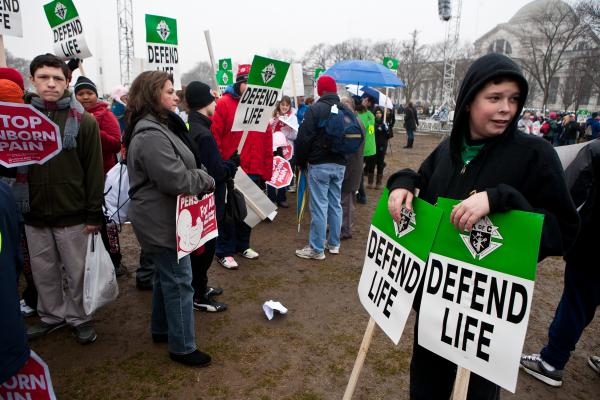
WASHINGTON — Each January in the four decades since the Roe v. Wade decision legalized abortion in 1973, Nellie Gray marshaled tens of thousands of anti-abortion demonstrators for the March for Life rally.
Now, after Gray’s death in August at age 88, a woman less than half her age will take up the cause to lead marchers from the National Mall to the Supreme Court on Jan. 25 to protest the 40th anniversary of Roe v. Wade.
“On one hand, it’s a very somber time for me every year,” said Jeanne Monahan, the new president of the March for Life Education and Defense Fund. “I’m always a little saddened. And on the other hand, there is a youthful sort of energy and enthusiasm that’s there.”
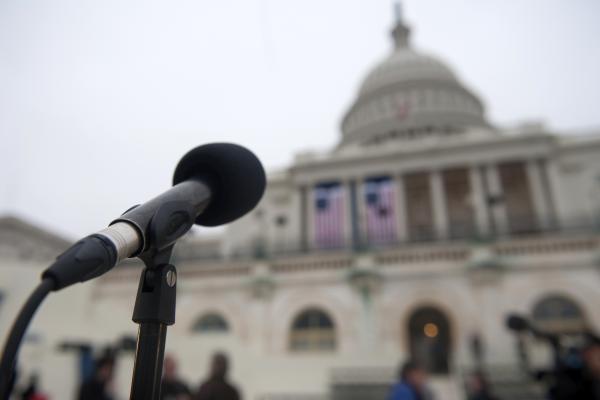
President Obama will publicly take the oath of office on two Bibles once owned by his political heroes, Abraham Lincoln and the Rev. Martin Luther King Jr. One Bible was well read, but cited cautiously, the other granted scriptural sanction to the civil rights movement.
When Obama lifts his hands from the Bibles and turns to deliver his second inaugural address on Monday (Jan. 21), his own approach to Scripture will come into view. Characteristically, it sits somewhere between the former president and famous preacher.
His faith forged in the black church, Obama draws deeply on its blending of biblical narratives with contemporary issues such as racism and poverty. But like Lincoln, Obama also acknowledges that Americans sometimes invoke the same Bible to argue past each other, and that Scripture itself counsels against sanctimony.
Obama articulated this view most clearly in a 2006 speech, saying that secularists shouldn’t bar believers from the public square, but neither should people of faith expect America to be one vast amen corner.
“He understands that you can appeal to people on religious grounds,” said Jeffrey Siker, a theology professor at Loyola Marymount University in California who has studied Obama’s speeches. ”But you also have to be able to translate your case into arguments that people of different faiths, or no faith, can grasp.”
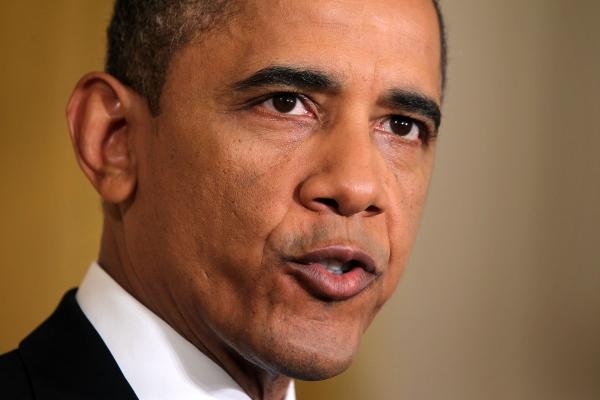
President Barack Obama and Vice President Joe Biden announced today a comprehensive plan to address gun violence in the wake of mass shootings in Newtown, Conn., and Aurora, Colo. The plan includes calling on Congress to require universal background checks, restore a ban on military-style assault weapons and 10-round limit to magazines, and implement stronger punishment for gun trafficking. The plan also includes measures aimed at increasing school safety and access to mental health services.
"This is our first task as a society: keeping our children safe. This is how we will be judged," Obama said, accompanied children who wrote to the White House calling for an end to gun violence.
In the 33 days since the Sandy Hook shooting, "more than 900 of our fellow Americans have reportedly died at the end of a gun," Obama said. "… every day we wait, that number will keep growing."
Biden, who has met with more than 200 groups representing various interests including law enforcement and people of faith, said the nation has a "moral obligation" to do everything in its power to address gun violence.
The announcement comes a day after faith leaders, including Sojourners president and CEO Jim Wallis, publicly called for many of the same measures, including reinstating the assault weapons ban, closing background check loopholes, and making gun trafficking a federal crime.
Today is Religious Freedom Day — a day to celebrate the adoption of Thomas Jefferson’s Virginia Statute for Establishing Religious Freedom. Why celebrate it?
Celebrate because our government does not use our tax dollars to propagate religion, something Jefferson found “sinful and tyrannical.” This does not mean that you have a right to stop any government action that you happen to think violates your religious beliefs — a ridiculous claim repeated during last year’s battle over insurance coverage for contraceptives.
Wise leaders spend time in the wilderness.
Some choose a sojourn in the desert; most are driven there when their leadership fails.
In the desert, beyond their cocoon of comfort and success, they see more about themselves. If they stay in the desert long enough, they come to understand what they see about themselves. Stay still longer, and some even come to appreciate themselves.
And a few whose desert wanderings go past endurance stop focusing on themselves at all. They discover people and God. Those become the great leaders. They move far beyond self-serving, calculation, manipulation, cleverness, methods, and successful habits. They find common ground with humanity in its brokenness and aspirations, in its resilience and its daily acts of common goodness.
We live in an era of weak and absent leadership.
“Everyone brings out the choice wine first and then the cheaper wine after the guests have had too much to drink; but you have saved the best till now.” John 2:10
I recently saw the very fine understated film, Promised Land, starring Matt Damon, which peels back the glamour and allure of large amounts of money from huge energy corporations drilling for natural gas, engaging in a practice called fracking. Fracking offered the promise of making individuals and families rich, maybe very rich millionaires, but there was also the possibility of releasing chemicals into the soil and groundwater hastening the death of these struggling communities.
No quick, easy answers are offered in this film, but we are reminded of the great promise that this land called America holds for all 300 million plus of us. We are reminded of promises unfulfilled, dashed hopes, and shattered dreams.
Reading this second chapter of John’s Gospel, when Jesus was at a wedding feast in Cana of Galilee, we see here also great promise, but promises unfulfilled, dashed hopes, and shattered dreams. A young couple at a high moment starting life out together with great joy, but the joy becomes elusive as a problem soon develops. There is a shortage, a running out of wine. Not only was that a social embarrassment; it was a symbol and sign of what was yet to come. For a wedding to run out of wine was an omen that there was little chance of this particular marriage reaching its full potential. Promises barely made, but already promises unfulfilled, dashed hopes, and shattered dreams.
As we stand this week on the cliff of a critical moment in the life of our nation — Martin Luther King, Jr. Day and the second inauguration of Barack Hussein Obama, the first person of African descent, as the 44th President of this country — some already view that promises are broken and unfulfilled. There are dashed hopes and shattered dreams.
Violence does not equal power.
Martin Luther King, Jr., understood this. Yesterday was King’s 84th birthday. This year the national holiday to honor him will coincide with President Barack Obama’s second inaugural ceremony. And, all of this happens in the wake of one of the worst mass shootings in the nation’s history. One month after the shootings at Sandy Hook Elementary School in Newtown, Conn. — which left 20 children and six adults dead, plus the killer’s mother, found dead in her home — the country grapples with the issue of gun violence. If the country is to come to consensus on the issue, we will have to distinguish between violence and power.
Vice President Joe Biden gave recommendations to the president regarding gun safety on King’s birthday. The questions the media are asking already abound: What recommendations can the president implement through executive order? Can an assault weapons ban pass Congress? Will victims and gun safety advocates be able to persuade Congress to pass meaningful legislation?
There will be varying interpretations of the Second Amendment, and there will be some who will argue that guns are necessary for self-defense. We will have the discussion as to whether or not the gun culture in the United States has taken on religious proportions.