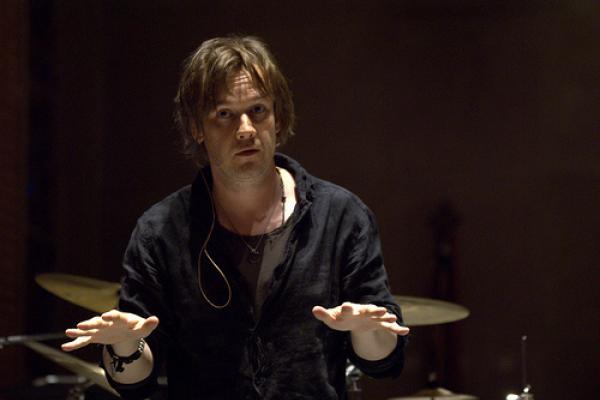
I love Peter Rollins' honesty about his dark night of the soul.
He's popularized a term for the intellectual position accompanying the dark night of the soul: a/theism. I interpret Peter's thought as being in relation to an experience of God's absence. [Note: corrected this paragraph's content from "even coined" to "popularized. Turns out another author coined a/theism."]
I thought it was hilarious that Tony Jones challenged Peter to give up atheism for Lent on the Homebrewed Christianity podcast.
But I took it seriously when Micah Bales, one of my best friends, wrote a post challenging Peter Rollins' Atheism for Lent. You can't give up God because God is a felt presence. (Peter later responded to Micah. And Brian Merritt a piece about who Micah is.) Our conversations got me thinking about what I value about Peter Rollin's voice and what I might challenge about a/theism as I understand it. In order to talk about why a person believes or disbelieves in God, you have to talk about a personal spiritual journey.

If one were to conduct a nationwide survey to learn the most common human fears, it is safe to conclude thatfailure would be near the top of the list. Due in part to the high value that North American society places upon success and achievement, we recognize through the twists and turns of daily life that everyone has – in some shape or form – firsthand experience of the fear of failure. We fret over falling short, we agonize about disappointment, and we even lose sleep from the potential shame of letting others down.
What if we, as a Lenten discipline, make a commitment to give up the fear of failure — for such fears are too often personally devastating and publicly debilitating if left ignored or unresolved?

On Saturday, Feb. 23, Bradley Manning marks his 1,000th day in prison without a trial. Manning, the 23 year-old Army intelligence analyst accused of leaking classified documents to WikiLeaks while stationed in Iraq, spent a full 600 days in prison before he even saw a judge, even though military law requires arraignment within 120 days of a person being detained. (Amid the material that Manning released was the now famous video showing two American military helicopters shooting civilians in Baghdad in 2007, killing two Reuters journalists.) During his confinement, Manning has been subjected to abuse and humiliating treatment.
Amnesty International wrote, “We’re concerned that the conditions inflicted on Bradley Manning are unnecessarily severe and amount to inhumane treatment by the US authorities. Manning has not been convicted of any offense, but military authorities appear to be using all available means to punish him while in detention. This undermines the United States’ commitment to the principle of the presumption of innocence.”
U.S. law is based on the presumption that a person is innocent until proven guilty. Our Constitution guarantees all persons in U.S. custody (not just citizens — Cole, D., Enemy Aliens, 2003) the rights to due process of law, humane treatment, and a speedy and public trial. Bradley Manning is only one example of how the U.S. is failing our own constitutional standards.
Melanne Verveer, the first U.S. ambassador for Global Women’s issues has been urging governments and leaders around the world on improving the lives of women.
As she begins her new journey as the Executive Director of the Georgetown Institute for Women, Peace and Security, she reflected on her tenure as ambassador and the personal encounters that she had along the way that drove her to raise awareness on the sufferings of women. When asked about her guiding principle of women’s advocacy, Verveer cited a conversation she had with an Afghan woman in Kabul,
Please don’t see us as victims but as the women leader we are
To read more about Melanne Verveer’s leadership in empowering women, read here.

So you’ve heard the flu shot is somewhat ineffective this year, and, though you have a normal immune system, you don't want to take the Eucharist from a common chalice.
Part of me kind of wants to slap you.
Obviously, that's not what Jesus would do. We know what Jesus did — he offered you his lifeblood, saying "This is my blood of the covenant, which is poured out for many." Ever after, Christians have taken wine and bread, a sacrament which binds us together in communion with other Christ-followers around the globe and through two millennia.
For the last few months, because my cancer treatment had decimated my immune system, I haven't been able to drink from the common chalice (or to eat most raw food, go to the movies, or get on the bus without a face mask). I really miss it. So I want to share two key insights I’ve had about the common Eucharistic cup.

President Barack Obama will be visiting Israel and Palestine in March. I call on you to write to Obama and tell him that if he is coming to engage Israelis and Palestinians in talks that will lead to a just peace, he is then welcome. Otherwise tell Obama to stay home.
Tell Obama that the world will be watching his upcoming visit and people all over our planet will look to his visit with hope and expectation. Tell him not to disappoint humanity by carrying on U.S. politics in the Middle East as usual.
Tell Obama when he visits us here to stand by the values that he reiterates in almost every speech: freedom, independence, equality, and justice for all.

On the road, listening to NPR's Terry Gross interview Lawrence Wright, author of Going Clear: Scientology, Hollywood and the Prison of Belief, and having recently spent two hours at the United States Holocaust Memorial Museum seeing the Nazis photographed, not in the usual black and white, but in the full colors of the natural world, it occurred that the human impulse to be part of an exclusive group has deep, powerful roots in religion.
People join "true churches" for this same impulse, a motivation that could not be further from the intention of the Gospel, which, at the heart of its mission, contains the abolition of exclusivity of any kind.
Christ following is not about joining the best club, but about following where Christ leads, straight into the company of every person, no matter their situation or circumstances, in order to be a servant to them, one who lays down his or her life, like Jesus, for the life of the world.
We were made for Communion with God and our neighbor, who Jesus tells us is every person.
Scientology, National Socialism, and other cults, past or present, religious or tribal, are modern forms of Gnosticism. They say, in varying ways, "We have something (usually 'knowledge') not publicly available to everyone and you must join us, submit to us, to participate in our secret." It's important to recognize that this is also an offer of power.