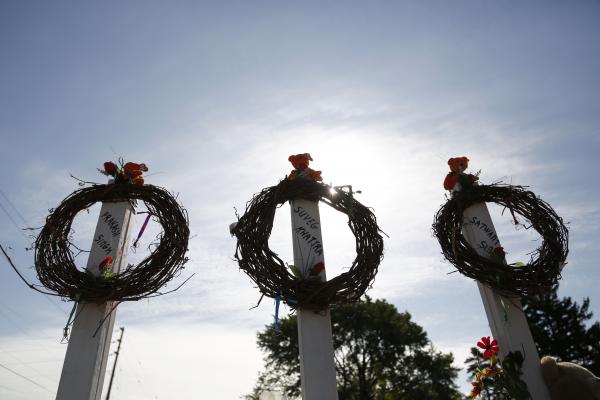
Few can know what goes through the twisted mind of a mass killer, but Wade Michael Page left behind plenty of signs that he was consumed by one thing: hate.
Page, 40, was identified by police Monday as the gunman who killed six worshippers Sunday morning at a Sikh temple here. Local and federal authorities said they were investigating whether the shooting was an act of domestic terrorism.
The bald, heavy man decorated in tattoos and shot dead in an exchange with police played in hate bands and used hate-filled heavy-metal music to recruit white supremacists to the cause.
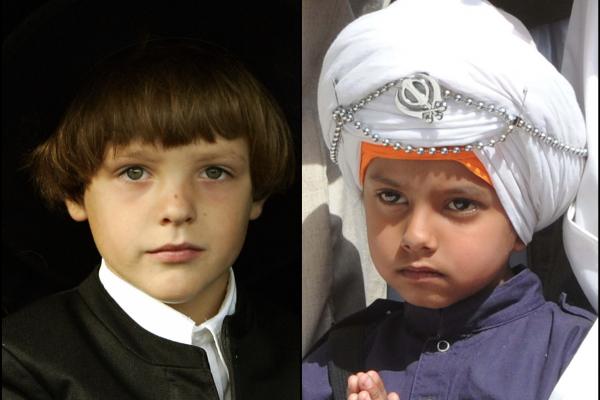
Like most people, I was deeply troubled by news of another mass shooting, this time at a Sikh temple in Oak Creek, Wis., not far from Milwaukee. On the heels of the tragic massacre in Aurora, Colo., this seemed all the more savage to me, given that it took place in a house of worship.
Maybe it’s because my wife and I work in a church and are aware of such vulnerabilities every day, but my first reaction is defensiveness. I want to raise my guard, double-check the locks and do whatever I can to ensure our safety. It’s the response that makes the most sense, after all.
Or is it?
Author and academic Jeffrey Sachs argues in a Huffington Post piece:
Consider the new U.S. unemployment announcement. If you are a college graduate, there is no employment crisis. 72.7 percent of the college-educated population age-25 and over is working. The unemployment rate is 4.1 percent. Incomes are good.
If you have less than a high-school diploma, however, you are barely scrapping by. Only 40.4 percent of those without a high-school diploma have a job. Their unemployment rate is 12.7 percent. Incomes are too low to make ends meet.
There are two Americas: the college-educated crowd that may have taken a hit in their retirement accounts, but who are generally doing well. Then there are the rest, around 60 percent of the population, who are increasingly dropping out of the middle class. Nearly one-half of American households are now classified as low-income, within twice the poverty line.
Read more here
For The Washington Post, former presidential speechwriter, Mike Gerson, writes:
In Tampa this month, Republicans will cheer themselves hoarse for a Mormon nominee. And a nation that carefully marks and celebrates every ethnic and religious first won’t take much notice. The Mormon church — for which visibility has often brought persecution — is unlikely to crow about the achievement. And Mitt Romney is probably getting advice to downplay his religion. That was the case in 2007, when Romney explained that he liked the idea of giving a speech on his faith, but “the political advisers tell me, ‘No, no, no, it’s not a good idea. It draws too much attention to that issue alone.’ ”
This cautiousness is understandable. In the typology of sociologists Robert Putnam and David Campbell, Mormons remain a rejected “out-group,” unlike accepted “in-groups” such as Catholics and Jews. Large majorities of Americans perceive Mormonism as “very different” from their own religious beliefs.
But in this case, the counsel of religious reticence is wrong. Romney should not be afraid to highlight his faith.
Read more of his column here

Among my must reads are the Sunday New York Times Book Review and other book reviews I come across in various media outlets. There are too many books being published that I would love to read, but just don’t have the time. So, I rely on reading book reviews as one way of keeping in touch with what’s being written.
Here are my picks in this week’s books of interest.
Peter Jackson releases a second trailer for The Hobbit: An Unexpected Journey --- feminist Ryan Gosling to become coffee table book --- animals forming their own bands --- Conan O'Brien's "Clueless Gamer" --- Sesame Street minimalist art --- Stephen Colbert's music performance festival Setphest Colbchella. See these and more in today's Links of Awesomeness...

This is the third and final installment of my little series on Harry Emerson Fosdick, his sermons about Modernism and Science, and how these century-old sermons remind us that our present conversations about the same are anything but new. They may be necessary, but they aren't new. You can read my first post, “I Love How History Repeats Itself,” and my second post, “Science, Faith, and An Ongoing Conversation.”
I want to continue to focus on the same two sermons, "Shall the Fundamentalists Win?" and "The Church Must Go Beyond Modernism," and finish up a line of thought about American Christian Fundamentalism and interlace a third and final sermon entitled, “The Greatness of God” in which Fosdick outlines some of his own understandings of atheism, science, and religion. Typical of Fosdick, there is a tome hidden in between the lines of that sermon. Nevertheless, I'll try to share some of it with you.
What does Fosdick say is the trouble with Modernism? In “The Church Must Go Beyond Modernism,” he lists a few problems. Here's a list:
- “... it is primarily an adaptation, an adjustment, an accommodation of Christian faith to contemporary scientific thinking.”
- for this reason it tends “toward shallowness and transiency” and thus cannot adequately represent the Eternal;
- “Unless the church can go deeper and reach higher than that it will fail indeed.”
- “... excessively preoccupied with intellectualism” eschewing the heart and thus missing much of Christian spirituality
- excessive sentimentality, which means the eternal progress of the human character and the eradication of evil and the loss of moral judgment, scientific progress being equated with human moral progress
- “... modernism has even watered down and thinned out the central message and distinctive truth of religion, the reality of God.”
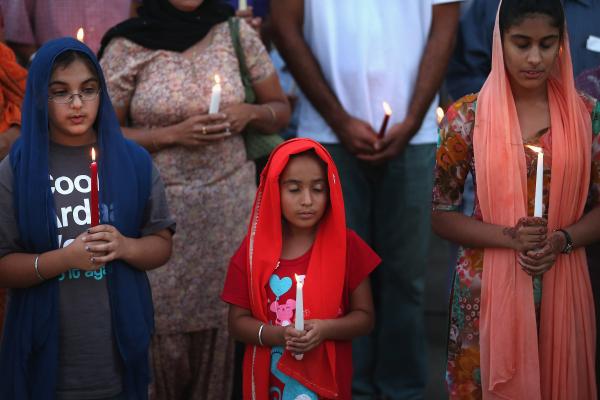
First, there were the cryptic news bulletins on TV. There had been a shooting at a Sikh temple in a Milwaukee suburb called Oak Creek. Then the details began to emerge. Six people were dead, others critically wounded, including a police officer. The shooter, who had a long history with the white power movement, was shot dead by another police officer, bringing the toll to seven.
And all around Wisconsin, people watched in horror as we learned of yet another mass murder, this one in our backyard, this one shattering the tranquility of a Sunday morning worship service.
There are not a lot of Sikhs in Wisconsin – about 3,000 in the southeastern part of the state, perhaps 250 or so in the Madison area where I live. Yet people everywhere shared the horror and the sadness of that moment.
In the Milwaukee area, a group called the Light Brigade — which had held up illuminated letters with political slogans during the effort to recall Gov. Scott Walker earlier this year — stood in Cathedral Square with a simple, powerful message in lights: “Wisconsin Weeps.”
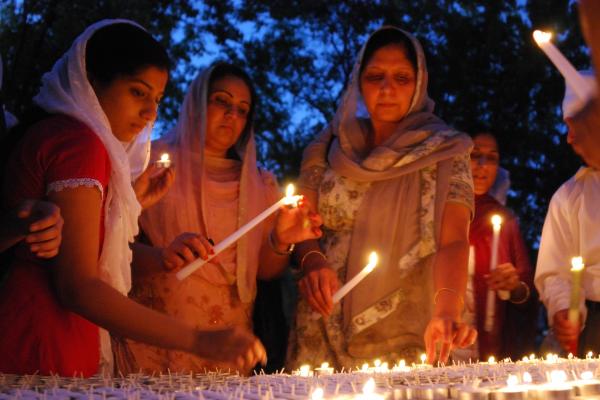
Imagine the terror.
You are in a temple, a safe, sacred place, preparing for a morning service. In the kitchen, you are busy cooking food for lunch, while others read scriptures and recite prayers. Friends begin to gather for the soon-to-start service.
At the front door, you smile at the next man who enters. He does not smile back. Instead, he greets you with hateful stare and bullets from his gun.
Such was the scene Sunday at a Sikh gurudwara in Oak Creek, Wis., just south of Milwaukee, where a gunman, Wade Michael Page, killed six and critically injured three others before being shot down by law enforcement agents.
As Page began his shooting spree, terrified worshippers sought shelter in bathrooms and prayer rooms. Rumors of a hostage situation surfaced, and those trapped inside asked loved ones outside not to text or call their cell phones, for fear that the phone ring might give away their hiding place.
The first police officer to arrive on the scene stopped to tend to a victim outside the gurudwara. He looked up to find the shooter pointing his gun directly at him, and then took several bullets to his upper body. He waved the next set of officers into the temple, encouraging them to help others even as he bled.
That magnanimity is a common theme among the stories of victims and survivors of the Wisconsin shootings. Amidst terror and confusion, Sikhs offered food and water to the growing crowd of police and news reporters outside the gurudwara as part of langar — the Sikh practice of feeding all visitors to the house of worship.
Holy God, give us peace in our hearts so that we may further pursue peace in the world. Amen.