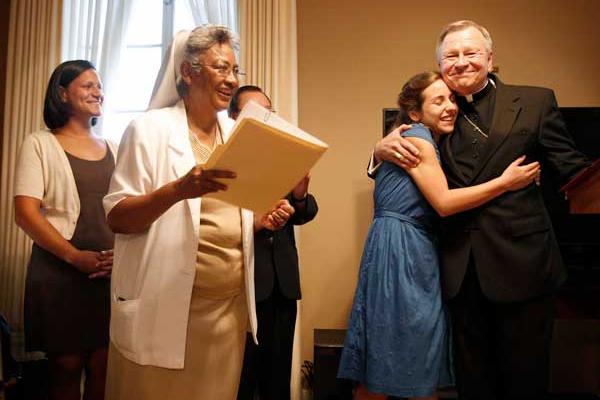
In what is being described as the first of its kind in the U.S., the Archdiocese of New Orleans has transformed a vacant church rectory into a group house where single women will live together while deciding whether to undertake lives as nuns.
The center, dedicated on Aug. 15, occupies the second and third floors of the St. Rita rectory. Within a few days, two women, then perhaps three more, will move into the spotless rectory, their collective lives to be superintended by two veteran nuns who will show the younger women the dynamics of shared community life.
“How we live in community. How to communicate. How to share,” said Sister Carmen Bertrand, for 48 years a member of the Sisters of the Holy Family.
Beyond orienting them to the rhythms of community life, Bertrand and her colleague, Sister Diane Roche, a Religious of the Sacred Heart, will teach the tenants various modes of prayer, organize occasional retreats, and bring in representatives of other religious orders to present themselves and their ways of life.
 I stepped down from the train,
Saw you there, old man, bent
Next to the Tudor station, smiling
And waving to me over the steering wheel.
Your aged blue eyes
Saw us through the maze of roads
Walled by high corn and close trees, roads
Which branch away from the train
Station to the cottage, to your wife’s eyes
And worn wrinkled skin. Her back bent
Over the low table. You turn the wheel
And press the horn, she’s smiling,

For the second time in Chicago this year, the life of a gender-variant young person of color was lost to violence.
Donta Gooden’s body was found in an abandoned building on the city’s West Side late in the evening of August 14th. Gooden, 19, who also went by the name “Tiffany,” was stabbed to death just three blocks from where Paige Clay, a 23 year-old transgender woman, was shot and killed in April, according to media reports. The police investigation is ongoing.
The tragedy of these senseless killings, still so raw and heartrending for the loved ones of Gooden and Clay, is beyond comprehension and deplorable on every level. But perhaps even more unsettling is how often violent crimes against LGBTQ people occur and how little social outrage they ignite.
For many, these two terrible tragedies may melt into the background in a year when Chicago is scrambling to stem a rising tide of murder across the city (year -to-date homicides are up 25 percent from August 2011 according to data compiled by the Redeye. However, they are part of an alarming trend of violence targeting LGBTQ people of color – and transgender and gender-variant people of color in particular – which directly intersects with the front lines of the HIV epidemic.
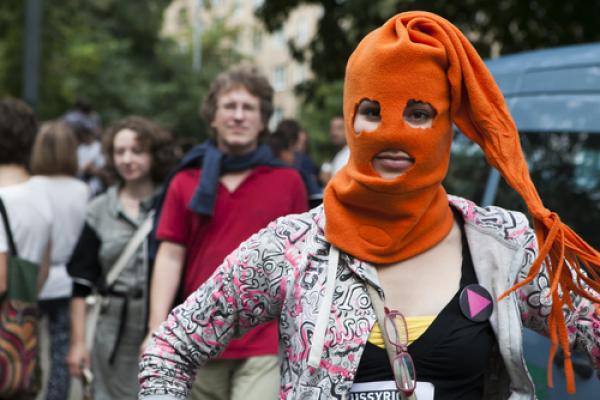
Perhaps I’ve missed something about Russian law, but it seems to me that it’s a conveniently trumped up charge to keep the women sequestered until (hopefully for the Putin Administration, at least) the attention blows over and the perpetually-distracted news cycle moves on. In short, I can’t imagine, at least from my cultural context, that such a sentence could be justified as anything less than government bullying.
As for the location of their “Punk Prayer” at the altar of a Russian Orthodox church, this state church has been in the pocket of the government for quite a long time, it turns out. In reading up a little more, the choice of such a church for their protest seems less shocking and more concertedly poignant, given the church’s complicity in promoting the agenda of the Powers that Be. Rather than standing up in the face of authority as an advocate for the poor and oppressed (arguably one of the principal responsibilities of a church), they have joined in the subjugation of human rights in Russia.

When I was in junior high, I attended a private Christian school where my youth pastor used to show us videos of Christians in public schools being arrested for praying at the flagpole, as well as future Christians being executed because of “liberals who want to take away our right to worship.”
So I get it. When a guy walks up to a conservative Christian organization’s headquarters and starts shooting, it confirms what many people already believe: Evangelical Christians in America are a persecuted minority; and the people behind the persecution are groups like the Southern Poverty Law Center, a group that labels anyone who “takes a stand for Biblical righteousness” a hate group. The storyline would sound reasonable if it weren’t for one small problem: It’s completely ridiculous.
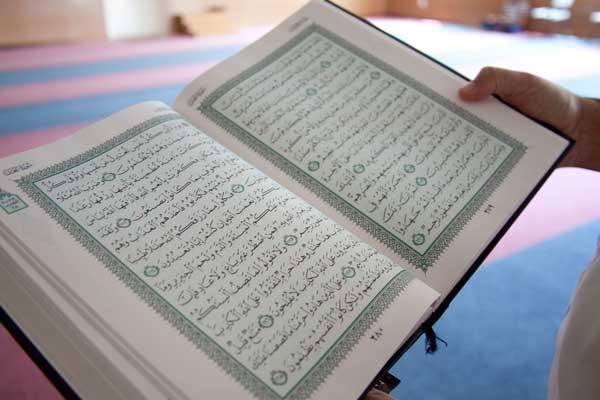
This year during Ramadan — the ninth month of the Islamic lunar calendar when Muslims believe the Quran was first revealed to the Prophet Muhammad — I was in solidarity with my Muslim sisters and brothers throughout the world by reading the Quran. But here's the thing: I am a Roman Catholic.
My copy of the Quran, with more than 1,700 pages, has sat on the top shelf of my bedroom bookcase among other sacred texts for 14 years. Typically I would use it as a sporadic reference and resource to better understanding Islam, reading a few short passages at a time.
However, this Ramadan something at the core of my being was calling me to read the Quran in its entirety. And so my monthlong Ramadan journey began.
Each day and evening, the prayerful poetry in the Quran held me in a meditative mode of peace as I read without being aware of the passage of time.
When I finished reading a week before the end of the month, I felt as if the Quran was almost endless, reaching beyond the confines of my calendar days. I didn’t want to read the last page. I didn’t want to be finished.
The Quran inspired me, taught me and helped me to remember my essential holiness and how that holiness in the image of God should be reflected in the world.
Today is my last run of "Links of Awesomeness." And rather than ending with a mediocre list of new links, I went through the archives to compile some of my favorites from this year. Enjoy the links and expect a fresh new batch from the next intern in early September.

Today is my last run of "Links of Awesomeness." And rather than ending with a mediocre list of new links, I went through the archives to compile some of my favorites from this year. Enjoy the links and expect a fresh new batch from the next intern in early September.
Three women from the Russian feminist punk collective Pussy Riot were convicted today of "hooliganism motivated by religious hatred."
Nadezhda Tolokonnikova, 22, Marina Alyokhina, 24, and Yekaterina Samutsevich, 30, were arrested in February following an uninvited “punk prayer” of protest against the iron fist and faux democracy of Russian president Vladimir Putin and calling to account the theological rubber-stamping of Putin's repressive regime by the Russian Orthodox Church.
Their "performance prayer" titled "Hail Mary, Putin Run!" (see video and lyrics) was offered to the Virgin Mary at the altar of Christ the Savior Orthodox Cathedral in Red Square. After spending five months in jail since the event, they were sentenced today to two years — time served credited against the sentence, so they've got another 19 months to go. While some have directly attacked the band as anti-religious, others have attempted to more subtly undercut them by saying their actions are just publicity stunts to get money. I say, Wrong and wrong. Acts of ecclesial disobedience are called for when institutions that are supposed to represent God fail to do so. And spending two years in a Russian prison - as a woman - is not the kind of thing we do for money.
At the last Festival of Faith and Writing at Calvin College, Brian Walsh interviewed singer / songwriter Bruce Cockburn. The following is the six-part interview. And continue scrolling to get the audio of Cathleen Falsani's 2006 "God Factor" interview with Cockburn.