
Al Jazeera reports:
“At least three people have been killed in a suspected US drone attack in Pakistan's northwestern region along the Afghan border, according to a Pakistani security official.
“The target of Saturday’s attack was a vehicle in Dattakhel area in North Waziristan, one of seven tribal districts and hotbed of al-Qaeda-linked fighters. All three people travelling in the car were killed and the vehicle completely destroyed, the security official said on condition of anonymity.”
The attack was also reported in Pakistani newspapers DAWN and The Nation.

We’ve all heard the rhetoric. “We need to take America back for God!”
Why? Supposedly so we can regain some bygone level of ethics or moral standards. Supposedly, if we don’t, God will get tired of us “rebuking” God and remove God’s hand of protection from us. Supposedly, so God won’t test us or judge us or something.
Yet, as Gregory A. Boyd notes in his important book The Myth of a Christian Nation: How the Quest for Political Power Is Destroying the Church, taking America BACK for God assumes we were at one really belonged to God, followed God, listened to God. Boyd goes on to ask, when was this glorious age in the history of the USA?
Let’s start way back. We’ve been taught that many people migrated to North America for religious freedom. So was this glorious time when some of our forebears imprisoned, tormented, and/or hanged many suspected to be witches? Is that what so many want to take us back to?

Most people, Christian or not, know the story of the Good Samaritan. In it, a man, who is presumably an Israelite, is mugged on the road between Jerusalem and Jericho. A priest passes by without stopping. So does a Levite. But then a Samaritan — someone who belongs to a radically different socioeconomic and cultural group than the Israelite — stops to help. This is Jesus’ vision for us as we answer the question, “Who is my neighbor?”
So it should shock us, surprise us, and sadden us, when we hear about tragedies like the shooting at the Sikh gurudwara in Oak Creek, Wisconsin. For the victims of such attacks — whether they are Sikh, Muslim, Hindu — are our neighbors too.

According to the Stockholm International Peace Research Institute (SIPRI), the United States currently spends more than $711 billion per year on military expenditures, which is – by far – the most of any country in the world.
In fact, if one were to combine the totals of the next fourteen nations on the list (China, Russia, the United Kingdom, France, Japan, Saudi Arabia, India, Germany, Brazil, India, South Korea, Australia, Canada, and Turkey), their combined amount is similar to the USA. All together, the USA provides about 43 percent of worldwide military costs, and in addition, the USA per capita ($2,240) and percent of Gross Domestic Product (4.8 percent) in relation to military funding is far greater than any other nation in the world.
With these statistics in mind, one is provoked to ponder some important questions. For example, what is revealed to us about the USA – and our world in general – when military expenses constitute such a significant percentage of a government budget?
In specifics, why does the USA spend far more on its military than any other country? In addition, what is revealed to us about the condition of our global village when $1.73 trillion is allocated each year to military funding? As stated by Sojourners CEO Jim Wallis, “A budget is a moral document. It clearly demonstrates the priorities of a family, a church, an organization, or a government. A budget shows what we most care about.”
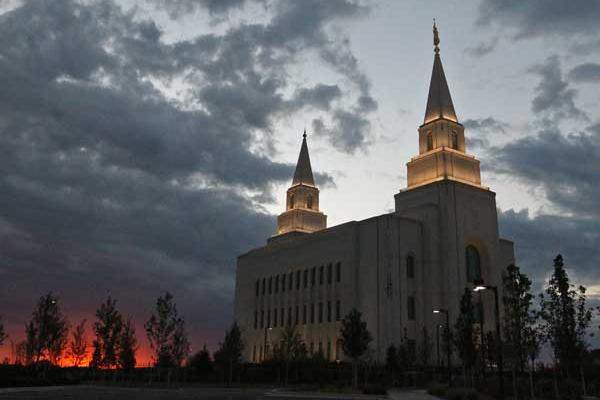
In 1831, Mormon founder Joseph Smith declared that the righteous would gather in Independence, Mo., to greet the Second Coming of Jesus Christ — just one of the prophecies that estranged his faith from traditional Christianity.
Thousands of converted Mormons moved from Ohio and upstate New York to claim their New Jerusalem. Disputes with Missourians led to a bloody Mormon War that ended only when the state's governor issued an "extermination order" to expel Smith's followers.
Today, few places are better to contemplate the evolving — but still uncertain — relationship between Mormonism and the country where it was founded.
On the one hand, Missouri symbolizes how far Mormons have come. At least 66,000 Mormons now live in the state, more than triple the number of just three decades ago. Most recently, the LDS church has built a temple in Kansas City, Mo., near the epicenter of the Mormon War.
But Missouri also serves to highlight the intractable differences between mainstream Christianity and Mormon theology.
My friend Mike Gerson wrote a significant column in the Washington Post today, titled "An Ideology Without Promise." It takes a deeper look at the now infamous Romney video and addresses the crisis that we all have to face now. I recommend reading Mike’s column. He says in part:
This crisis has a number of causes, including the collapse of working-class families, the flight of blue-collar jobs and the decay of working-class neighborhoods, which used to offer stronger networks of mentors outside the home. Perverse incentives in some government programs may have contributed to these changes, but this does not mean that shifting incentives can easily undo the damage. Removing a knife from a patient does not automatically return him to health. Whatever the economic and cultural causes, the current problem is dysfunctional institutions, which routinely betray children and young adults. Restoring a semblance of equal opportunity — promoting family commitment, educational attainment and economic advancement — will take tremendous effort and creative policy.

The white working class, a potentially rich bloc of voters for Republicans or Democrats, hasn’t settled on Mitt Romney or President Barack Obama, a new study from the Public Religion Research Institute shows.
“These white working class voters are not particularly enamored of either candidate,” said Daniel Cox, PRRI’s research director. “In terms of their favorability, they’re both under 50 percent.” Forty-four percent look favorably upon Obama and 45 percent upon Romney.
Released seven weeks before the election, the August survey found Romney with a double-digit lead over Obama among the white working class, which preferred the GOP candidate 48 to 35 percent.
But Cox points out that the gap narrows to statistical insignificance among women voters in this group, and in the Midwest and West, home of several swing states. The upshot for Romney and Obama?
If they want to woo this group, which makes up 36 percent of the nation according to the study, the campaigns may want to consider other findings of the PRRI poll.

Cheerleaders at an East Texas high school are fighting their school district’s orders to stop using Bible quotes on their signs at football games.
In August, cheerleaders at Kountze High School, a school with fewer than 500 students 30 miles north of Beaumont, Texas, began painting Bible verses on large paper signs football players burst through at the beginning of games.
But this week, Kountze Independent School District Superintendent Kevin Weldon called for an end to the banners after consulting with a legal adviser at the Texas Association of School Boards.
“It is not a personal opinion of mine,” Weldon told KHOU, a Houston television station. “My personal convictions are that I am a Christian as well. But I’m also a state employee and Kountze ISD representative. And I was advised that such a practice would be in direct violation of United States Supreme Court decisions.”
That prompted the cheerleaders and their supporters to launch a Facebook page, “Support Kountze Kids Faith,” which attracted 34,000 members in its first 24 hours — more than 10 times the population of Kountze.
Parents of at least three cheerleaders have hired an attorney and are considering suing the school district.
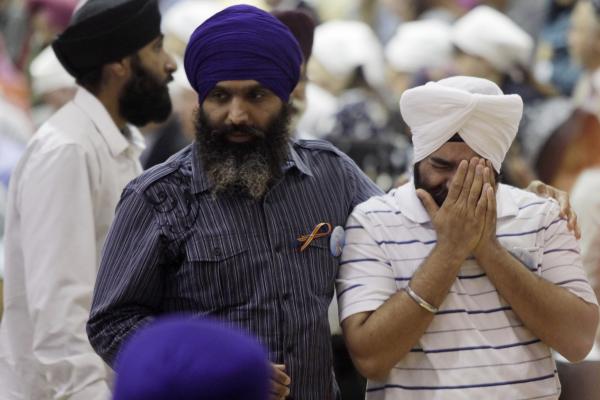
U.S. Sikhs are taking heart in a widely publicized Senate hearing on hate crimes and a pledge by the Justice Department to consider tracking hate crimes directed at their community.
The hearing, on Sept. 19, featured Harpreet Singh Saini,18, whose mother was one of six Sikh worshippers killed Aug. 5 when a gunman opened fire in their Wisconsin gurudwara (house of worship or, literally, "house of the guru").
“Senators, I came here today to ask the government to give my mother the dignity of being a statistic,” he told a subcommittee of the Senate Judiciary Committee. “My mother and those shot that day will not even count on a federal form. We cannot solve a problem we refuse to recognize.”
Sikhism, a monotheistic faith founded in South Asia, is the world’s fifth largest religion with an estimated 200,000 to 500,000 adherents in the U.S. Male Sikhs often keep their uncut hair bound up in a turban.
The Senate hearing, spurred by the Wisconsin shooting, brought more than 400 people to Capitol Hill, most of them Sikhs.
A cat runs for mayor and may or may not try out a new electric skateboard or a bike made out of cardboard. Some of the Pixar staff could've used some free coffee courtesy of GOOD when they studied for their graduate-level final exam in ichthyology for Finding Nemo. Oh, and the second trailer for The Hobbit came out too.