
On Nov. 29, Palestinians will bid to become a “non-member observer state” in the United Nations. If approved, this would be a major step toward full statehood for Palestinians. Israel, and perhaps more important, the United States, are against this move, not least for fear of possible war-crime investigations against Israel. Israel’s rationale has always been that a final resolution cannot be achieved unilaterally, but only through direct negotiations. Ironically, Israel achieved its own independence unilaterally and through the United Nations.
Palestinian Christians leaders have sent a strong message of support for this step. A statement signed by 100 community leader says:
We believe the Palestine Liberation Organization’s initiative to enhance Palestine’s status in the United Nations to an Observer State is a positive, collective, and moral step that will get us closer to freedom. This is a step in the right direction for the cause of a just peace in the region. We fully endorse this bid, just as we supported Palestine’s application for full membership of the United Nations a year ago.

Presidents, government ministers and religious leaders from around the world gathered in Vienna on Monday Nov. 26 for the gala launch of the King Abdullah Center for Interreligious and Intercultural Dialogue.
While Austria and Spain joined Saudi Arabia in establishing the center, it originated in a bold initiative by Saudi King Abdullah. Some years ago, the king convened representatives from all segments of the Muslim world in Mecca to support his call for Islam to engage the other world religions in addressing the social, scientific, and global challenges of our times.
He followed this up with an interfaith conference in Madrid co-hosted with King Juan Carlos of Spain and subsequently brought his initiative to the United Nations in 2008, hosting a gathering of world political leaders that included Israeli President Shimon Peres.
Another star of the CBS sitcom “Two and a Half Men” has gone rogue — but in a decidedly different direction than notorious carouser Charlie Sheen.
Actor Angus T. Jones — the “half” in the sitcom’s title — says in a new online testimony that he’s become a Seventh-day Adventist and loathes the “filth” produced by his raunchy show.
“You cannot be a true God-fearing person and be on a television show like that,” says Jones, 19, in a video posted online by Forerunner Chronicles. “I know I can’t. I’m not OK with what I’m learning, what the Bible says, and being on that television show.”
“Please stop watching it,” says Jones, who reportedly earns $350,000 per episode and has starred in the show since he was 10. “Please stop filling your head with filth.”

CANTERBURY, England — When the Church of England scuttled plans to allow women bishops on Nov. 20, incoming Archbishop of Canterbury Justin Welby called it “a very grim day for women and their supporters.”
Now, that grim day is turning into a church-state nightmare for Britain's established church.
On Monday, The Times of London quoted from a leaked memo to church leaders from William Fittall, secretary general of the General Synod, who called the public and political fallout "severe."

Earlier this month, I went to vote at our local middle school in North Durham. It was one those winter-tease days, colder than usual, a glimpse of the coming months in North Carolina. As I walked into the school’s auditorium, I was met by poll monitors with visible breath and bundled-up like Ralphie’s brother from the movie A Christmas Story. For a Midwesterner, cold temperatures in North Carolina is a warm day in the fall, nonetheless, it was clear the monitors as well as voters were uncomfortable and frustrated with the conditions. While searching for my name in the voter list, I overheard one monitor pleading with an administrator to get the heat turned on, fearing the cold atmosphere might shoo voters away.
When I left the facility, I couldn’t help but wonder at the irony of the situation. In a crucial election with many issues at stake, including tax fairness, our local voting facility struggled to provide reasonable and comfortable conditions for the voters. It might be unfair to assume that the lack of heat in the earlier morning hours is related to the school’s budget, and subsequently, tax revenue. Perhaps the custodian simply forgot to turn it on. But, as national, state, and local governments continue to cut back on budgets and programs due to the lingering recession’s effects on revenue, the public sector and often those in lower-income neighborhoods are taking the brunt of tax policies and restructuring.
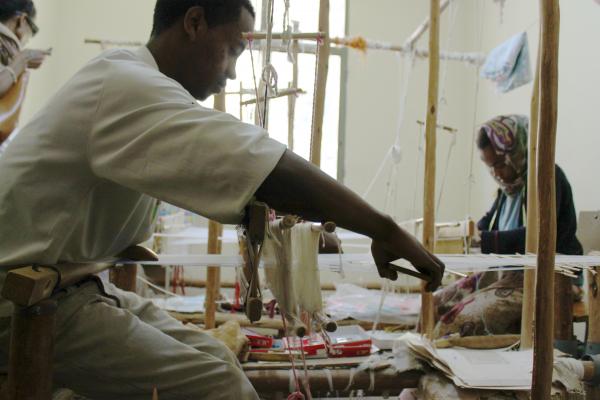
When I think of weavers, what comes to my mind are the ladies in the back of the knitting store in my Southern California hometown, the ones who hang out on weekend afternoons with their handlooms – weaving cloth shawls, blankets, or the occasional modern tapestry.
Here, weaving is, by and large, a pastime. Some would call it an art form. The ladies in the back of the knitting shop are craft weavers. We might consider them "artisans" and laud them for mastering the truly ancient craft.
In the West, machines do most of the commercial weaving, not people. In Ethiopia, and elsewhere in the developing world, handloom weaving is most often an occupation for men and one that isn't usually heralded for its artistry. Weaving isn’t a prestigious job and, by and large, those who weave are the working poor.