In the past four decades, American attitudes have changed markedly on gay marriage, smoking, bullying, and a host of other cultural issues.
But on Roe v. Wade, the 1973 Supreme Court decision that legalized abortion, public opinion today looks much as it did back then.
When it comes to American views on the legality of abortion, “the trend lines look about as flat as they can be,” said Daniel Cox, research director at the nonpartisan Public Religion Research Institute.
Just a few years after the justices decided Roe, Gallup pollsters began asking Americans about abortion. In 1975, 54 percent said it should be legal only under certain circumstances; last year, that figure was virtually unchanged, at 52 percent.
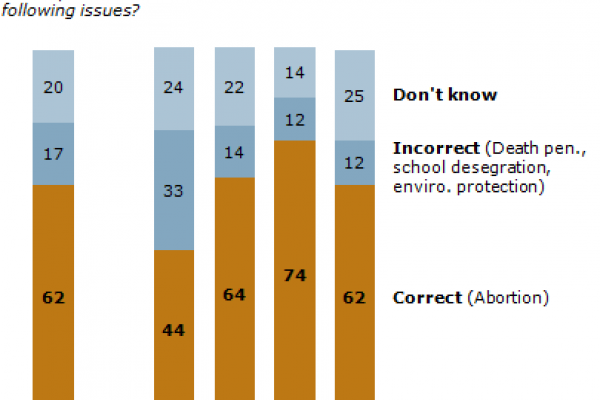
And the Pew Forum on Religion & Public Life this month found that 63 percent of Americans don’t want Roe overturned, a mere 3-percentage-point increase from 1992.
In more recent years, opinions on the morality of abortion have remained similarly stable, with about half of Americans (47 percent) calling it “morally wrong” and four in 10 considering it “morally acceptable” or “not a moral issue,” according to Pew.
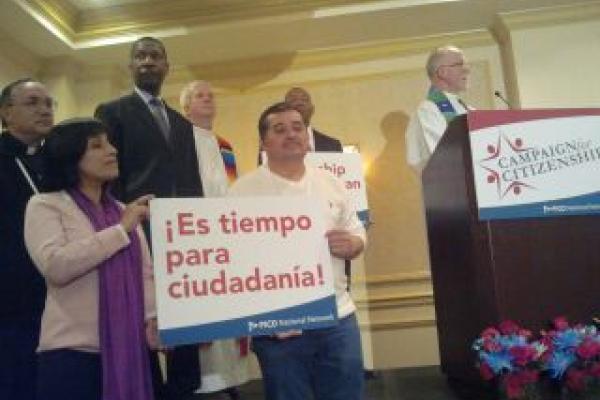
On Jan. 17, faith leaders, DREAMers, and community leaders from across the country gathered in Washington, D.C., to launch a new Campaign for Citizenship — an effort to pressure Congress to enact reform that prioritizes citizenship.
The Campaign for Citizenship, a project of PICO National Network, invited our country’s leaders to gather and view the “Separated Families Supper Table.” At the table gathered DREAMers and clergy next to empty seats representing the millions of homes around the country experiencing family separation as a result of our broken immigration system.
As each member at the table spoke, they expressed how every day, families like theirs have to sit at their dinner tables and try to cope with the fact that a family member is missing. They have to live in constant worry for their family member’s safety and well-being in a distant land that is oftentimes unfamiliar to them. Families are experiencing real loneliness and grief.
The Vatican applauded President Obama’s gun control proposals. The Vatican continues to appeal for disarmament and morally supports firearm limits. The Huffington Post reports:
“The initiatives announced by the American administration for limiting and controlling the spread and use of weapons are certainly a step in the right direction,” the Vatican spokesman said.
A rare winter fire in Colorado's Rocky Mountains is fueling fears the 2013 wildfire season will be longer and more intense. Unusually high temperatures and wide spread droughts have contributed to the increase in wildfires. USA Today reports:
"The wildfire season's length and intensity is driven largely by how much snow and rain falls each winter and spring. Heavy, wet snows tend to delay the season by keeping the ground, grasses and trees wet. Even the weight of snow plays a factor in some fires: Tall grasses that haven't been squashed down like normal carry fires faster and hotter.
Put another way: It hasn't snowed or rained much and forecasters say it doesn't look likely to get any better."
During his second inaugural address, President Obama reframed protecting the environment as a command from God. Slate reports this reframing “transcends not only partisanship but the divide between those who believe in science and those who doubt science but believe in God.” Obama said:
"The path towards sustainable energy sources will be long and sometimes difficult. But America cannot resist this transition; we must lead it. We cannot cede to other nations the technology that will power new jobs and new industries — we must claim its promise. That is how we will maintain our economic vitality and our national treasure — our forests and waterways; our croplands and snowcapped peaks. That is how we will preserve our planet, commanded to our care by God. That's what will lend meaning to the creed our fathers once declared."