You probably have a gallon of milk in your fridge. It might be fat free, soy, or maybe even 1 percent. Most of us drink milk in some form. But how long does it take for us to 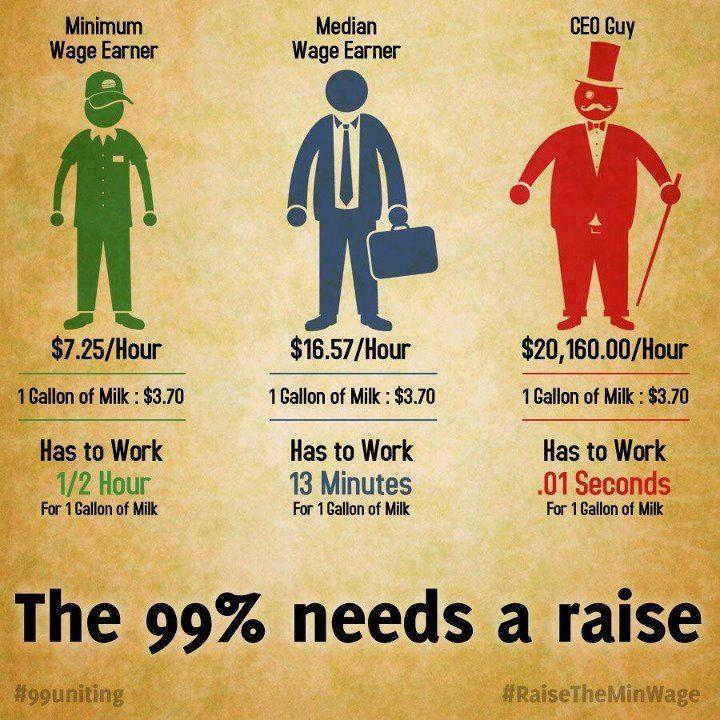 earn enough to buy it?
As part of their ‘Raise The Minimum Wage’ campaign, 99 Uniting produced this telling infographic, comparing how long it takes a minimum wage earner, a median wage earner and ‘CEO Guy’ to earn a gallon of milk. It makes for some sad and frustrating reading …
The Atlantic's national correspondent, Jeffrey Goldberg, on the Syrian crisis and how the U.S. should respond:
"Secretary of State Clinton has again stated that it is only a matter of time before the regime of Syrian dictator Bashar al-Assad collapses. Speaking in Tokyo to reporters, she said: "The sand is running out of the hourglass," and went on to say, "There is no doubt that the opposition is getting more effective in their defense of themselves and in going on the offense against the Syrian military and the Syrian government's militias. So the future, to me, should be abundantly clear to those who support the Assad regime: the days are numbered."
But what is the number? And could the Administration be doing more to move that number down? When it comes to Syria, this administration has a very elastic sense of time."
Learn more here

In huge news last week that was largely overwhelmed by the Supreme Court ruling on health care, Washington came together to direct the Clean Water Act fines from BP's oil drilling disaster of 2010 to fund Gulf coast restoration and recovery.
Attached to the transportation bill that President Obama signed on July 6 was a provision called the RESTORE (Resources and Ecosystems Sustainability, Tourism Opportunities and Revived Economies) the Gulf Coast Act, which will send 80 percent of BP's eventual fines (likely somewhere between $4-$20 billion) to the five Gulf states and set up an ecosystem restoration council with joint state and federal leadership.
Faith communities should cheer this news for a couple of reasons. First, they asked for it. The legislation has been supported by many different faith-led efforts, such as a letter signed by over 140 religious leaders from Sojourners own Jim Wallis, Mitch Hescox of the Evangelical Environmental Network, and many clergy from around the nation. Local Gulf faith leaders spoke up as well, with the Louisiana Interchurch Conference passing a resolution calling on their member groups to support and lead efforts for Gulf recovery and the RESTORE Act.
A New York Times op-ed this week examined the growing phenomenon of poverty in the suburbs:
"Hardship has built a stronghold in the American suburbs. Whatever image they had as places of affluence and stability was badly shaken last year, when reports analyzing the 2010 census made it clear that the suburbs were getting poorer.
While the overall suburban population grew slightly during the previous decade, the number of people living below the poverty line in the suburbs grew by 66 percent, compared with 47 percent in cities. The trend quickened when the Great Recession hit, as home foreclosures and unemployment surged. In 2010, 18.9 million suburban Americans were living below the poverty line, up from 11.3 million in 2000."
Learn more here
Writing for The Huffington Post last Friday, Richard C. Leone asks:
"So is a renewal of the war against poverty in the offing? The current balance of political forces suggests that, rather than muster all the weapons we have to fight for the poor, many are willing to settle for uneasy neutrality. This is one "war of choice" we choose not to wage. Austerity is the watchword of the day defined somewhat differently but accepted by the mainstream of both parties as the bedrock of policy for the foreseeable future…
It's past time to connect the dots and see that by ignoring the poor we undermine the welfare of everyone in the 99 percent living from pay check to pay check. We must revive our generous national nature. And more selfishly come to see that we might find ourselves in their shoes. It may be that the poor will always be with us, but that doesn't mean it's OK to ignore them."
Read more here

"If you tell a lie, it will be all over the country in a day or two. But if you tell the truth, it will take ten years to get there." ~ Eddie "Son" House
And the truth is what Jesus offered the people of his hometown in this tale from Mark's Gospel. Jesus offered his prophetic witness of truth-telling. He held up a mirror and showed them who they were. He held up a mirror and said to them, "The Kingdom of God is with you."
They were enraged that one of their own would do such a thing.
He was utterly astonished that the people who had raised him were incapable of facing their own truth.
He also knew that if they could not face the realities of their own complicated lives they would not be able to embrace the healing and forgiveness that God offered.
Jesus had the blues. He had the hometown blues.
So, rejected, he fled his hometown.
Then he sent his apostles out into the world proclaiming peace, healing the sick and the lame, and prepared to face the same rejection. People don't like to be reminded of the complications of real life. None of us like the feeling of being judged when the mirror is held up before us.
This week, we have a special talk-back version. Several of these signs have responses that are particularly awesome. Check it out.

Why come to our church? Because it's AWESOME, that's why!
After announcing the Evangelical Statement of Principles for Immigration Reform, Sojourners asked Christians across the country to add their endorsement. More than 10,000 people have now signed their name!

The first news stories Friday afternoon (from AP and AFP) wrote of 4 suspected militants killed by two missiles fired from a drone in northwest Pakistan. It was soon updated to 9 dead, which is what we reported at the end of the day.
This morning, I checked my Reader and found 30-some new stories overnight (many just repeats of updated wire stories.) But the stories and death totals were all over the map. Some still echoed the earlier AP story; there were also reports of 12 deaths, or 15, or 21, and a few 24. The most comprehensive stories told of three drones. According to the Pakistani newspaper The Nation:
"The initial strike on a house killed 13 militants, five more were killed in a second attack when they drove to the site to recover dead bodies, and a third drone killed six more five minutes later, a senior security official in Peshawar said."
Other stories also recounted the 3 drone strikes, but gave varying numbers of deaths in each of the three.
Here is a more detailed version from DAWN, another Pakistani newspaper, which tells of multiple drones and 20 deaths:
"According to sources, six missiles hit the fortress-like residence of tribesman Muhammad in Zoi Nari locality of tehsil Dattakhel at around 8:45pm.
Local people rushed to the site of the attack and started rescue work while drones continued to hover over the area. They retrieved 17 bodies and two injured persons from the rubble of the house.
At about 10:30pm, the drones fired another two missiles on the compound, some 35km from the agency’s headquarters of Miramshah, when tribesmen were still carrying out rescue work. Three people died and two others were injured in the attack.
Local tribesmen feared the number of the people killed or injured might go up because they had to stop work due to the hovering drones. They said most of the bodies retrieved were mutilated beyond recognition."
These details raise two questions:
First, will we ever know how many deaths there were on Friday? And if they were militants, civilians, or both?
Second, even if one accepts the U.S. rationale for targeting militants (which I don’t), if it is true that after the initial strike, a second strike was launched some time later against rescue and recovery efforts, experts consider that a violation of international law – a war crime.
Perhaps in another day or so we will get the complete story, with timeline and casualty totals. But what is already clear is that these attacks must stop.

“So what brings you in to the clinic tonight?” I ask, beginning a conversation with a middle-aged woman in typical fashion.
“I need some help with my medication,” she tells me, digging into her purse for the packaging from her last filled prescription.
“It’s for high blood pressure, but… I can’t afford it anymore.”
I take a look at her chart.
“Oh!” I say, pleased with my growing ability to recognize medications without aid from a reference text. “I think that’s on the Wal-Mart list. We should be able to give you a prescription for the generic which will be just four dollars per month at Wal-Mart.”
“I know,” she says. “That’s what I was prescribed. I can’t afford it.”
I don’t talk much about the Affordable Care Act in day-to-day conversation, even with the Supreme Court’s decision last week to uphold its constitutionality. In fact, I try to avoid it. It’s just not a conversation I’m poised to treat as small talk, simply because it’s a conversation that goes way deeper than I think most people realize.