
Last week, a member of my youth group texted me this picture of a pregnant Kim Kardashian. It’s a recent cover from Star Magazine. She added these sarcastic words:
What? How dare she gain weight while carrying another person in her stomach!
My heart broke. We have a big problem of objectifying women in our culture. I’d just written about the Steubenville rape case and the need to finally answer the ancient question “Am I my brother and sister’s keeper?” with a definitive yes. Rape is an extreme and obvious example of the objectification and violence against women.
But what about the cover of a magazine whose central thesis is: OMG, a pregnant person gains weight?

In some way or other, I think it’s safe to say that we all have a kind of nostalgia for the innocence and purity of the Garden of Eden before what we call “the fall.” We have a sense that we are not supposed to be outside the gates of the Garden … out here. At the expulsion of the man and the woman in the story from Genesis, the cherubim (angels) are posted at the gate to be sure that those who have been expelled cannot get back in. The cherubim and a twirling, flaming sword keep Adam, Eve — you, me, all of us — on this side of the gate, outside the Garden of Eden.
Well it’s a story, of course, but isn’t it our story? Nostalgic for a world where nothing ever goes wrong. But illness comes, a marriage goes bad, a relationship with someone you love falls apart just when you think it’s to lead to something more permanent, you lose a job, you suffer depression, you suffer from an illness, you’re left alone in grief over the loss of a loved one. Or you yourself are dying, and there are wars and rumors of wars. We watch the children and wish that we could protect them, but we can’t, even though we are parents and grandchildren, aunts and uncles. Out here, outside the Garden, it’s rough sometimes.

This week on the Homebrewed CultureCast, we welcomed Stephen Simpson, one of the heads of Psychology at Fuller Theological Seminary, to the show to discuss the intersection of faith and psychology. Specifically, we wanted to try and figure out with him where the thin line between religious fanaticism and pathological mental illness was. Hey, there it is!!!
Sojourners President and CEO Jim Wallis sat down with George Stephanopoulos on ABC's 'This Week' to discuss his latest book On God's Side: What Religion Forgets and Politics Hasn't Learned About Serving the Common Good.
He joined a roundtable of guests to discuss themes in his book, as well as engage in a broader discussion about the Common Good.
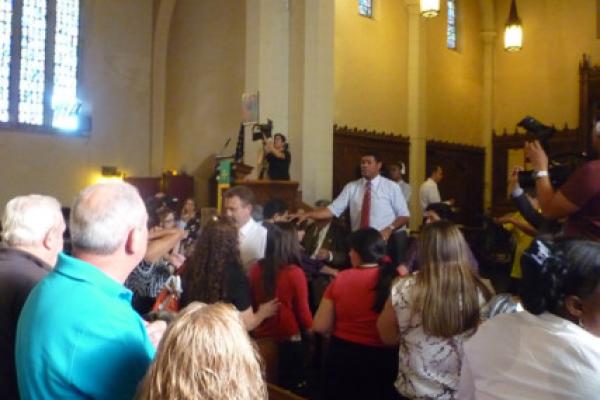
NEW YORK — The apostle bellowed in Portuguese to a packed crowd in a rented Astoria, Queens, church.
“Get out, spirit of death. Now you are burnt, now you are plucked out by my God!”
A blood-curdling shriek rose from one of the front pews, but Apostle Valdemiro Santiago, founder of the Worldwide Church of God’s Power, didn’t flinch.
“Don’t be afraid, church, by these screams,” Santiago reassured the crowd. “They are the evil spirits being defeated.”
Fourteen years after he started out in the countryside outside Sao Paulo, Santiago sits at the helm of a booming Pentecostal church in Brazil, the world’s fastest-growing evangelical country. He now leads 4,000 churches, including 10 in the United States, where fiery worship and exorcisms form part of the appeal.

For someone who was once dubbed “the most hated woman in America,” Madalyn Murray O’Hair is getting a lot of love in this city she once called home.
Ten years after her mysterious disappearance in August 1995, the legacy of activist Madalyn Murray O’Hair still influences atheists in America today. She was known for her role in the landmark 1963 Supreme Court decision in Murray vs. Curlett, which, combined with Abington vs. Schempp, ended prayer in public schools across the U.S. and turned her into the self- described “most hated woman in America.” She is depicted here in a Religion News Service file photo from the 1970s.
New Jersey-based American Atheists, the group O’Hair founded here in 1963 to further the separation of church and state, is marking its 50th anniversary with a three-day convention that’s expected to draw more than 900 people in its former hometown.

New scientific tests on the Shroud of Turin, which went on display Saturday in a special TV appearance introduced by the pope, date the cloth to ancient times, challenging earlier experiments that dated it only to the Middle Ages.
Pope Francis sent a special video message to the televised event in the Cathedral of Saint John the Baptist in Turin, Italy, which coincided with Holy Saturday, when Catholics mark the period between Christ’s crucifixion on Good Friday and his resurrection on Easter Sunday.
The Vatican, tiptoeing carefully, has never claimed that the 14-foot linen cloth was used to cover Christ after he was taken from the cross 2,000 years ago, as some believers claim.