For some Mormon feminists, there can be only one goal on the road to gender equality: ordination to the all-male priesthood.
After all, every worthy male in the Church of Jesus Christ of Latter-day Saints — starting at age 12 — is ordained in this priesthood. It is seen as a holy power, described as the authority to act in God’s name, yet given exclusively to men.
At the same time, lots of Mormon women are perfectly comfortable with the roles they believe God assigned to them, including motherhood and nurturing. They would not want, they say, to “hold the priesthood.”
Now comes a third and, some suggest, growing group of Mormon women somewhere between these two poles.
They are not pushing for ordination, but they crave a more engaged and visible role for women in the Mormon church. It is a role, they believe, that their Mormon foremothers played — and one that could fit easily into the institutional structure without distorting or dismantling doctrine.

“So what are food stamps anyway?” my 8-year-old son, Mattias, asked as I drove him to his summer camp this morning. “Are they, like, stamps that you eat that taste like different foods?”
“Not exactly,” I said.
My family was less than thrilled when I presented the idea of living on the equivalent of what a family of four would receive on food stamps for a week. Actually, the program is now called “SNAP,” which stands for “Supplemental Nutrition Assistance Program,” and involves government-issued vouchers or debit cards, rather than the antiquated stamp method. But the result is the same; we have a lot less to spend on food this week than usual.
“But I don’t want to be poor,” Mattias moaned as I explained the challenge to him.
“We’re not poor,” I said, “but it’s important for us to know what it’s like to struggle to feed our family.”
“Why?”
“Because,” I paused, trying to figure out a way to explain privilege and compassion to a third-grader who was quite content to have all he has, and then some, “Jesus tells us to have a heart for the poor, but how can we really do that if we don’t know anything about what it’s like to live with less?”
“Hmm,” he wrinkled his brow, “I guess we can do it for a few days.”

President Barack Obama recently announced a policy change that would let young people living in the U.S. without immigration status pursue an education and find meaningful work without fear of deportation. As communities continue to suffer the effects of the country’s broken immigration system and families live in fear of their loved ones being deported, this was news to celebrate and an answer to prayer.
Apparently Jan Brewer, the governor of Arizona, had a different reaction to the compassion and progress embodied by this new policy. On the day it went into effect, Brewer issued an executive order denying driver’s licenses to young people in Arizona qualifying for the relief being offered by the federal government.
The Daily Digest is not available this week. But here are some links to Duane''s usual sources to browse until his return next week.
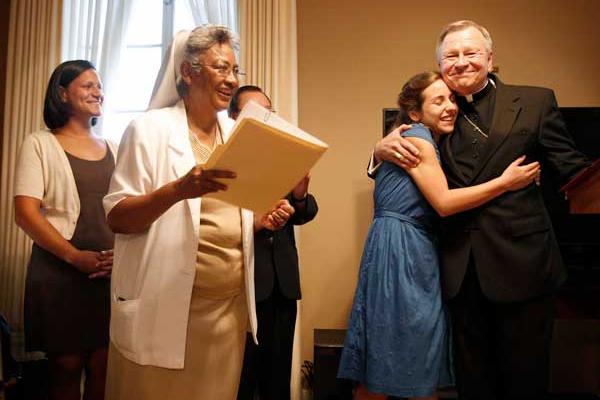
In what is being described as the first of its kind in the U.S., the Archdiocese of New Orleans has transformed a vacant church rectory into a group house where single women will live together while deciding whether to undertake lives as nuns.
The center, dedicated on Aug. 15, occupies the second and third floors of the St. Rita rectory. Within a few days, two women, then perhaps three more, will move into the spotless rectory, their collective lives to be superintended by two veteran nuns who will show the younger women the dynamics of shared community life.
“How we live in community. How to communicate. How to share,” said Sister Carmen Bertrand, for 48 years a member of the Sisters of the Holy Family.
Beyond orienting them to the rhythms of community life, Bertrand and her colleague, Sister Diane Roche, a Religious of the Sacred Heart, will teach the tenants various modes of prayer, organize occasional retreats, and bring in representatives of other religious orders to present themselves and their ways of life.
 I stepped down from the train,
Saw you there, old man, bent
Next to the Tudor station, smiling
And waving to me over the steering wheel.
Your aged blue eyes
Saw us through the maze of roads
Walled by high corn and close trees, roads
Which branch away from the train
Station to the cottage, to your wife’s eyes
And worn wrinkled skin. Her back bent
Over the low table. You turn the wheel
And press the horn, she’s smiling,

For the second time in Chicago this year, the life of a gender-variant young person of color was lost to violence.
Donta Gooden’s body was found in an abandoned building on the city’s West Side late in the evening of August 14th. Gooden, 19, who also went by the name “Tiffany,” was stabbed to death just three blocks from where Paige Clay, a 23 year-old transgender woman, was shot and killed in April, according to media reports. The police investigation is ongoing.
The tragedy of these senseless killings, still so raw and heartrending for the loved ones of Gooden and Clay, is beyond comprehension and deplorable on every level. But perhaps even more unsettling is how often violent crimes against LGBTQ people occur and how little social outrage they ignite.
For many, these two terrible tragedies may melt into the background in a year when Chicago is scrambling to stem a rising tide of murder across the city (year -to-date homicides are up 25 percent from August 2011 according to data compiled by the Redeye. However, they are part of an alarming trend of violence targeting LGBTQ people of color – and transgender and gender-variant people of color in particular – which directly intersects with the front lines of the HIV epidemic.