For two years, in the rectory where I live, my spouse and I hosted two parents seeking asylum along with their Canadian-born child. When she was a baby, not walking or talking, I used to sing lullabies to radicalize her—songs like the “Canticle of the Turning” (based on the Magnificat) and “Here I Am, Lord.” I would rock her to the beat of these justice-inspired songs, hoping that she would come to know that God is a God of justice.
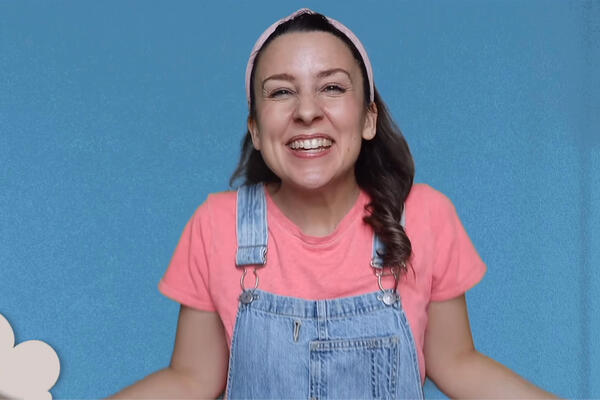
But eventually, as anyone with a child in their life knows, you get bored of the traditional kid content, and so you begin searching for something unique. YouTube had just the thing I was looking for. The video I showed my 2-year-old housemate was from Rachel Griffin Accurso, who goes by the name Ms. Rachel. In this particular video, Ms. Rachel looks right into the camera and asks the toddler, “Can you say mama?” As I held this child, so innocent, so vulnerable, beside me as she engrossed herself in language and learning, I found myself thinking about the state of the world. How did we get to a point where—for years—we idly stood by and watched a genocide in Palestine livestreamed on our devices? How did we get to a point where anti-Black racism is making an unapologetic comeback? Why are we so hyper-focused on limiting the freedom of trans folks and immigrants when the actual source of our troubles is the Epstein class?
While thinking through these things, I kept hearing Ms. Rachel ask the question, “Can you say mama?” It felt like the world was falling apart, and yet, there was something profoundly comforting about Ms. Rachel trying to teach a child how to say something so simplistic. Here was an example of an adult trying to teach a child something both important and mundane, even as the world seemed to be crumbling. The line kept repeating itself in my head, taking on an almost liturgical quality. I started to wonder: What else can we teach children to say so that we can create a more just future?
The impact of Ms. Rachel isn’t confined to my weary couch reflections. Her impact reverberates throughout the world as she boldly and publicly advocates for a variety of causes. She has been vocal about opposing anti-Black racism, stating that “Black boys deserve to grow up,” and she has also consistently advocated for children in Gaza, even while critics have called her antisemitic for such advocacy. All of this, according to her July interview with National Catholic Reporter journalist John Grosso, is an outgrowth of her Christian faith and commitment to Jesus’ words in Matthew 25:31-46. “I was praying once, and I felt like I was getting the message that I wasn’t here to be the most loved or the most liked,” Ms. Rachel said in the July interview. “I’m here to help kids, and I am here to serve God.”
Her impact is also reflected in my relationship with my toddler housemate, as Ms. Rachel reminds us that God loves the least of these and pursues justice, mercy, and righteousness.
Ms. Rachel’s public advocacy for kids in Gaza, Sudan, and Immigration and Customs Enforcement detention centers has drawn intense criticism online. Critics ask why the host of a toddler show is getting into politics. Such criticism ignores the prophetic characters of the Bible and other early childhood educators or media figures who have used their platforms to teach kids to imagine a more just world. Ms. Rachel is an example of a modern prophet.
Many people think of prophets as those who are able to predict the future. But prophets should instead be understood as people who speak truth to power and, in doing so, change the course of the future. Hope is central to imagining and changing the future. “I hold on to hope because we have to hold on to hope for others. If I was a child experiencing injustice I would be sad if people gave up hope that my situation could not change,” she told NCR in July. “Hope is fuel that helps us keep working towards change.”
Many people think of prophets as those who are able to predict the future. But prophets should instead be understood as people who speak truth to power and, in doing so, change the course of the future.
Christian witness uses this kind of moral clarity to expose systemic harm, and Ms. Rachel isn’t the only early childhood educator who has allowed the moral clarity that comes from her faith to influence her pedagogy. She articulates this important but mundane reality when she emphasizes that the Bible tells us to love all our neighbors: “[The Bible] doesn’t say, ‘Love every neighbor, except.’” This, for Ms. Rachel, is what pushes her to advocate for children all around the world even when such advocacy invites criticism.
READ MORE: The Enduring Kindness of Mister Rogers
When Presbyterian minister Fred Rogers shared a wading pool with François Clemmons in 1969, he used his children’s program to carry out a quiet, prophetic act of desegregation. At a time when Black Americans were being violently attacked for trying to swim in public pools, Rogers, who was white, and Clemmons, who was Black, both dipped their feet in a small pool on a hot summer day. By mimicking the childlike act of dipping feet in a pool on a hot day, Rogers and Clemmons imagined a future outside of Jim Crow America.
Ms. Rachel’s public advocacy is a continuation of the prophetic work of Mister Rogers. I can’t think of a moment that better captures this reality than when Ms. Rachel met with Rahaf, a 3-year-old girl from Gaza who lost both of her legs due to an Israeli airstrike. When I saw the video, it had only been a month since I’d come back from the West Bank. When Rahaf stepped out onto the screen, I was thrilled and awestruck to see a child, in the worst of circumstances, still be joyful. In bringing Rahaf onto her show—singing with her, playing with her, and sharing her story—Ms. Rachel did something profoundly prophetic. She took a child who state violence had tried to make invisible and placed her center stage, forcing millions of people to look at the human cost of the genocide in Gaza.
Ms. Rachel embodies the scandalous empathy of Jesus: the belief that every child, regardless of border or nationality, is sacred. During a May 2025 interview with journalist Mehdi Hasan, she explained why she had decided to speak out about Gaza. “I think it should be controversial to not say anything,” Ms. Rachel told Hasan. She continued: “The idea that caring for a group of children in an emergency situation means you don’t care about other children is false.”
To slightly revise the question I posed earlier: How do we teach children to say basic but radical things so that we can change the future? When a child learns to speak, they are not only learning to name the world as it is, but also as it might be. Ms. Rachel isn’t only asking kids to do this, but she is also asking adults to do this as well. When I sit next to my favorite 2-year-old housemate and hear Ms. Rachel ask viewers to say “Mama,” I think about the state of the world and wonder if we can also teach people to say:
- Palestinian children deserve to live.
- Black kids deserve to grow up.
- Trans kids deserve safety.
- No child should be starved.
- Indigenous people have a right to the land.
Ms. Rachel’s impact shows that sometimes the best way to challenge systemic injustice and affirm that every child’s life has value is by clearly, gently, and firmly insisting that the God of the universe is a God who pursues justice.
Ms. Rachel, along with the biblical prophets, Jesus, and other early childhood educators, reminds us that one of our best tools to fight injustice is teaching people how to say things that may seem basic but are actually prophetic.
“Can you say mama?”
“Can you say Palestinians deserve to live?”
“Can you say Black kids deserve to grow up?”
“Can you say trans folk deserve safety?”
“Can you say Indigenous people deserve sovereignty?”
Then say it.
Did this article have an impact on you? Tell us how! Whether you’re moved to take action, have a question, or want to share a comment (good or bad), we value your feedback!