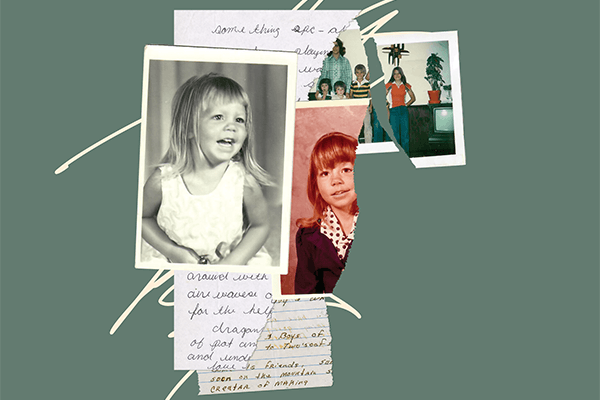
I LEARNED HOW to build a fire from watching you. Thirteen years ago, in the living room of the Denver Catholic Worker on Welton Street, you’d fill the wood stove with kindling, loosely rolled newspaper, a few logs. Along with a carefully scaffolded collection of the right materials leaning on each other, you also needed patience. You needed to be calm. Steady.
It’s almost one year since your death. At a writing residency in the Adirondacks, I remember how the fire kept you busy. Another writer pauses from her work, carefully places a couple of logs into the fireplace; soon the flames swell, flicker.
Michelle, was tending the fire a distraction from the silence—or from the internal noise, the fire raging inside of you? I have so many questions I never got to ask—questions I likely never would have asked when you were alive. I never knew what hidden wound I might be pressing on with them.
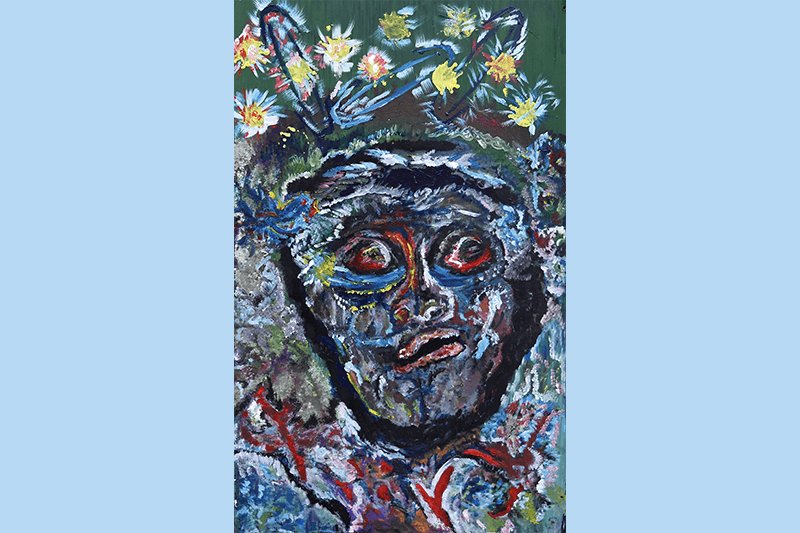
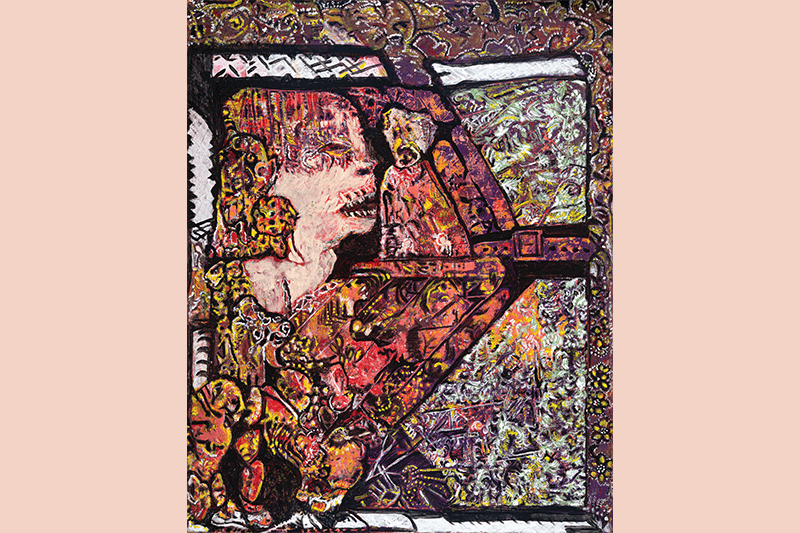
Instead, I’ve been looking through the letters you sent me over the years. None of them are dated. Hay thanks for the times of knowings, you wrote in one. I’ve been looking carefully at your paintings, those you let me have, those I photographed over the years. At each layer of paint. The sudden, sharp contrasts in colors. Reading through your poems, noticing the repetition, the way you used questions as a way of opening things up, making room for possibility, complexity.
I have so many questions I never got to ask—questions I likely never would have asked when you were alive.
In early winter of 2013, you were invited to live at the Denver Catholic Worker where I was also living as a volunteer. The Worker offered housing to two single women, two single men, a couple, and a family. We offered housing to people with a goal: They were seeking work, waiting on benefits, on a place to accept their Section 8 voucher. We offered transitional, not long-term, housing. Usually, the phone never stopped ringing. But, that week, one woman’s room remained empty. No single woman had called seeking housing, and it was so cold out. They found you on the 16th Street Mall. On a bench with your belongings, trying not to fall asleep. You were afraid of getting ticketed for lying down.
The next morning, we tried to follow your turns of thought. You didn’t have a plan. From the moment you moved in, you posed a problem to our small community. During house meetings we asked: What are we offering? And, to whom?
Reluctantly, you stayed. You even started coming to community prayer, 30 minutes of silence at noon. The founders of the Denver Catholic Worker, women nearing 80, dozed off; another volunteer fidgeted; I squirmed. But you always sat so still.
Do you remember how we’d sit in the dining room sketching, painting, talking? I took your picture, painted your portrait from it on a used, thrift-store canvas. It appears unfinished to me, flawed—but truer than any painting I’ve done since. I learned from you: Use whatever you have, get the image down.
You stayed for three years. In 2016, a fire tore through the house in the middle of the night. The house, built in 1895, was a fire hazard in itself—and there was that stack of cardboard out back, where people smoked. Others wondered if the fire had been intentionally set; our house, a homeless shelter, was in one of the fastest gentrifying neighborhoods in Denver. The next day, everyone was homeless again. Some accepted Red Cross gift cards, but you walked away with what was left of your things. Michelle, I can’t remember: Did your paintings burn in that fire?
Your sister saw your photograph in the newspaper around this time—you were trying to hide your face in the picture. A couple of us in the Worker community saw that picture, too. Again, we found you on the 16th Street Mall. Your bags, one on top of another, like a tired body beside yours.
While the Worker looked for a new permanent home—a process that took years—you were invited to stay temporarily at the homes of extended community members. Home was always elusive. And people left—like my husband and me, slowly making our way back to New York City.
Feature-Brunelli-spot B-v2(1).png
WHY DIDN'T YOU tell me you had a sister? A brother?
Your sister texted me last fall, when she learned you’d passed away. My phone number had been in your wallet. “I believe my sister Michelle stayed with you for a while,” she wrote. “We have been looking for her for a long time.” I let her know you were housed and loved for 13 years. Did you know your family had been looking for you for 20 years? That they still loved you? I shared images of your art. Your family never knew you were a painter.
The last night I saw you was at your art exhibit in downtown Denver in early 2025. A few days before, you’d told us you were planning to burn all your paintings. You knew you would soon be homeless again—the latest iteration of the Denver Worker, where you lived, was closing, permanently—and there was no place for your art. Our community quickly organized a show for you. We weren’t sure if you’d show up. You did. Your work surrounded the small, white gallery. People from the Worker community and people you’d never met trickled in. You loved talking about your work, even sold a few paintings, told people to offer what they believed was fair. That night I bought my first painting from you, gave you $200 in cash, hoping it would help. In a couple of days, I would be heading back to New York. Your health was so poor; you’d always had that cough (it hurt just to hear it); there was what the news was calling an “Arctic freeze” in Denver. I thought that becoming homeless again would kill you. Did you know this too?
Later, that month, during a cold snap, you showed up at your parents’ old house outside of Denver. Did you know your sister lived just 30 minutes away? When the new residents of that house figured out who you were, she and your brother raced over. But you were gone. They searched the streets, a few shelters. The police station. “It was dark,” she said. “It was really cold.”
Nine months later, in October last year, a chaplain called from a hospital in Boulder to tell your family that you had taken yourself there, and soon died. Did you know you had cancer, Michelle? You were suffering from so much; the doctor said they couldn’t determine the true cause of death.
I learned from you: Use whatever you have, get the image down.
OVER YOUR LAST few years, in a small house on 26th Street—only a few blocks away from the original Catholic Worker in Denver, still empty, still charcoal-black—you lived beside those elderly women who you’d sat in silence with so many years earlier. Now they—the remnant of our dwindling community—welcomed families seeking asylum. You grew close to these once-strangers. But you were, often, hard to live with. Controlling. Stubborn. You didn’t trust most people. You didn’t trust technology. You only allowed an old-fashioned box TV in the house—and just for the sake of the kids. You covered the smoke alarm and carbon monoxide detector in your room, certain the government was spying on you. You never saw any kind of doctor. By your late 50s, you lost nearly every one of your teeth. Your eyesight was so poor you couldn’t read. You never told anyone—not even me—your birthday or your last name.
But you offered your art materials, your time, your curiosity, to the kids of these families trying to find home here; even if you didn’t speak the same language, art was a way to communicate. When you’d stay in your room too long, they’d knock on your door. You’d give in, share your canvases, colored pencils, crayons, paints; each of you sat around that big table with something to create.
You kept painting. You painted over old canvases I’d painted on, given you—our visions overlapping. Ten years ago, I took pictures and recorded you talking about your art. Listening to you, I often lost track. But, to you, everything was connected. Maybe truth is found in layering—truths upon truths upon truths—not in excavating.
You made art with whatever you could find: thick, damp crayon; crusty acrylic paint from decades-old bottles; quick, hard lines of cheap sharpies; the neon grease of hand-me-down highlighters; whisper-soft lines drawn with the edges of cracked colored pencils. Were you trying to show us, to reflect your experience back to yourself: This is what it is like to be me?
In his Letters on Cézanne, Rainer Maria Rilke wrote: “Surely all art is the result of one’s having been in danger, of having gone through an experience all the way to the end, to where no one can go any further.” You always sensed danger at your back. “Fear of all senses,” you told me about one painting that you called “The Talking Miracle.” “You never know what’s going to happen,” you said. “Are they going to eat you? Are they going to beat you up?” On “Sammy’s Vision,” you spoke of “all the things that could scare him”—how, now, he’s able to make decisions for himself, find some relief from “nightmares.” Michelle, did your art bring you any relief?
During our last visit, before your art show, my husband and I convinced you to visit the new community offering you a room. We thought it might help change your mind, just to see that it was not a jail, that it had a garden, some chickens. You agreed to be open, but in the front seat of the truck, you clutched the armrests the whole way there. As we neared, you said, “Let me out. … Let me the f**k out!”—threatened to open the car door while we were driving. “Okay,” he said, “We’ll turn around.” We took you back to the Worker. You had just a few more days there.
Feature-Brunelli-spot C-v2(1).png
YOU SIGNED YOUR letters Michelle & The Missing Boys. From the day I met you, you told us about your sons, as if you called them regularly. You were doing your best to support them, you told us. I knew this was a delusion. Your sister said the last time you saw your sons—your mother-in-law got custody of them—they were under 10 years old, that your youngest might not remember much about you.
Did you know your mom died? About 10 years ago now, but your sister had no way of telling you. That same year, your oldest son died at age 23. There was a hotel where they thought they might find you—but they had no recent pictures of you. They spoke to the Denver Police Department. “How can I find her?” your sister asked. “What can I do?” They tried for about six months. Then your stepdad died. And then, your older brother. And then your family sold your parents’ house. Michelle, did you know, did you sense all those losses?
Michelle, did your art bring you any relief?
I HEAR YOU were a softball star. Your sister told me your parents helped coach the team, were proud of you. Then something changed—you changed. You were so angry. Disconnected. You told lies. Only recently, your sister learned that you didn’t share the same biological father. Your mother had you when she was 16 after a one-night stand. Your aunts assured her that you learned this, that it caused you so much pain. You dropped out of high school. “Get a job or move out,” your parents told you. You ran away, back to Wyoming, where you were born, then to Denver.
Your sister was just a kid when you left your family home in Utah. Your family moved to Longmont, Colorado, years later. When they were old enough to drive, your siblings said, “Let’s go find Michelle.” They got in the car and drove to Denver. As if it would be that simple.
You found them on your own. Your sister met the man you’d married—she did not like him. You always seemed to have something against men—you were even protective of me. Did that start with him? Soon you had two little boys. What was being a mother like for you? You and your husband were arrested for growing marijuana. How long were you locked up, Michelle? In that time, you lost your home, lost your kids.
When you got out, you were homeless, alone, and your sister invited you to live with her young family. Your grief showed up as anger—you thought she’d been given more opportunities than you had. Michelle, did something happen to you as a child? Your sister helped you with visitations with your sons; then they were cancelled. Why did they end? You fought when she asked you to get a job, to contribute in some way. You told her, “Just take me back.” The family pooled money, and she brought you to a hotel in Denver, like you’d asked. She tells me during our second conversation, months after our first, “I never told her to leave.” She was your sister, Michelle. She lived just an hour away. Why didn’t you go see her? What kept you gone?
I’d finally learned there was no making sense of you, that you were not someone I could explain.
THE LAST TIME your family saw you was about five years before you moved into the Denver Catholic Worker. It had been maybe two years since you’d had any contact. Your sister saw a note stuck on the back door of your parents’ house: “I’m in the back,” she read, and saw you sleeping on the back patio. You were dirty. Your parents, out of town at that time, said, “Don’t let her inside,” but she’d already let you in, and you were telling her your good news: If your parents signed their house over to you, there was a chance you could get your kids back.
You flew into a rage when your parents told you over the phone that they would not sign their house over to you. Your sister called your brother for help. It was the first time she felt afraid of you. Your brother took you to a bus station. He gave you the money the family had pooled; you gave him a duffel bag with a few of your things. And then you took your teeth—those that had fallen out of your mouth—out of your pocket and handed them to him.
In one poem, which appeared in the 2022 Denver Catholic Worker newsletter, you wrote: They all understood, whatever choice they made, there would be dangers to face. Their eyelids all opened wide understanding this: Whatever comes, we may not see each other ever again. They all shouted and cried together before they started on their ways. In another poem, later that year, you wrote about a rosebush growing through an old wooden chair: The life of a rose is the journey of the thorns, sitting in the chair, as two different lives become new works together of their own beauties that become untouchable and become some kind of normal and natural scent, talking to the humans of a new growth of working together. When it becomes forced, it becomes nothing but war. … Why do humans keep causing these wars of problems? ... When will they learn there is a right to live and change? ...
Your portrait hangs in the dining room at Maryhouse, the Catholic Worker in the East Village in New York City, where I first volunteered before I moved to the Denver Worker. A few years ago, I presented Maryhouse with a series of portraits of unhoused people I’d gotten to know in Denver and elsewhere. As I carried your portrait out of Maryhouse to have it photographed, someone asked about you. I shared what I know, that you were an artist—I’d finally learned there was no making sense of you, that you were not someone I could explain—and I promised to bring your portrait back soon.

Did this article have an impact on you? Tell us how! Whether you’re moved to take action, have a question, or want to share a comment (good or bad), we value your feedback!