After 25 Years, We Must Let Love Cast Out Fear

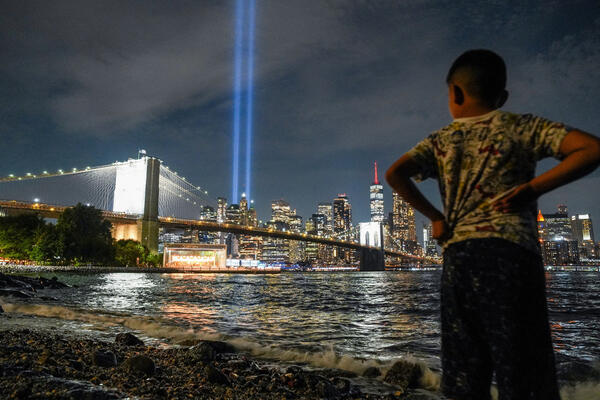
The Tribute in Light installation is illuminated over the lower Manhattan skyline ahead of the 25th anniversary of the September 11, 2001 attacks on the World Trade Center, as viewed from Brooklyn Bridge Park in Brooklyn, New York, September 9, 2026. REUTERS/Ryan Murphy

Most people remember exactly where they were on the morning of Sept. 11, 2001. I was in Nairobi, Kenya, a full day removed from the moment everyone else calls “that morning.” A week earlier, I had attended the U.N. World Conference Against Racism, Racial Discrimination, and Xenophobia, and Related Intolerance in South Africa. From there, I’d traveled to Kenya to visit HIV/AIDS projects with the U.K. humanitarian organization ActionAid. Since I was on a field visit during the attacks, I didn’t see the news until that evening. Watching the horrific images of the planes hitting the towers was surreal.

Even today, I can still feel the shock and anger at the realization that this tragedy was no accident, but some kind of terrorist attack. I felt further horror when I learned of a third plane hitting the Pentagon in Washington, D.C., and a mixture of heartbreak and relief when I learned the story of Flight 93, which the hijackers had planned to fly into the U.S. Capitol. I spent a lot of time the next day trying to reach loved ones in New York and praying for every family who’d been affected. I also asked God to help me overcome the intense fear and anxiety arresting my spirit.

When I think about the legacy of 9/11, I think of the 2,977 precious lives stolen by the terrorist hijackers. These were parents, siblings, and loved ones who bore the image of God and were beloved by God. I also think about the heroism of countless firefighters, first responders, medics, and more who rushed in to save lives, often risking their own.

But what I think of next is the fear. The overwhelming, suffocating fear. The fear we all felt that day, and the fear that has clung to our society and politics ever since like a blinding fog. More than a climate of fear or a culture of fear, I believe what 9/11 and our response to it have unleashed is a spirit of fear, because it has affected our very souls, both individually and as a nation. That spirit of fear has enabled much of what successive presidential administrations have done since in the name of “national security” or “fighting terror,” and given far too many of us permission to ignore or accept the terrible cost of those actions.

One stark example: According to the Brown University Cost of War Project, since 9/11, the United States has spent an estimated $8 trillion on the war on terror, with some projections now approaching $10 trillion as new conflicts and long-term obligations add to the total. This makes the war on terror the longest military campaign in U.S. history, and the costliest since World War II. The more bargains we make, the more atrocities we look away from, the more of our rights that we relinquish, and the more that fear holds us captive. We can tell ourselves, “this time, we’ll finally be safe” or “maybe now we won’t be so afraid anymore,” but do we truly believe it? After all, it never works. There’s always a next war, a next executive order, a next drone strike.

READ MORE: ‘Never Forget’ Is Easy. Remembering Well Is Hard

One of the most frequently repeated phrases in all of scripture is “do not be afraid.” It shows up at least 70 times, signaling the profound importance of trusting God and resisting the temptation to be controlled by fear.

2 Timothy 1:7 tells us: “God has not given us a spirit of fear, but of love and a sound mind” and 1 John 4:18 teaches: “There is no fear in love. But perfect love drives out fear, because fear has to do with punishment. The one who fears is not made perfect in love.” These verses are a powerful reminder that the spirit of fear that has hung over the U.S. for the last 25 years is not of God, because a spirit of fear and of love cannot coexist. In reality, the antidote to a spirit of fear at the personal level is perfect love. Perfect love does not mean that we ignore real danger or threats. Instead, it empowers us to face danger with a “sound mind.”

The prophet Micah offers a timeless prescription for how God calls nations to understand and resist a spirit of fear. Micah proclaims to the southern Kingdom of Judah:

Come, let us go up to the mountain of the  Lord, to the temple of the God of Jacob. He will teach us His ways, so that we may walk in his paths. The law will go out from Zion, the word of the Lord from Jerusalem. He will judge between many peoples and will settle disputes for strong nations far and wide. They will beat their swords into plowshares and their spears into pruning hooks. Nation will not take up sword against nation, nor will they train for war anymore. Everyone will sit under their own vine and under their own fig tree, and no one will make them afraid (Micah 4:1-5).

God’s ways of securing and preserving peace are tied to ensuring that everyone is able to sit under their “own vine and fig tree.” In other words, the antidote to fear at the national level is ensuring that everyone has access to peace and prosperity.

From the moment the second plane hit the World Trade Center, there were people who foresaw and warned us about the spirit of fear such an attack could create. Sojourners founder Jim Wallis worked with Jewish, Muslim, and Christian clergy to develop a statement called “Deny Them Their Victory,” which had 3,900 signers. A few excerpts from it feel especially relevant to me, 25 years later:

[W]e face deep and profound questions of what this attack on America will do to us as a nation. The terrorists have offered us a stark view of the world they would create, where the remedy to every human grievance and injustice is a resort to the random and cowardly violence of revenge — even against the most innocent.

…we can deny them their victory by refusing to submit to a world created in their image. Terrorism inflicts not only death and destruction but also emotional oppression to further its aims. We must not allow this terror to drive us away from being the people God has called us to be. We assert the vision of community, tolerance, compassion, justice, and the sacredness of human life, which lies at the heart of all our religious traditions. America must be a safe place for all our citizens in all their diversity. It is especially important that our citizens who share national origins, ethnicity, or religion with whoever attacked us are, themselves, protected among us.

The statement went on to say that our response to the attacks would be a “test of our national character.” I think it’s sadly evident from the way history has unfolded since 9/11 that far too many of our nation’s leaders and people have repeatedly failed that test. Nearly 90% of the public approved invading Afghanistan in 2001, and the majority of both the American public and Congress supported the disastrous war in Iraq. The so-called “rally around the flag” effect propelled President George W. Bush as high as 86% approval, which is unheard of for any president since. The USA Patriot Act, which was passed by overwhelming bipartisan majorities in Congress 45 days after 9/11, allows law enforcement agencies to conduct secret surveillance and acquire individuals’ private records (including medical and student records) without probable cause. 

The spirit of fear, so potent in the immediate aftermath of the terrorist attacks, made these and other government actions possible.

Once it emerged that the hijackers were members of al-Qaida, a relatively well-known terrorist group that followed a distorted version of Islam, I feared that we’d see a spike in Islamophobia and xenophobia in U.S. society and politics as a reaction to the attacks. While I’m thankful for President Bush’s remarks at the Islamic Center of Washington six days after 9/11, where he praised Muslims in the United States for their contributions to society and condemned Islamophobia, saying American Muslims “love America just as much as I do,” we still saw a spike in anti-Islamic sentiment and hatred.

Examples include the huge surge in hate crimes against Muslims after 9/11 (the rate has never returned to pre-9/11 levels), followed years later by the creation of the National Security Entry-Exit Registration System, a special registry that affected almost exclusively non-citizens from Muslim-majority countries. More recently, we’ve seen travel bans the first and second Trump administrations enacted against mostly Muslim-majority countries. 

READ MORE: Valarie Kaur Wants the U.S. to Recognize the Second Ground Zero

Twenty-five years after the attacks of 9/11, negative views of Muslims are distressingly widespread. According to a Pew Research Center survey this spring, “43% of U.S. adults said Muslims are less patriotic than other Americans, and 42% said Muslim Americans are having a negative impact on the country.” Sadly, this spirit of fear toward Islam and Muslims that arose in the wake of 9/11 has been nurtured by government policy and political rhetoric that has become all too normalized and tolerated. This includes an alarming increase in anti-Muslim bigotry from political leaders with seemingly no consequences.

This week, I was proud to stand with other Christian, Muslim, and Jewish leaders through Shoulder To Shoulder to launch an Open Letter from Faith Leaders and Allies. The letter declares that for the love of God and neighbor, this bigotry must end.

How do we change the spirit of our country? Part of that work is the work of changing hearts and minds at the individual and community level. But we also need to change how the nation manages threats and risks on behalf of its citizens, from an approach rooted in fear to one rooted in love and a sound mind. For example, the Friends Committee on National Legislation provides a compelling alternative to the current war-based, military-first approach to international terrorism through an emphasis on diplomacy, development and peacebuilding, law enforcement, intelligence gathering, and restorative justice.

The importance of eliminating the conditions that produce terrorism is a huge reason why I have been filled with such grief and righteous anger at this administration’s dismantling of the U.S. Agency for International Development and severe cuts to development assistance. These alternative approaches echo Micah’s call and proscription.

Like all of us who were alive at that time, I'll never forget where I was when the towers fell. I think often of being stranded in Nairobi due to flight cancellations, far away from so many people I loved. I also can’t help thinking about the painful irony that a conference dedicated to combating and ending racism, hatred, and intolerance was followed, a week later, by a horrific attack that has unleashed such a torrent of everything it was formed to combat. But Micah’s alternative vision and the call to perfect love continue to provide the antidote to fear and the more hopeful and moral pathway to peace.

More than a climate of fear or a culture of fear, I believe what 9/11 and our response to it have unleashed is a spirit of fear, because it has affected our very souls, both individually and as a nation.