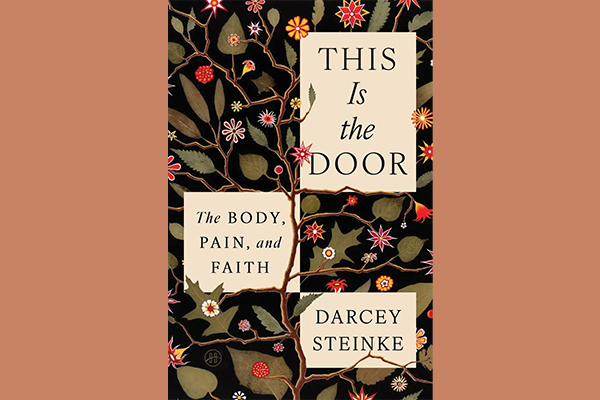
AS SOMEONE WHO has experienced life-altering, faith-shaking physical pain, when I see a book with a subtitle like The Body, Pain, and Faith, I find myself automatically asking: Can I trust this author? Do they speak of pain from personal experience or as a mere intellectual exercise? Five-time novelist Darcey Steinke answers this question right away. In the foreword to her new nonfiction book This Is the Door, Steinke details her experience of several months of back pain so intense that it caused her to “walk a tight-rope between raging against [her] pain and trying to search for any scraps of meaning that might be left in its wreckage.” Those of us who have endured pain like this can likely relate. As the book continues, Steinke explores her own pain, the pains of her family members, the pains of various historical artists and thinkers, and the pains of people she interviewed who suffer in different ways. Is there meaning to be found?
The first six chapters reflect on body parts and bodily pain, while the last four chapters address more abstract concepts of heartache, suffering, soul, and healing. In chapters with titles such as “Spine,” “Knees,” and “Breast,” Steinke explores both the physicality of each body part and the ways it has been metaphorically or spiritually understood. She writes both about literal knee pain and about how, “when pain pushes bodies to their knees, old faith systems are sometimes abandoned and new religious practices and beliefs emerge.”
Conversely, with pains like heartache that seem more emotional than physical, she shows that the distinction is not so clear cut. “Heartache pain,” she reflects, “tears down the duality of Cartesian thought, the idea that mind and body are separate. It chips away at the myth of two distinct kinds of pain. Your brain doesn’t care whether you break an ankle or lose your love; both psychological and physical components are always behind the ache of pain.”
Suffering, for Steinke, is both “complex” and “potentially generative.” She does not shy away from the brutal realities of pain, including graphic depictions that might disturb some readers. She asks us to look at wounds we might rather turn away from. In many religious communities, pain is covered over with trite, optimistic statements—perhaps that God needed another angel, or that our current suffering is part of God’s unique plan to sanctify us. Steinke resists these platitudes, offering a more honest and nuanced perspective on faith and suffering. “Faith can help calm the grief-stricken brain,” she writes, “but so can slipping out from under former beliefs.” Pain can inspire creativity, “projected out and held in poetry, music, religion.” And “the best theologies,” in Steinke’s view, “acknowledge pain as a reality not to be masochistically worshipped, but to connect with other people as well as the divine.” She does not invite us to seek pain or glorify it, but to consider that we might find meaning in the transformation, creativity, and connection it can surface.
Ultimately, for Steinke, “pain always has meaning, not because it is good but because bodies always have meaning.” In a world full of pain, we do not need clear-cut answers so much as thoughtful questions, broad-ranging reflection, and an open-minded approach to theology that does not presuppose traditional Christian answers. In This Is the Door, this is what Steinke offers.

Liz Cooledge Jenkins is the Seattle-based author of Nice Churchy Patriarchy and the forthcoming Maybe We Could Pray Again (Broadleaf, Spring 2027). She blogs at growingintokinship.substack.com.
Did this article have an impact on you? Tell us how! Whether you’re moved to take action, have a question, or want to share a comment (good or bad), we value your feedback!