When the Church Fails Small-Town Queer People, Who Steps Up?

A pair of documentaries highlight local institutions that provided what Christians wouldn’t.

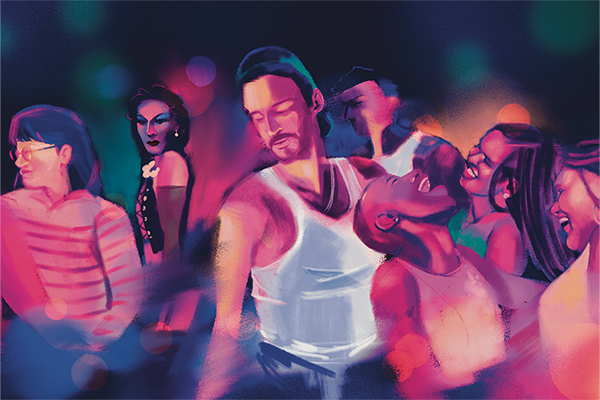
Illustration by Ryan McQuade

THIS YEAR’S TRIBECA Film Festival featured an intriguing pair of documentaries about gay life in small towns, one released 20 years ago and one brand-new. Together the two of them offer unexpected vistas of hope and community.

The 2006 documentary Small Town Gay Bar (available for free on YouTube) follows the story of several gay bars in and around Shannon, Miss., near Elvis Presley’s hometown. It’s immediately clear that, for queer residents in this town of less than 1,500, the gay bars provide a shelter and a lifeline in an otherwise bleak and often scary existence. “You walk in and you walk into family,” says one patron. “If there wasn’t a gay bar there wouldn’t be any kind of community,” says another.

We soon discover these safe harbors exist within a broader context of persecution and judgment. “You have to balance your own personal convictions based on the things you believe with another person’s right to exist, to live their own life,” explains Tim Wildmon, president of the Christian organization the American Family Association, which he describes as a “national, pro-family, traditional values organization.” Wildmon (who still leads the AFA today) continues, “That’s why our actions at American Family Association are taken against groups who try to revolutionize the culture, not against individual gay people.” Despite his words, the film shows Wildmon stationing people outside the bar to take down patrons’ license plate numbers, then sending letters to the vehicle owners saying they were seen there or announcing their plate numbers on the radio.

During filming, just across the state line in Alabama, three people murdered an 18-year-old named Scotty Joe Weaver who liked to dress in drag. The assailants tied him to a chair before mutilating him and disposing of his body in the woods and setting it on fire. “His lifestyle might not have set well with somebody else,” a local explains in a clip from a TV news broadcast. “And they took care of him because of that.”

“If there wasn’t a gay bar there wouldn’t be any kind of community.”

cultureledespotASO26 (1).png

From ‘Small Town Gay Bar’

The film’s creator, Malcolm Ingram, usually presents the queer bar patrons that he interviews alone or in pairs outside the bar, underlining their isolation. But when he goes inside, the images are filled with bright colored lights and dancing. Sometimes it’s just one person alone; other times it’s whole groups. There’s something amniotic about the overall visual effect, the sense that these bars pulse with fragile, hungry life.

On the surface, the 2026 documentary Time Warp has a lot in common with Small Town. Set in the community of Rock Springs, Wyo., discrimination and fear color the backdrop. Laramie, Wyo., where Matthew Shepard was murdered, is just a few hours away. “I was very openly out when I was younger because I didn’t realize how unsafe that was,” someone in the film explains. “So I stopped being as proud and out about my sexuality.” Queer young people, who are the majority of the film’s subjects, talk about being thrown into lockers, called slurs, or shunned by their parents.

Here, too, the LGBTQ+ community turns to a local institution for support. But where the queer people in Mississippi looked to gay bars, Time Warp ’s haven is a new drag theater company formed by 25-year-old, recent transplant Kenny Starling. Film director Allison Berg follows the group as they rehearse their first production, The Rocky Horror Picture Show, about an alien from a planet of transvestites.

But unexpectedly and repeatedly, the people of Rock Springs demonstrate a level of acceptance that the people in Small Town never found. A city council meeting to discuss a petition to shut down the show or limit its audience ends after a member of the city council reveals he’s in the show. One actor’s father, a former biker, announces he will provide security for the production.

In Time Warp’s most astonishing sequence, a self-proclaimed “Cowboy for Trump,” with a gun in his car and penchant for public protesting, is asked by Berg if he has any opinion as to why the suicide rate in Wyoming is so high. The Trump supporter breaks down. He lost a brother to suicide, he says. “There’s a total lack of mental health services here.”

The cowboy’s answer stands in contrast to the response given by AFA president Wildmon when asked why it is that he thinks queer people are unhappy: “I think they’re spiritually unhappy. I would say there’s a high level of promiscuity in the homosexual community ... . Maybe they’re looking for something, trying to find love or what they think of as acceptability.” He never recognizes how the AFA terrorizing and outing queer people might prevent them from finding love or acceptance.

In some ways, the cowboy even identifies with queer people. “You’ve got to be willing to step out there and be who you are if you’re going to go against the grain, like I do, and stand up for what you believe in.” In a moment that made our entire audience laugh aloud (with tears in more than a few eyes), the man ends up announcing he’s going to attend the show.

cultureledespotBSO26 (1).png

From ‘Time Warp’

The Wyoming community displays a level of queer affirmation absent from the Mississippi community of Small Town Gay Bar. You’d like to think it’s a sign of progress over the last 20 years, no matter the current administration’s efforts to erase and demonize queer people.

But Starling also brings a profound sense of understanding and encouragement both to his theater company and the broader community. “I’m inviting people to come and learn,” Starling says at the city council meeting. The show is an expression of queer joy, he explains, defining the term as “seek[ing] to spread a message of kindness, celebration, and love for oneself and for everyone else, just for being themselves.” Starling makes no comment about his own religious background or beliefs, and yet his words echo many of the sentiments of Jesus.

That’s the common denominator of Time Warp and Small Town Gay Bar—queer people and groups providing the sense of community and belonging that has traditionally been ascribed to Christian churches, in no small part because those Christian communities have marginalized or demonized them. These queer venues become the place where people find hope, even a Christ-like sense of mission.

Starling holds no illusions about the world in which he’s living. He wants to provide the queer actors with a space where they can bring their full selves, he explains, “but at the same time, the escape route is always in the back of my mind.” Yet he proceeds with courage informed by empathy that finds room for everyone.

“It’s so easy to dream what you want to be and what you want the world to be. But it takes real courage to go out there and be it,” says Starling as he watches Tim Curry in the film version of Rocky Horror singing “Don’t dream it, be it” over and over directly to the audience.

“I just want people to be free.”

This appears in the September-October 2026 issue of Sojourners