SOMETIMES THE WORLD is very small.
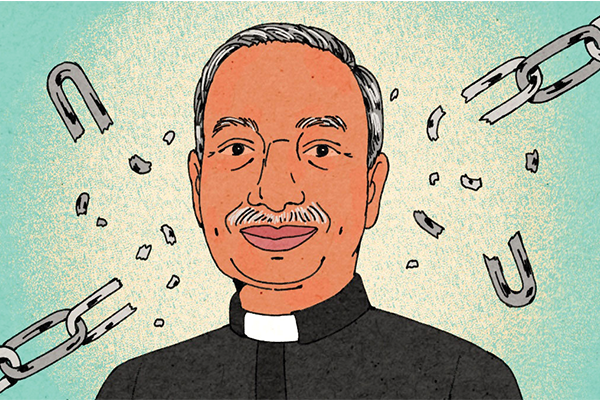
The Catholic priest from Pakistan handed me a self-published booklet in Urdu and pointed to a single English word: Sojourners. Pakistan is a third of the way around the globe from my home in California. Father Emmanuel Asi was in the Ojai Valley (where I live) for four days, visiting members of the Pakistani Christian diaspora. As part of his hosting team, I was eager to learn more about this liberation theologian from Lahore. And learn how articles from Sojourners ended up translated into Urdu.
“I inherited love for the Bible from my family,” Asi told me. Born into a Catholic family in 1949, “we were poor, living among a majority of Muslims, and we suffered discrimination, untouchability, and hard labor.” Asi’s father was a tailor. Though not formally educated, he memorized the Bible and taught his children at night, while sitting on the floor sewing.
Asi, ordained as a priest in 1974, studied at Lahore’s Christ the King Seminary, then at Pontifical Biblical Institute in Rome. Christians make up less than 2% of Pakistan’s population. For many years, he taught scripture, worked on Bible translations, and preached throughout the world.
But his fairly traditional teaching track was upturned in 1987 when a funder offered him a sabbatical at the Maryknoll School of Theology in New York. “That was a converting experience for me, a new light, new inspiration. For the first time in my life, we were taught liberation theology by the founders: Gustavo Gutiérrez, Tissa Balasuriya, James Cone, Jon Sobrino, and many others. Also there were Philip and Daniel Berrigan, who taught us about a political reading of the gospel of Mark, drawing on notes they brought with them.”
Those “notes” were copies of an article series by biblical scholar Ched Myers that Sojourners published in early 1987. “They shocked me,” Asi said, eyes wide. “How was it possible that Ched Myers could reread Mark’s gospel from this perspective [of the poor]?” It was revolutionary for Asi. It gave power and meaning to the gospel’s words. “We had information about Jesus, the Bible, our catechism and teaching, but at Maryknoll the Third World theologians and liberation theologians gave us perspective. Whatever you say or do, you should have the perspective of common people, their realities, and always read from the perspective of poor people. Otherwise, you will fail to understand anything.”
And that’s how the word “Sojourners” ended up in a small booklet of sweeping Urdu script. “I carried this gift of light from the Holy Spirit and wisdom from Ched Myers and Sojourners back to Pakistan. And I wanted to convey it to others, so I translated it for my people and gave credit to the magazine.”
After Maryknoll, Asi returned to Pakistan and founded Maktaba-e-Anaveem, a “people’s forum for contextual theologies.” This network is particularly known for fostering feminist theology. Asi says that earlier this year, the group published a women’s study Bible that highlights scripture passages with women, feminist commentary, short descriptions of female saints, and original psalms written by Christian women around Pakistan. And yes, there’s been pushback.
Asi told me, “Jesus made his perspective very clear and when your perspective becomes clear, your vocabulary becomes very dangerous.” Without this clear perspective, “nothing happens to you and nothing happens to others through you,” Asi said. But with it, “you become blessing and grace for common people because you speak about their salvation.”
Did this article have an impact on you? Tell us how! Whether you’re moved to take action, have a question, or want to share a comment (good or bad), we value your feedback!