We Don’t Have To Work This Way

Reenvisioning labor so that everyone can flourish.

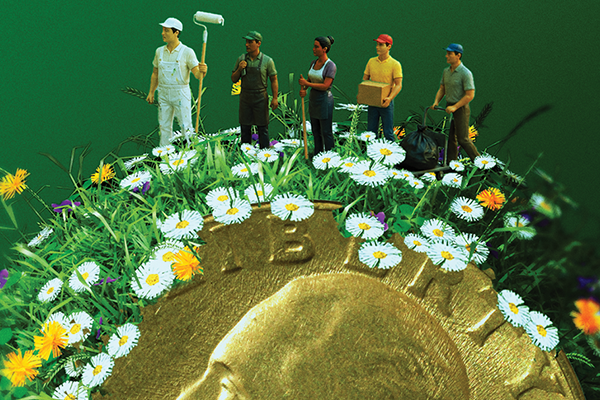
Illustration by Nico Ortega

IN TODAY’S CONVENIENCE-BASED economy, powered by 24-hour availability and instant shipping, we heavily rely on a labor force that is invisible. Gone are the days of an 8-hour workday and a 5-day workweek for most Americans, especially those in the service industry, gig economy, and logistics sector. Now gaining momentum is the “996” schedule—which stands for 9 a.m. to 9 p.m., six days a week. According to the Bureau of Labor Statistics, nearly 60% of the U.S. workforce is paid hourly and work the shifts that allow for a 24-hour a day economy. To make that economy run, reports labor researcher Kristen Harknett, 69% are required by their employer to keep their schedules “open and available” to work whenever needed, often causing a major disruption in family life.

Our society frames job choice as an individual responsibility: It’s our job to find good employment. We tend to ignore long-standing structural inequalities that dictate the lives of marginalized workers. Policymakers concerned with the quality of life of workers too often rely on top-down economic metrics, such as gross domestic product and the U.N. Sustainable Development Goal that measures “decent work and economic growth” through average earnings and unemployment rates. These can provide valuable information about labor markets as a whole and promote institutional success but often don’t capture the lived reality of a line cook or grocery store clerk struggling with everyday expenses.

In short, today’s labor market does not serve the majority of Americans. But we don’t have to “work” this way.

As we consider the work of the future, we remember American labor heroes, such as Mary Harris Jones, Eugene V. Debs, A. Philip Randolph, May Chen, Dolores Huerta, and Hattie Canty, who organized for improvements in workers’ lives based on workers’ demands. These labor movements pushed policymakers to not only use top-down metrics but also bottom-up realities.

Today we can advocate for “dignified work,” which shifts the authority back to the worker to determine the quality of their labor, instead of an outside party. In the United States, any lack of “dignity” on the part of the worker is too often seen as the worker’s fault, as we live within a cultural assumption that the individual bears the responsibility of securing their family’s basic human needs. If someone doesn’t have access to certain necessary benefits—such as healthcare, flexible schedules, or paid leave—many will say it’s their own fault. (These kinds of benefits are primarily available to those in salaried, full-time jobs.) What is sometimes glamorized as “hustle” or “grit” is often a survival strategy in an economy with inadequate safety nets for workers who need them the most.

Feminist economics helps reveal how the so-called “success” in some neoliberal markets is built on the backs of unpaid care work (especially of children and elders), predominantly carried out by women. When we forgo social insurance (such as Social Security, public health insurance, universal parental leave, and public auto insurance) in favor of a “balanced” federal or state budget, then the labor involved in building flourishing families is not accounted for and treated as a “zero-cost input” rather than as an essential contribution to society.

How might we work differently for the flourishing of all?

What if kitchen table economics shaped national policy?

Some countries in Europe are debating a four-day workweek without a drop in pay to improve work-life balance, address labor shortages, and enhance productivity. Since 2019, 4 Day Week Global has coordinated trials in more than 10 countries. Following the tests in the U.K., 92% of participating companies planned to keep the 4-day work policy, citing lower stress, reduced sick leave, and stable or higher revenues.

Jennifer Nedelsky and Tom Malleson focus on unpaid care work in Part-Time For All: A Care Manifesto. The authors advocate for an economy where everyone engages in paid part-time jobs and in unpaid part-time care for family, community, and creation. There are paths for reclaiming time for family and community without sacrificing economic well-being. We must push for new priorities.

Worker-owned cooperatives offer another way of letting all employees set the standard for a dignified workplace. When employees share in the means of production without the exploitative implications of a trickle-up model, companies can succeed and workers can benefit. In the U.S., a few examples are Publix Super Markets, WinCo Foods, Amsted Industries, and King Arthur Baking.

Examples such as these help demonstrate that, even working within the existing economic system, we can create an economy that better provides for everyone. We can reimagine work not just as a way to generate income, but as an expression of our relationality and community. In other words, all jobs and those who perform them should be treated with dignity.

Reclaiming humanity in the workplace requires us to shift from a “what can you do for me” mindset toward a vision in which our work contributes to human flourishing: the prioritization of socially minded business, care for the vulnerable, and the protection of the commons. Crucial to the Economy of Francesco movement, a global network of young economists and entrepreneurs launched in 2019, is belief that when we promote human flourishing, we reclaim ourselves as healthy human beings and move beyond our roles as consumers. Then we are more able to expand our responsibilities as good friends and coworkers, and to make better choices that directly impact the common good.

What would our world look like if mutual aid and respect replaced the culture of ruthless competition and, to borrow a phrase from global management guru Mark Lipton, “mean men” behavior? If kitchen table economics shaped national policy? If businesses with higher “human dignity” scores were rewarded?

By viewing the economics of our homes through the lens of social justice, we can demand an economy that serves humanity rather than one that sacrifices it. We can pull each other out of extractive systems to build a flourishing society—starting now.

This appears in the September-October 2026 issue of Sojourners