Why These Nuns Set Their Land on Fire

Image via Holy Wisdom Monastery on Facebook

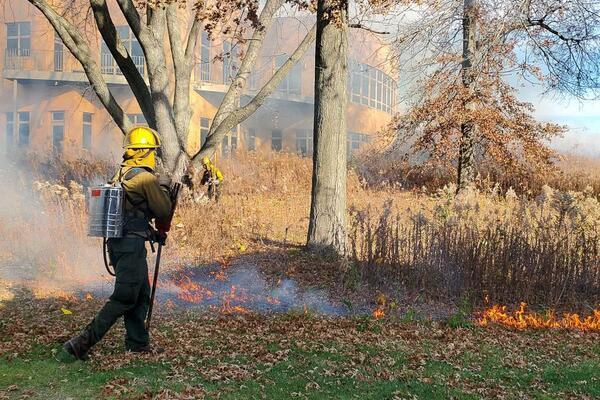
In the spring, on a day when the weather was just right, the conservation team at the Sisters of St. Joseph in Brentwood, N.Y., set part of their meadow on fire. 

The “prescribed burn” is a land management technique that helps control invasive species and reduce the risk of wildfires. And it’s one example of how religious congregations are taking an active role in environmental stewardship.

Caring for creation, or the “dear neighbor,” as the sisters call it, has always been a central part of their mission, but in the last decade it has evolved. The sisters affirmed a land ethic statement in 2015, specifically expanding the definition of “dear neighbor” to include all living things. Annual prescribed burns, which the sisters started in 2024, are a much newer interpretation of that. The burns are meant to keep grasslands as grasslands by pushing off shrubs and woody plants while burning off invasive species that didn’t evolve to survive the fire.

Heather Coste, director of ecological sustainability for the Sisters of St. Joseph, explained that the fresh, black soil left after a burn benefits the ecosystem more than using a tool like a lawnmower would.

“They burn up all the top material so it clears the soil for germination of new seeds, but also for certain animals that need that fresh black soil,” they said. “A bunch of ground nesting bees in particular actually co-evolved with these fire regimes and they can't make their nests without this blackened bare soil.”

While prescribed burns are new for the Sisters of St. Joseph, they are a historic land management practice rooted in Native American tradition. At Holy Wisdom Monastery, an ecumenical community of women religious in Wisconsin with Benedictine origins established in 1953, burns and other land management practices rooted in Indigenous wisdom have been an annual occurrence since the early 2000s according to Emma Kloes, a land restoration coordinator at the monastery.

“We're going back and taking care of those 20, 40, 200 years of lack of management,” Kloes said.

Across several decades, the monastery has slowly restored land previously used to farm corn and soybeans into its native state: prairie and oak savanna.

The prairie and a number of effigies—animal-shaped mounds of land built by Native Americans before the arrival of Europeans—on the 130-acre property are periodically burned with fire to clear invasive plants and restore the area to its native state. Kloes said involving and consulting local Ho-Chunk people, who originally managed the land with techniques like burning, on properly caring for the effigy mounds and the rest of the property has been an important part of the restoration process.

“Land usually, to be in its most healthy state, requires human interaction,” Kloes said.

But impactful land stewardship doesn’t have to involve the hours of wildland firefighter training, careful planning, and permit obtaining that controlled burns require.

Ryan Juskus, a researcher who studies congregations involved in food and environmental justice at the University of Notre Dame, said he thinks it’s important for environmental stewardship to “transform the way we relate to one another as well,” particularly through growing food.

READ MORE: Why Climate Work Keeps Me In Church

Plainsong Farm in Michigan is doing this through regenerative agriculture. An ecumenical companion ministry of the Episcopal Diocese of the Great Lakes, Plainsong is12 acres of farm that started with the goal of growing food for the community in a way that benefits the soil, the land, and the farmers doing the work. Although they don’t use commercial farming tools like tractors, seeders, or harvesters, they’ve been able to sustainably farm the land through careful and intentional planning that prioritizes efficiency while not extracting more from the land than it can give.

“Right now, the least intense crop that we are growing is in the furthest field, so we’re not walking that far out there every day to attend to it,” Emily Ulmer, director of faith-based programs at Plainsong, said. It’s an arrangement that works out well given how little fuel she said they use in their farming process.

By supplying local food pantries with fresh produce and selling directly to community members who’ve purchased shares through their community supported agriculture program, they’re feeding their neighbors while stewarding the land in a way that lets it thrive for future generations.

“We come from an understanding that the relationship that we have with ourselves and with our neighbors and with the land is intimately tied up with the relationship that we have with God—and it’s so often when one of those relationships is hurting that the land is what suffers because of that,” Ulmer said.

While the folks at Plainsong have a lot of land to work with, Juskus said religious communities can and do have an impact on their communities at smaller scales, like community gardens.

“Even if it’s just a small garden and it starts there, that’s such a good place to start because it can help retrain us from having such an extractive mindset where food is just another commodity that’s bought and sold in international markets, that you buy at aisle nine, and instead is something that deeply connects you to God’s wider creation,” Juskus said.

He’s seen examples of this in many lesser-known urban communities across the U.S., where post-industrial “white flight” has left communities with vacant land or abandoned, run-down housing that churches have turned into gardens. Although they started small, they’ve been able to provide parishioners and community members with local, fresh produce.

About 10 years ago in Gary, In., one church started growing fresh produce in a small garden for its members and other people who need it. That project has since grown into Faith CDC, a community organization that distributes fresh food grown on its own urban farm and donated by local farmers. Faith CDC even opened a flash freezing facility to make all that produce more widely available year-round.

“It’s great when a church just starts a garden or something like that, but what I love about [Faith CDC] is that they said, ‘Well, let’s keep going,’” Juskus said.

But getting started, even on a small scale, is still hard for many congregations who haven’t embraced the idea of land stewardship yet. 

Tim Eberhart, Director of Garrett Theological Seminary’s Center for Ecological Regeneration, helps congregations throughout the Midwest develop and foster a deeper relationship with their land. He said land stewardship isn’t a bigger concern for so many congregations because of spiritual and theological barriers that prevent many faith traditions from seeing it as an important part of the gospel.

“It’s about the inner soul, not the body; it’s about the afterlife and not the Earth, the creation,” he said. “And so for some, the invitation to steward the land in sustainable and just ways seems disconnected from what’s central to the gospel.”

Through the Center’s Hope for Creation program, launched in 2022, he said he’s seen a growing number of congregations take up environmental justice work out of a “deep concern for the realities of climate change.”

“Churches are really beginning to view their land as not just a place for ministry, but a way in which to live out commitments to the Gospel through land use, through land return, through organizing and advocacy,” Eberhart said.

“We come from an understanding that the relationship that we have with ourselves and with our neighbors and with the land is intimately tied up with the relationship that we have with God.” —Emily Ulmer, director of faith-based programs at Plainsong